
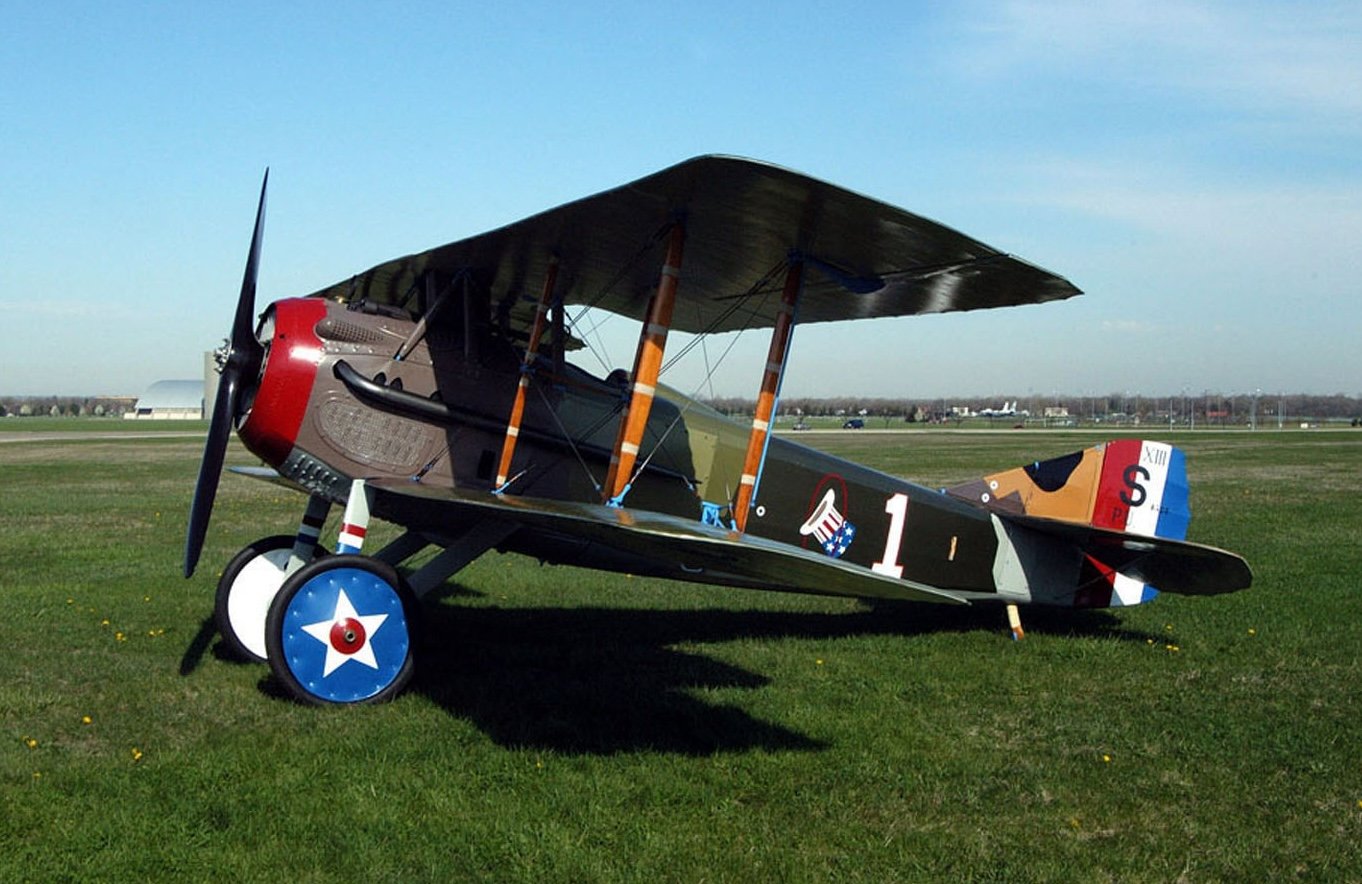
The SPAD S.XIII was a French single-seat biplane fighter designed by engineer Louis Béchereau for Société Pour L'Aviation et ses Dérivés (SPAD). The prototype first flew on 4 April 1917, and the aircraft entered operational service by the autumn of that year. Designed for mass production, approximately 8,472 units were built between 1917 and 1918, with production effectively ending at the conclusion of the First World War.
Manufacturing was centered at SPAD's facility in Suresnes, near Paris, though production was widely subcontracted to other firms, including Blériot Aéronautique. Additionally, the aircraft was produced or assembled under license in the United States and Italy.
Technically, the S.XIII represented a significant advancement over its predecessor, the SPAD S.VII. It was powered by a Hispano-Suiza 8B series liquid-cooled V-8 piston engine. Depending on the variant, such as the 8Ba or 8Be, power outputs ranged from 200 to 235 hp. This increased power, combined with a robust and rugged airframe, allowed for high dive speeds and superior high-altitude performance compared to many contemporary German fighters. The aircraft's armament was also upgraded to two synchronized 7.7 mm Vickers machine guns firing through the propeller arc.
During World War I, the S.XIII became a cornerstone of Allied air power. It equipped approximately 80 to 81 French escadrilles and served as a primary fighter for the American Expeditionary Forces' Air Service starting in July 1917. Other operators included the Royal Flying Corps (later RAF), the Belgian air service, and Italian forces, who operated the type on various fronts, including the Greek theater. Post-war, the S.XIII saw military use in at least ten countries, including Poland, Japan, and Czechoslovakia.
The aircraft is remembered as the mount of many legendary aces, including René Fonck, Charles Nungesser, and American ace Eddie Rickenbacker. Today, original airframes are preserved in museums, including the Musée de l’Air et de l’Espace du Bourget.