
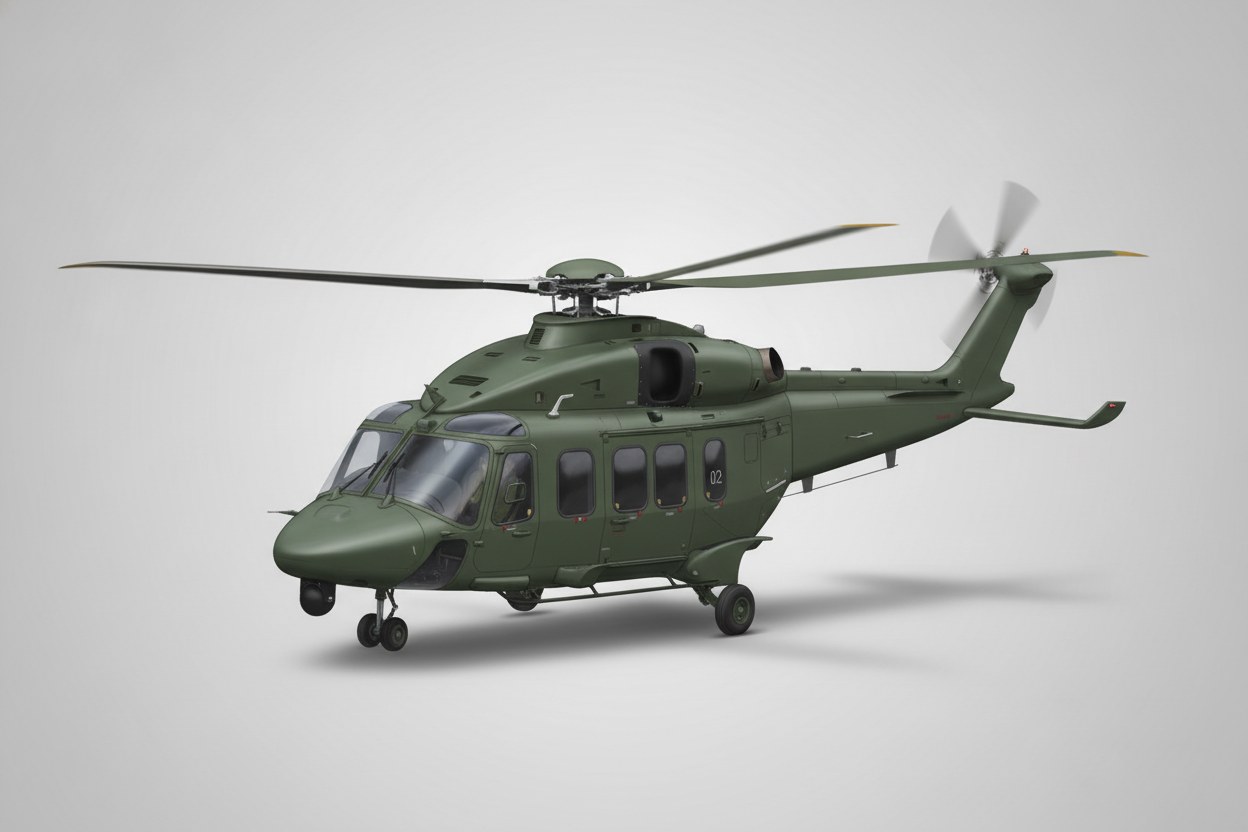
Development and First Flight
The AW149 emerged from the Italian Air Force's specific requirement for a new medium-class Search and Rescue helicopter, representing AgustaWestland's response to a critical capability gap in modern military aviation. Development began in the mid-2000s, with the helicopter making its public debut at the Farnborough Air Show in July 2006. The prototype took to the skies for the first time on November 13, 2009, lifting off from AgustaWestland's Vergiate manufacturing facility in northern Italy.
Technical Innovation
The AW149 incorporated cutting-edge avionics technology that distinguished it from previous generation helicopters. Its fully digital glass cockpit featured four large 8x10-inch Active Matrix Liquid Crystal Displays, eliminating traditional analog instruments. The aircraft's 4-axis digital automatic flight control system worked in conjunction with dual-channel Full Authority Digital Engine Control to significantly reduce pilot workload during complex missions.
The helicopter's open avionics architecture enabled seamless integration into Network-Enabled operating environments, a critical capability for 21st-century battlefield communications. Night vision goggle compatibility extended operational hours, while the crashworthy design incorporated up to 18 crashworthy troop seats, exceeding safety standards for military transport aircraft.
Powerplant and Performance
Two General Electric CT7-2E1 turboshaft engines provide the AW149's propulsion, each delivering 2,000 shaft horsepower. These engines were specifically selected for their proven performance in extreme hot-and-high environments, addressing operational requirements in challenging geographic conditions from desert operations to high-altitude missions. The FADEC-equipped powerplants contribute to the helicopter's maximum cruise speed exceeding 150 knots and service ceiling of 20,000 feet.
With a maximum range of over 650 nautical miles and endurance capabilities extending to five hours, the AW149 demonstrated significant operational reach. The aircraft's fuel capacity of 546 gallons supported extended missions without requiring frequent refueling stops.
Military Capabilities and Armament
The AW149's multirole design accommodated diverse military missions from troop transport to fire support. In standard troop configuration, the helicopter carried 12 fully equipped soldiers, expanding to 18 troops in ferry configuration. For casualty evacuation missions, the cabin accommodated NATO standard litters with medical attendant positions.
Armament options transformed the AW149 into a formidable combat platform. Window and door-mounted machine guns ranging from 7.62mm to 12.7mm calibers provided defensive and offensive firepower. Rocket launcher configurations included 7, 12, or 19-tube systems firing 70mm or 81mm rockets. The aircraft's external cargo hook capacity of 6,000 pounds enabled heavy equipment transport and supply missions.
Special operations capabilities included fast-roping and rappelling systems deployable from both cabin sides, while self-sealing fuel tanks and ballistic protection enhanced survivability in hostile environments.
Production and Service Entry
Military certification arrived in 2014, validating the AW149's readiness for operational deployment. The Italian military and police forces became the initial operators, followed by international customers recognizing the helicopter's advanced capabilities.
Poland represented the largest single customer commitment, ordering 32 Leonardo AW149 helicopters manufactured by local subsidiary PZL-Świdnik. This production partnership demonstrated the aircraft's export potential and Leonardo's strategy of establishing international manufacturing relationships.
The Manufacturer's Evolution
AgustaWestland originally developed the AW149 as part of its medium-lift helicopter portfolio. Corporate restructuring subsequently placed the program under Leonardo Helicopter Division, maintaining continuity in production and support. The original Vergiate facility in northern Italy continued as the primary manufacturing center, with international partnerships expanding production capacity.
Leonardo's stewardship ensured continued development and marketing of the AW149, including specialized variants such as the TUHP149 proposed for Turkey's Utility Helicopter Programme. These customized configurations demonstrated the platform's adaptability to specific national requirements.
Operational Legacy
The AW149's significance extended beyond its technical specifications to its role as a bridge between older-generation military helicopters and modern battlefield requirements. Its integrated mission systems, crashworthy design, and network-enabled capabilities established new standards for medium-lift military helicopters.
Continued production under Leonardo maintains the AW149's availability for nations seeking to modernize their rotorcraft fleets. The helicopter's proven performance in Italian service and expanding international operator base validates its design objectives and operational effectiveness in contemporary military aviation.