
Service History
The AW189 achieved dominance in the medium helicopter market within three years of its introduction, accumulating over 150 orders by March 2015. Gulf Helicopters became the first operator to launch commercial service in November 2014, followed by Asia-Pacific launch customer Weststar Aviation in July 2014. The aircraft's market success stemmed from its optimization for North Sea offshore operations, where its unique 50-minute run-dry main gearbox capability provided unmatched safety margins for long-range flights to oil platforms.
By October 2013, more than 80 units were on order, establishing the AW189 as the market leader in its class. A significant milestone came in January 2015 when Russian oil giant Rosneft contracted for 160 aircraft through 2025, to be manufactured by HeliVert, a joint venture between AgustaWestland and Russian Helicopters. This represented the largest single order in the program's history.
The Manufacturer
AgustaWestland, a subsidiary of Italian aerospace giant Finmeccanica (now Leonardo), announced the AW189 program at the June 2011 Paris International Air Show. The company established dual production lines at Vergiate, Italy, and Yeovil, United Kingdom, with the UK facility initially dedicated to building aircraft for Britain's Search and Rescue service.
AgustaWestland's engineering team designed the AW189 as a civil variant of the military AW149, itself an enlarged development of the successful AW139. According to CEO Bruno Spagnolini in 2011, the aircraft shared architectural concepts with the AW139 while representing a distinctly different aircraft. The company's strategy focused on creating a helicopter family spanning the 4 to 8.5-tonne categories with common cockpit layouts and maintenance concepts.
Engine & Technical Details
Standard AW189 helicopters utilize two Rolls-Royce CT7 turboshaft engines, providing the power for the aircraft's eight-tonne maximum weight capacity. In October 2017, Leonardo introduced the AW189K variant featuring two Safran Helicopter Engines Aneto-1K turboshafts, each producing 2,500 horsepower. These engines deliver an additional 500 shaft horsepower per engine compared to the CT7s, while consuming 10 percent less fuel.
The aircraft requires a two-pilot crew and accommodates various cabin configurations including 16-seat standard, 18-seat high-density, and 12-seat long-range layouts. Engineers designed the helicopter to exceed certification standards, particularly with its innovative main gearbox system that maintains operation for 50 minutes without oil pressure, surpassing typical industry requirements.
Performance Characteristics
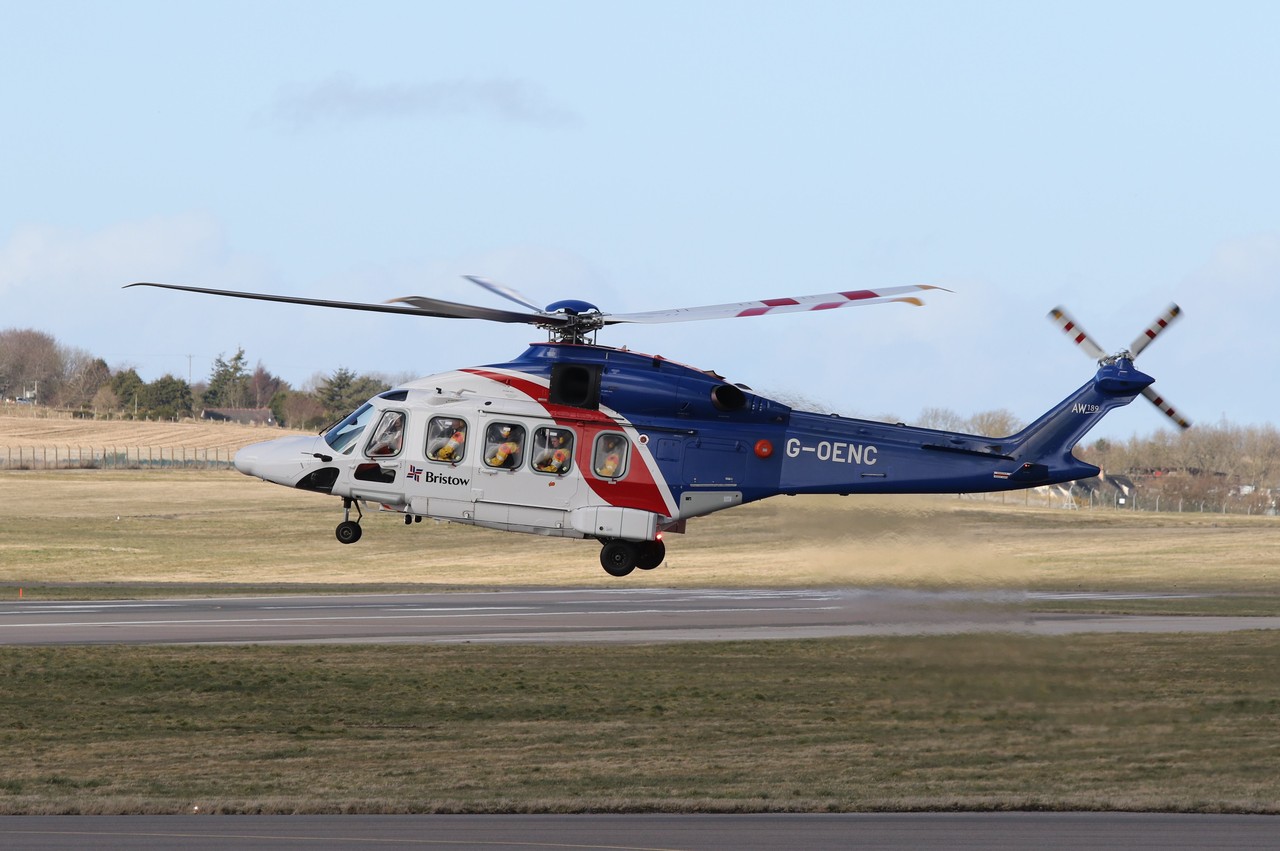
Operators praise the AW189 for its long-range capabilities and reliability in demanding offshore environments. The helicopter achieves maximum speeds exceeding 170 miles per hour with an operational range of approximately 230 miles. These performance figures enabled operators like Bristow Helicopters to deploy the aircraft for North Sea oil platform support missions beginning in early 2014.
The aircraft's design philosophy emphasized versatility across multiple mission profiles including passenger transport, search and rescue, and parapublic operations. Its ability to maintain controlled flight after engine failure, combined with the extended gearbox run-dry capability, provided operators with unprecedented safety margins for over-water operations.
Production & Certification
Full-scale production commenced in June 2013, with the first production aircraft completing its maiden flight in October 2013 at Vergiate. The European Aviation Safety Agency granted type certification in February 2014, followed by Federal Aviation Administration approval in March 2015. The Interstate Aviation Committee issued civil certification in August 2015, opening additional markets.
By the time Initial Operational Capability was achieved on July 16, 2014, AgustaWestland had delivered aircraft to multiple operators worldwide. Lease Corporation International became the first aircraft lessor to take delivery in October 2014, demonstrating the type's appeal to the leasing market. Total production reached 312 aircraft as operators embraced the helicopter's combination of capacity, range, and safety features.
The AW189K variant received EASA certification in June 2020, with Gulf Helicopters serving as launch customer for the more powerful version. Today, Leonardo continues production at both Italian and British facilities, with serial numbers indicating each aircraft's manufacturing origin. The helicopter's success established it as a cornerstone of Leonardo's rotorcraft portfolio, bridging the gap between smaller utility helicopters and larger transport aircraft.