
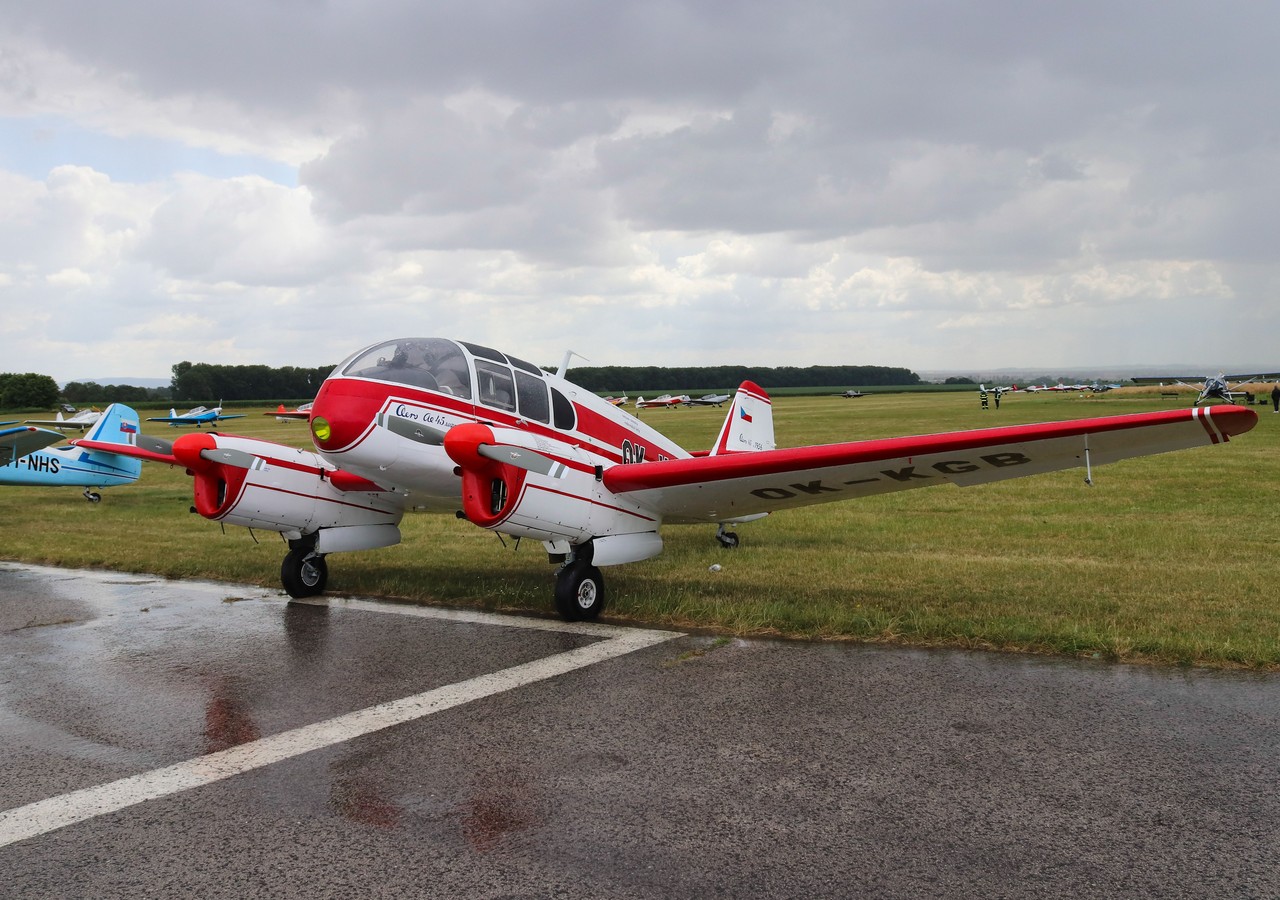
International Success and Commercial Impact
The Aero 45 achieved remarkable commercial penetration for a Communist-bloc aircraft, reaching thirty foreign markets across six continents including Poland, Romania, South Africa, India, Indonesia, Mongolia, and Australia. During the 1950s, dozens operated as aerotaxis with Czechoslovak Airlines, while international operators valued its combination of speed, range, and exceptional outward visibility.
The aircraft's capabilities earned prestigious recognition early in its career. In August 1949, chief pilot Jan Anderle captured the Norton Griffith Challenge Trophy in Birmingham, England, demonstrating the type's competitive performance against Western contemporaries. More dramatically, Aero 45S variants achieved several aviation firsts: the first Czechoslovak non-stop Sahara Desert crossing, the first Czechoslovak aircraft to cross the Atlantic Ocean (Buenos Aires to Milan via Fernando de Noronha), and a demanding 3,000-kilometer South Atlantic crossing by an Italian-registered example in 1958.
Design Team and Development
Four experienced engineers—Miroslav Baitler, Jiří Bouzka, Ondřej Němec, and František Vlk—developed the Ae-45 beginning in 1946 as an after-hours private initiative. The nationalized Aero company eventually authorized the project, designating it after the year development commenced. The design team sought to revive prewar Czech aviation traditions while creating a modern aircraft for individual air transport and business travel.
The first prototype's maiden flight on July 21, 1947, was followed by a second prototype in March 1948. Public debut occurred at International Aviation Day at Ruzyně in September 1947, showcasing the aircraft's innovative all-metal construction, teardrop-shaped fuselage, and retractable landing gear—advanced features for civilian aircraft of the era.
Manufacturing Legacy and Company Evolution
Aero, established as one of the world's oldest aircraft manufacturers, initiated production at its Prague facility in 1948, completing 200 baseline Ae-45 aircraft by 1951. When Aero relocated to Vodochody in 1953 to concentrate on military projects including Soviet-licensed MiG fighters, production transferred to Let company in Kunovice. Let continued the program through 1963, producing 228 improved Ae-45S "Super Aero" variants (1954-1959) and 162 Ae-145 aircraft (1959-1963).
Today, Aero Vodochody remains the Czech Republic's largest aircraft manufacturer, focusing on military trainers including the L-39 Albatros series and modern L-39NG variants. This evolution from civilian to military specialization reflected Cold War political pressures that ultimately ended Czech civilian aircraft production.
Powerplant and Performance
Twin Walter Minor 4-III inline piston engines, each producing 105 horsepower, powered all Ae-45 variants. These Czech-manufactured engines provided reliable service across diverse operating conditions from Arctic tundra to African deserts. The baseline configuration achieved a 230 km/h cruising speed and 265 km/h maximum velocity, while later variants reached 280 km/h maximum speed.
The aircraft's 1,000-kilometer range enabled long-distance operations that established numerous aviation records. One Ae-45 completed an 18,500-kilometer journey from France to Africa and return without significant mechanical issues, demonstrating the design's fundamental reliability and the Walter engines' durability under demanding conditions.
Military Applications and Variants
The Czechoslovak Army operated Ae-45 aircraft designated K-75 as courier machines, with specialized ambulance conversions featuring medical equipment installations. Military operators valued the type's reliability for communications duties and medical evacuation missions across Czechoslovakia's mountainous terrain.
Civilian operators employed the aircraft in equally diverse roles: utility transport, air ambulance service, police patrol, pilot training, and scheduled air taxi operations. This versatility contributed significantly to the type's commercial success and international acceptance during an era when Eastern Bloc aircraft rarely achieved Western market penetration.
Current Status and Preservation
By 2024, fewer than ten airworthy Ae-45/145 aircraft survive worldwide, with three or four operational between the Czech Republic and Slovakia, plus additional examples in America and Germany. This remarkable longevity—aircraft remaining operational more than sixty years after construction—testifies to the design team's engineering excellence and the aircraft's robust construction standards.
The Ae-45 family represents Czechoslovakia's most successful civilian aircraft program, demonstrating the nation's technical capabilities during the early Cold War period. Its international success across commercial, military, and private operations established a lasting legacy that influenced subsequent Czech aviation development, even as political changes ended the country's civilian aircraft manufacturing tradition.