
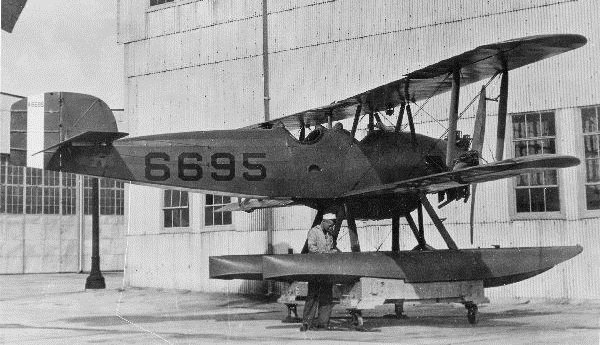
The Naval Aircraft Factory N2N was a specialized primary training aircraft developed for the United States Navy. Produced in very limited quantities, only three N2N-1 aircraft were ever built. All production took place at the Naval Aircraft Factory (NAF) located in Philadelphia, Pennsylvania. The NAF was a government-operated facility established by the Navy in 1918 to address aircraft supply challenges during wartime. While the factory continued aircraft production until early 1945, it transitioned into research and development roles and was renamed the Naval Air Material Center in 1942.
Designed as a two-seat, open-cockpit biplane, the N2N was specifically intended for primary flight instruction. To accommodate the Navy's maritime requirements, the aircraft was designed to be fitted with twin floats, allowing it to operate as a seaplane. The aircraft was powered by a Lawrance J-1 air-cooled radial piston engine, which delivered 200 hp (approximately 150 kW) of power.
In terms of physical dimensions, the N2N featured a wingspan of 33 ft 8 in (10.26 m) and a total length of 26 ft 11 in (8.20 m). Its performance capabilities included a maximum speed of 106 mph (171 km/h or 92 kn) and a service ceiling of 16,900 ft (5,200 m). Due to its role as a primary trainer, the aircraft was not intended for combat operations, and there is no recorded history of the N2N serving in a combat capacity or being utilized by civil or commercial operators.
The legacy of the N2N is defined by its role as an early experiment in the Navy's internal manufacturing capabilities. Because production was so limited, the aircraft is significantly less documented than subsequent trainer models produced by the Naval Aircraft Factory. There are currently no identified surviving airframes, museum examples, or airworthy aircraft remaining from the original production run of three.