
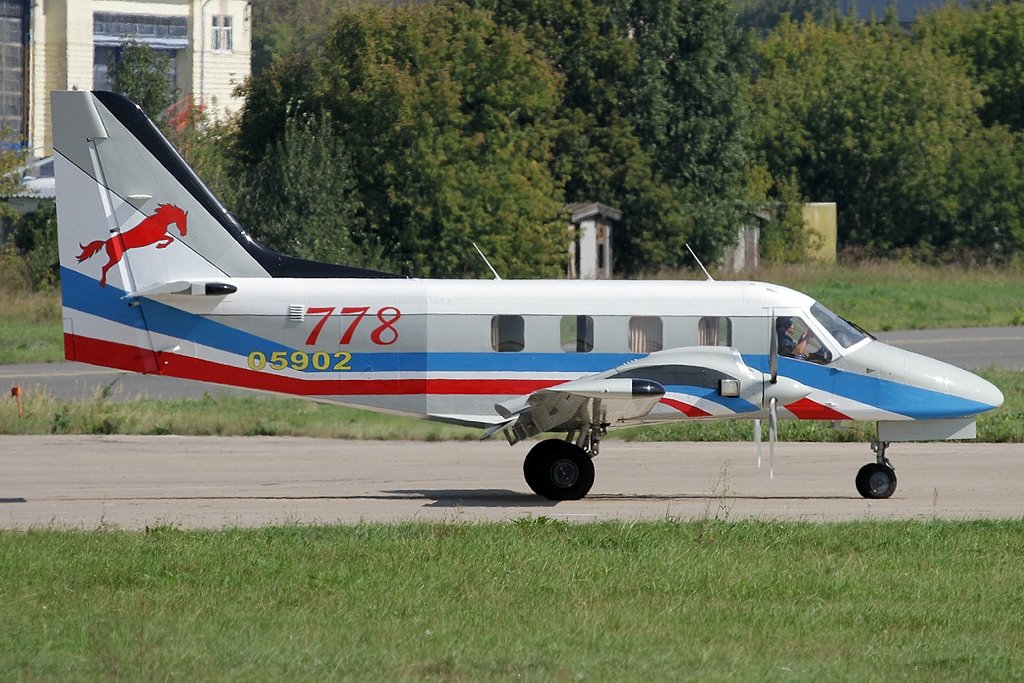
Development and Design
The Rysachok emerged from Russia's pressing need for modern regional aircraft capable of serving the country's remote territories. Technoavia began development in 2007, envisioning a versatile platform that could fulfill multiple roles from passenger transport to military patrol. The design featured a high-wing configuration optimized for rough-field operations, with twin GE H80 turboprops mounted on the wings providing reliable power for challenging environments.
The aircraft's cabin measured 6.86 meters in length, 1.50 meters in width, and 1.57 meters in height, offering sufficient space for up to 10 passengers in standard configuration or 16 in high-density layouts. This flexibility extended to the aircraft's mission profile, with provisions for aerial survey equipment, paratrooper operations, and even military armament for patrol duties.
The Manufacturer
Technoavia, formally known as LLC SCF Technoavia (Scientific Commercial Firm Technoavia), was established in 1991 by Vyacheslav Kondratiev with headquarters at the Smolensk Aviation Plant. The company specialized in general aviation aircraft, producing the SM-92 Finist family, SP-91/SP-95 aerobatic aircraft, and modifications of the Yak-18T/SP-55M. While Technoavia handled the Rysachok's design, actual prototype construction was undertaken by Progress Rocket Space Centre in Samara, a facility better known for manufacturing Soyuz rockets for Russia's space program.
Prototypes and Testing
The first Rysachok prototype achieved its maiden flight in 2010, marking the beginning of what would become a protracted development program. Progress Rocket Space Centre ultimately constructed three flight-test prototypes and two static test examples, representing the entirety of the aircraft's production run. These prototypes underwent extensive testing to validate the design's performance parameters, including its impressive 2,480-kilometer ferry range and 7.5-hour maximum endurance.
The twin GE H80 turboprops proved capable of propelling the 6,800-kilogram maximum takeoff weight aircraft to a cruise altitude of 6,000 meters. General Electric's H80 engines, each producing 770 horsepower, were selected for their reliability and fuel efficiency in the regional turboprop market, having also been tested on the Let L-410 aircraft platform.
Presidential Intervention and Production Plans
The Rysachok gained significant political attention when it appeared at major air shows including MAKS, where it was displayed in an armed configuration demonstrating its military potential. In 2015, Russian President Vladimir Putin personally ordered the production of at least 350 aircraft, recognizing the strategic importance of domestic regional aviation capabilities. This presidential mandate briefly revitalized the program, with serial production announced for later that year.
However, these ambitious plans quickly encountered insurmountable obstacles. The program stalled in 2016 despite multiple restart attempts, as Progress Rocket Space Centre struggled to balance aircraft production with its primary mission of space vehicle manufacturing. The facility's resources were increasingly devoted to Soyuz rocket production for Roskosmos, leaving insufficient capacity for the complex certification and production processes required for the Rysachok.
International Exposure
Despite its production struggles, the Rysachok gained international attention through appearances at prestigious air shows. The aircraft was exhibited at the 2014 Farnborough Airshow, showcasing Russian aerospace capabilities to a global audience. At MAKS air shows, the armed variant demonstrated the aircraft's potential military applications, including border patrol, surveillance, and light attack roles.
These international exhibitions highlighted the aircraft's technical capabilities, including its normal operating range of 2,000 kilometers and cruise speed of 250 km/h over distances exceeding 400 kilometers. The specifications positioned the Rysachok as a competitor to established regional aircraft, particularly for operators requiring versatility and rough-field performance.
Program Cancellation and Legacy
After years of delays and unfulfilled production promises, Progress Rocket Space Centre officially cancelled the Rysachok program in 2023. The decision reflected the facility's strategic pivot toward space technology, with limited resources preventing simultaneous aircraft and spacecraft production. The company cited facility limitations and changing priorities as primary factors in the cancellation.
Today, no Rysachok aircraft remain in active service, with the fate of the five prototypes undocumented. The program stands as a symbol of post-Soviet Russian aviation ambitions that ultimately succumbed to resource constraints and competing priorities. While Technoavia continues operations under its original name, the Rysachok represents a missed opportunity to establish a modern Russian presence in the regional aircraft market.
The aircraft's legacy serves as a case study in the challenges facing specialized aviation manufacturers when partnering with organizations having competing priorities. Despite presidential support and genuine market need, the Rysachok's failure demonstrates the complex industrial requirements necessary for successful aircraft development and production in the modern aerospace environment.