
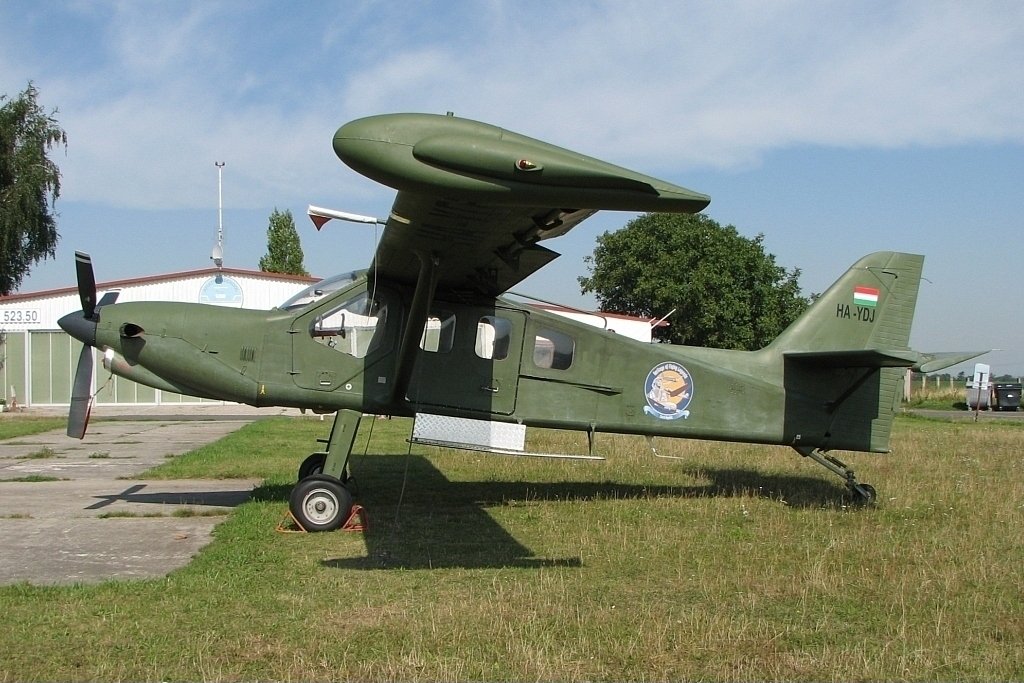
Design Genesis and Development
The SMG-92 Turbo Finist emerged from the vision of Slava Kondratiev, a designer renowned for his work on the Yak-55 and Sukhoi Su-26/Su-29/Su-31 aerobatic aircraft. Beginning development in January 1993 at Technoavia, Kondratiev aimed to create a versatile STOL utility aircraft that could serve multiple roles from passenger transport to parachute operations. The aircraft's name derives from the mythical Finist bird of Russian folklore, reflecting its intended ability to operate from austere airfields.
Construction of the prototype began with remarkable speed, culminating in the first flight of RA-44482 on December 28, 1993, less than twelve months after design work commenced. This initial version utilized a nine-cylinder M-14P radial engine, establishing the aircraft's fundamental STOL characteristics and robust construction philosophy.
International Production Evolution
The Finist's production history reflects the complex aerospace relationships of the post-Soviet era. Initial manufacture occurred at the Smolensk Aircraft Factory (SmAZ), which produced five development aircraft and ten production units before suspending operations in the late 1990s. Total production across all variants reached approximately 30 aircraft, but this modest number belies the aircraft's international appeal.
Production shifted westward as Czech and Slovak manufacturers recognized the design's potential. Zlin Aircraft acquired production rights and developed the Z-400 Rhino variant, while Aerotech in Slovakia focused on the turboprop conversion that became the SMG-92 Turbo Finist. Later, Czech companies including Orbis Avia and Praga continued development, with Praga producing the SM-92TE Praga Alfa variant as recently as the 2000s.
The Turboprop Transformation
The most significant evolution occurred with the installation of the Walter M.601D-2 turboprop engine, transforming the aircraft's capabilities. This 536-721 shaft horsepower reverse-flow free-turbine engine, driving an Avia V-508D-2 three-blade feathering and reversible propeller, dramatically improved performance over the original radial configuration. The first turboprop conversion flew on November 7, 2000, registered as HA-YDF.
This powerplant change reduced takeoff distances to 250 meters and enabled climbs to 4,000 meters in just 11 minutes. Maximum service ceiling reached 19,500 feet, while stall speeds dropped to 54 knots with flaps extended. The reversible propeller proved particularly valuable for operations from short strips, reducing landing rolls to just 145 meters when utilized.
Operational Capabilities and Design Features
The SMG-92's high-wing configuration and fixed tricycle landing gear prioritize reliability over speed, making it ideal for utility operations in challenging environments. The spacious cabin accommodates up to eight passengers or equivalent cargo, with special provisions for parachuting operations including handholds and entry steps. Optional ferry tanks extend range to 324 nautical miles, enabling positioning flights between distant airfields.
Certification to both FAR 23 and JAR 23 standards opened Western markets, a significant achievement for a design originating in post-Soviet Russia. This certification reflected Kondratiev's commitment to international standards from the project's inception.
Marketing and Demonstration Efforts
Technoavia mounted an ambitious marketing campaign, culminating in a remarkable round-the-world demonstration flight by RA-44484 in August 1995. This 30,000-kilometer journey covered 160 flight hours, routing through Europe, Canada, Alaska, and Siberia to showcase the aircraft's reliability and versatility. Such promotional efforts were unusual for Russian manufacturers of the era and demonstrated serious export ambitions.
Subsequent appearances at international air shows, including Aero '01 Friedrichshafen where HA-YDG was displayed, maintained visibility in European markets. These efforts contributed to orders from operators in the United Kingdom, Germany, and other Western European countries.
Current Status and Legacy
Today, the SMG-92 family maintains a modest but active presence in European skies. Aircraft like HA-YDM, spotted in the Czech Republic as recently as 2011, and OK-PRA, active in 2017, demonstrate the type's continued utility. Most examples serve specialized roles including parachuting, demonstration flights, and short-haul passenger transport from confined airstrips.
The aircraft's primary legacy lies in demonstrating successful East-West technology transfer and certification in the post-Cold War period. While production numbers remained limited, the SMG-92 proved that Russian designs could meet Western certification standards and find international markets. Its evolution through multiple manufacturers across several countries illustrates the increasingly globalized nature of aircraft development and production.
The Finist's specialized capabilities ensure continued relevance in niche markets where STOL performance and passenger capacity intersect, particularly in parachuting operations and remote area access throughout Europe.