
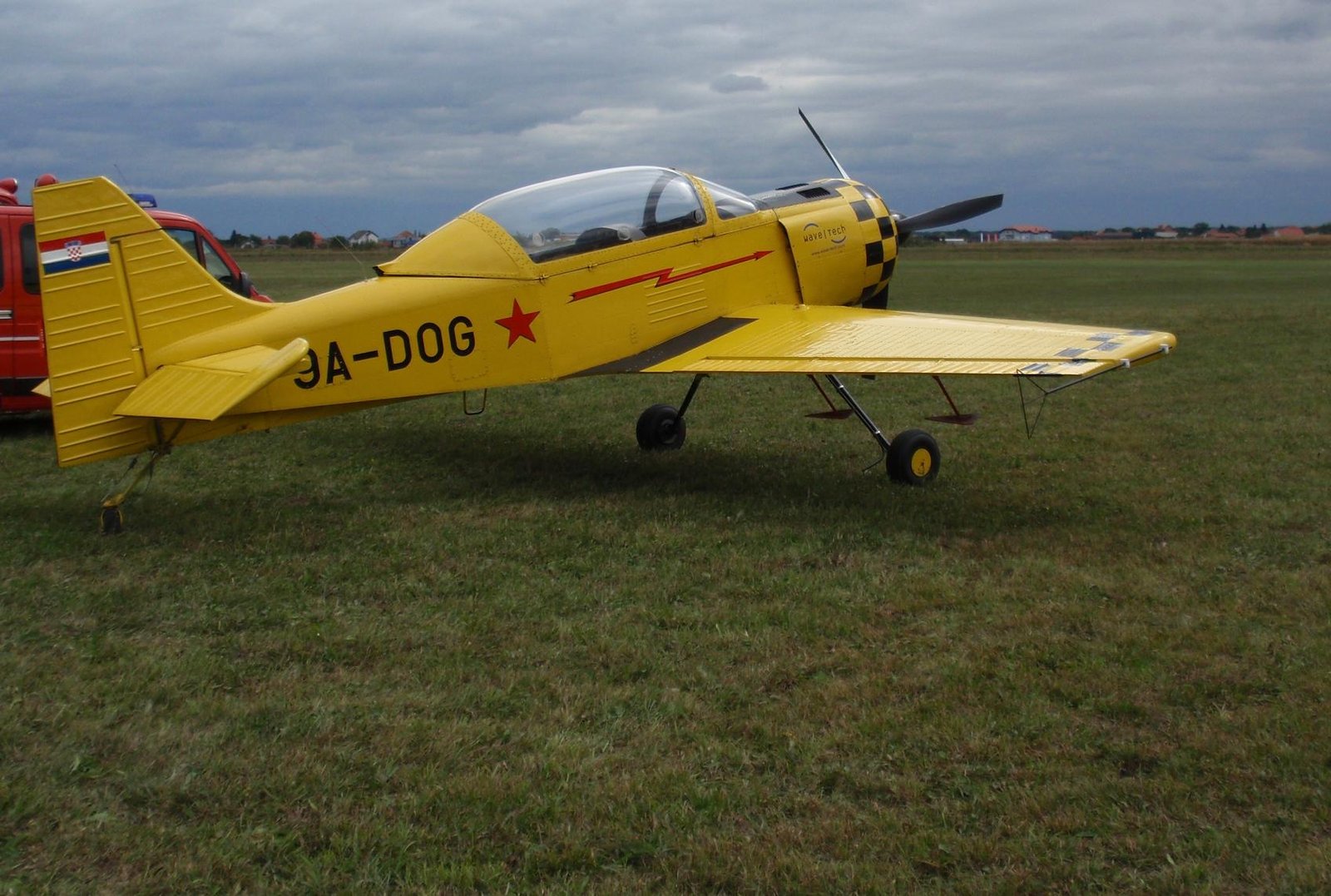
Design Heritage and Development
The SP-91 Slava emerged from the prestigious lineage of Soviet aerobatic aircraft design through the expertise of Sergey Estoyan, who had previously contributed to the renowned Sukhoi Su-26 family of competition aircraft. This connection to proven aerobatic design principles gave the SP-91 immediate credibility in the competitive world of precision flying. Estoyan's team focused on creating a robust, all-metal aircraft that could withstand the extreme stresses of advanced aerobatic maneuvers while maintaining the reliability standards expected in Russian aviation.
The aircraft's development coincided with the dramatic political and economic changes following the Soviet Union's dissolution. Technoavia, established in 1991 by Vyacheslav Kondratiev, represented a new generation of Russian aerospace companies seeking to commercialize decades of accumulated design expertise for international markets.
The Manufacturer
Technoavia, formally known as LLC SCF Technoavia (Scientific Commercial Firm Technoavia), established its primary manufacturing operations at the Smolensk Aviation Plant. The company's founding in 1991 positioned it at the forefront of post-Soviet aviation development, focusing specifically on aerobatic and sport aircraft that could compete in global markets. Under Kondratiev's leadership, the company aimed to transform Soviet-era design capabilities into commercially viable products for Western customers.
The company continues operations today, having successfully transitioned from the experimental SP-91 to production variants and other aircraft designs. This longevity in the volatile post-Soviet aerospace market demonstrates the fundamental soundness of both the company's business approach and its technical capabilities.
Engine and Technical Excellence
At the heart of the SP-91's performance lay the Vedeneyev M14P, a nine-cylinder air-cooled radial engine producing 270 kilowatts (360 horsepower). This Soviet-era powerplant represented decades of refinement in radial engine technology, offering the reliability and field maintainability that characterized Russian aircraft design philosophy. The M14P's proven service record across multiple aircraft types provided SP-91 operators with confidence in the engine's durability under the extreme conditions of aerobatic flight.
The aircraft's structural design accommodated the tremendous forces generated during competition aerobatics, with G-load limits of +11/-9 in single-seat configuration and an even more impressive +12/-10 when configured for two occupants. These specifications placed the SP-91 among the most capable aerobatic aircraft of its era, matching or exceeding the performance envelopes of established Western competitors.
Performance Characteristics
Pilots found the SP-91 capable of exceptional performance across all flight regimes. The aircraft achieved a maximum speed of 300 km/h while maintaining a relatively low stall speed of 105 km/h, providing a wide operational envelope crucial for aerobatic sequences. Its impressive rate of climb of 17.0 meters per second enabled rapid altitude recovery between maneuvers, while the never-exceed speed of 450 km/h offered substantial safety margins during high-energy aerobatic routines.
With a maximum range of 1,300 kilometers on internal fuel, the SP-91 provided the endurance necessary for cross-country competition travel without requiring frequent fuel stops. The empty weight of 800 kilograms and maximum takeoff weight of 1,080 kilograms reflected the aircraft's efficient structural design, maximizing performance while maintaining the strength necessary for extreme G-loading.
International Market Presence
For export markets, Technoavia marketed the SP-91 under the designation I-3 (sometimes referenced as E-3), recognizing that Western customers might prefer non-Cyrillic model designations. This marketing approach proved successful, with aircraft finding homes across Europe and North America. Registered examples operated in Germany, Denmark, the United States, and other countries, demonstrating the aircraft's acceptance among international aerobatic pilots.
The flexibility of single-seat or two-seat configurations enhanced the aircraft's market appeal, allowing use for both competitive flying and aerobatic instruction. This versatility proved crucial in justifying the aircraft's acquisition costs for flying clubs and individual owners seeking maximum utility from their investment.
Production Reality and Legacy
Despite its technical excellence, the SP-91 remained limited to prototype status, with only five examples completed. This limited production reflected the challenging economics facing new aircraft manufacturers in the turbulent 1990s Russian market. However, the SP-91's design philosophy and engineering solutions proved their worth through the successful development of the SP-95 production variant, which represented the commercialized evolution of the original concept.
The preservation of aircraft RA-1860G at the Technik Museum Speyer in Germany underscores the SP-91's historical significance in post-Soviet aviation development. This museum recognition validates the aircraft's role as a bridge between Soviet-era design excellence and modern Russian commercial aviation manufacturing.
The SP-91 Slava ultimately represents more than a prototype aircraft; it embodies the successful transition of Russian aerospace expertise from military-focused Soviet programs to commercially oriented international markets. While production numbers remained minimal, the technical achievements and design principles established with the SP-91 continue to influence Technoavia's ongoing aircraft development programs.