
Design Innovation
Alexander Brena, head designer at SIAI-Marchetti, conceived the S-205 in 1964 with the ambitious goal of creating a superior light aircraft for the general aviation market. His design incorporated advanced honeycomb panel construction, giving the airframe exceptional structural rigidity while maintaining relatively light weight. The maiden flight of the original S-205 occurred in 1965, followed by the more powerful S-205-18F variant in February 1966.
Engine and Performance
The S-205-18F was powered by a 180-horsepower Lycoming engine, providing substantial performance for its class. With a maximum speed of 170 mph at sea level and a cruise speed of 158 mph, the aircraft offered competitive performance against other four-seat tourers of the era. The design accommodated a wide range of powerplants, from 180 to 300 horsepower, allowing for multiple variants to serve different market segments.
The aircraft demonstrated impressive operational capabilities with a service ceiling of 17,650 feet and a rate of climb of 870 feet per minute. Its maximum range of 930 miles with internal fuel extended to 1,400 miles when equipped with tip tanks, making it suitable for extended cross-country flights. The aircraft's takeoff distance over a 50-foot obstacle was 1,340 feet, while landing distance was 1,540 feet.
International Production
Production reached an international scale when approximately 65 fuselages were shipped to the United States for assembly by the Waco Aircraft Company in Syracuse, New York. These American-assembled aircraft were marketed as the Waco Vela S.220, representing a significant expansion of the type's market reach. However, this arrangement ended following the death of the company president, Mr. Berger, highlighting the personal relationships that often drove aviation partnerships in this era.
Deliveries began in 1967, with production continuing until 1975. The aircraft found customers across 27 countries spanning Europe, Africa, the Americas, and Australia, demonstrating its broad international appeal among private pilots seeking a modern four-seat aircraft.
Military Applications
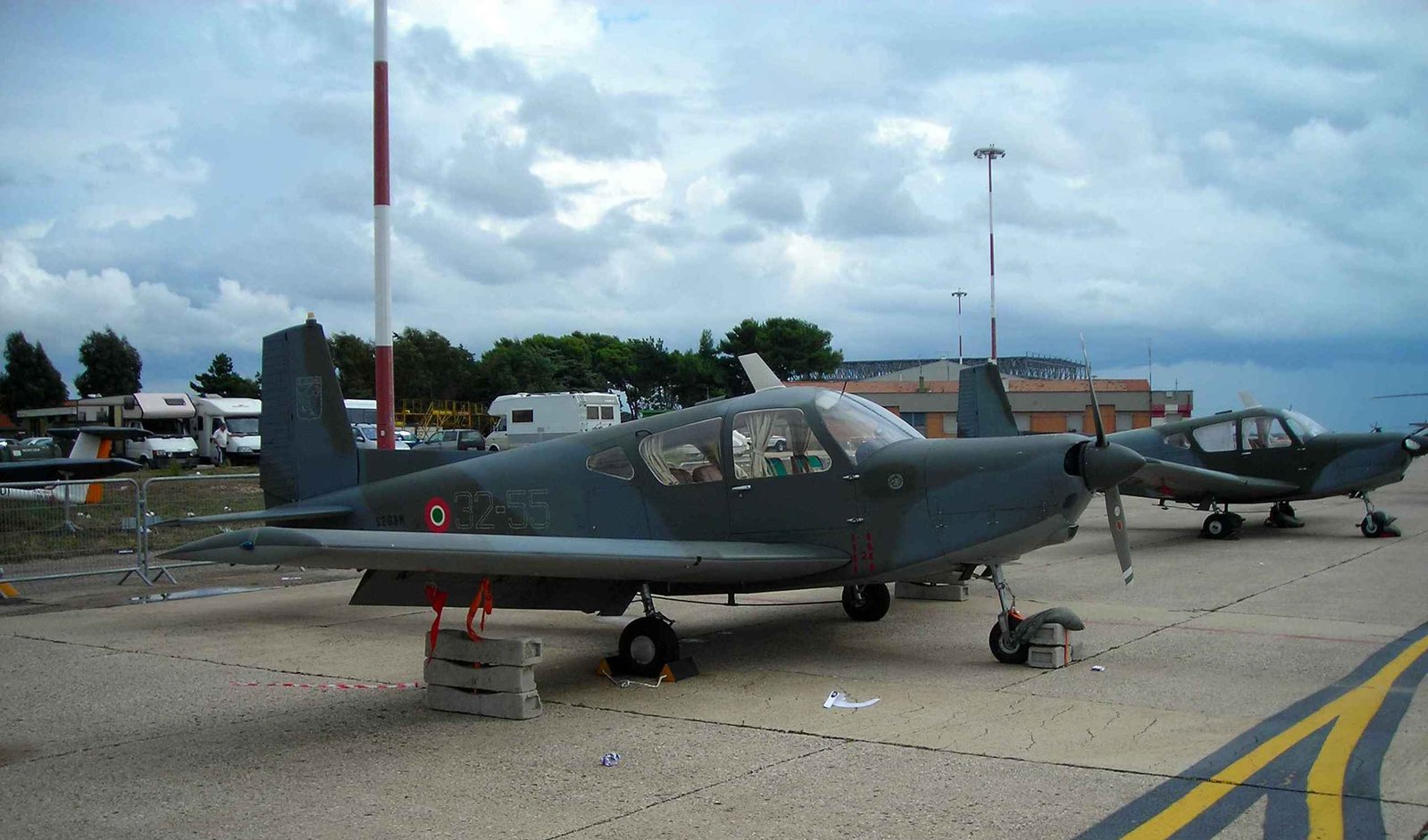
The Italian Air Force became the type's most significant military operator, acquiring 45 aircraft for liaison, glider-towing, and training duties. The military variant, designated S.208M, incorporated specific modifications including specialized avionics, dual cockpit doors for easier access, glider-towing hook capability, and reduced fuel tank capacity to accommodate military equipment.
Operations began in 1968 with 44 S.208M aircraft entering Italian Air Force service. The type's military appeal extended beyond Italy, with Ethiopia and Tunisia also acquiring aircraft for their air forces. Tunisia specifically purchased two aircraft for pilot training, recognizing the type's suitability for instructional duties.
Technical Specifications
The S-205-18F featured a gross weight of 2,755 pounds with an empty weight of 1,630 pounds, providing a useful load of 1,125 pounds. Fuel capacity of 57 US gallons provided adequate range for most general aviation missions. The aircraft's stall speed of 52 mph contributed to its docile handling characteristics, making it suitable for pilots with varying experience levels.
The honeycomb panel construction technique employed in the S-205 was advanced for its time, providing exceptional structural integrity while minimizing weight penalties. This construction method contributed to the aircraft's reputation for durability and longevity in service.
Variant Development
The S-205 spawned multiple variants to address different market segments. The basic S.205 F/R offered either fixed or retractable landing gear configurations, while the S.208 provided five seats with a more powerful 260-horsepower engine. An agricultural version, the S.208AG, served specialized aerial application roles, and an aviation-ambulance variant addressed emergency medical transport needs.
Plans for a six-seat S.206 and twin-engine S.210 were developed but never realized, as the company focused resources on proven single-engine configurations. The later S.205-20/R variant incorporated the 200-horsepower Avco Lycoming IO-360-A1A engine with a 2,000-hour overhaul interval, reducing operating costs for commercial operators.
SIAI-Marchetti Legacy
SIAI-Marchetti established itself as a significant player in the Italian aviation industry through designs like the S-205. The company's focus on advanced construction techniques and performance optimization positioned it competitively against established American and European manufacturers during the general aviation boom of the 1960s and early 1970s.
The S-205 series represented the company's successful entry into the competitive four-seat touring aircraft market, demonstrating that European manufacturers could develop aircraft competitive with established American designs. The type's international success validated SIAI-Marchetti's engineering capabilities and manufacturing quality standards.