
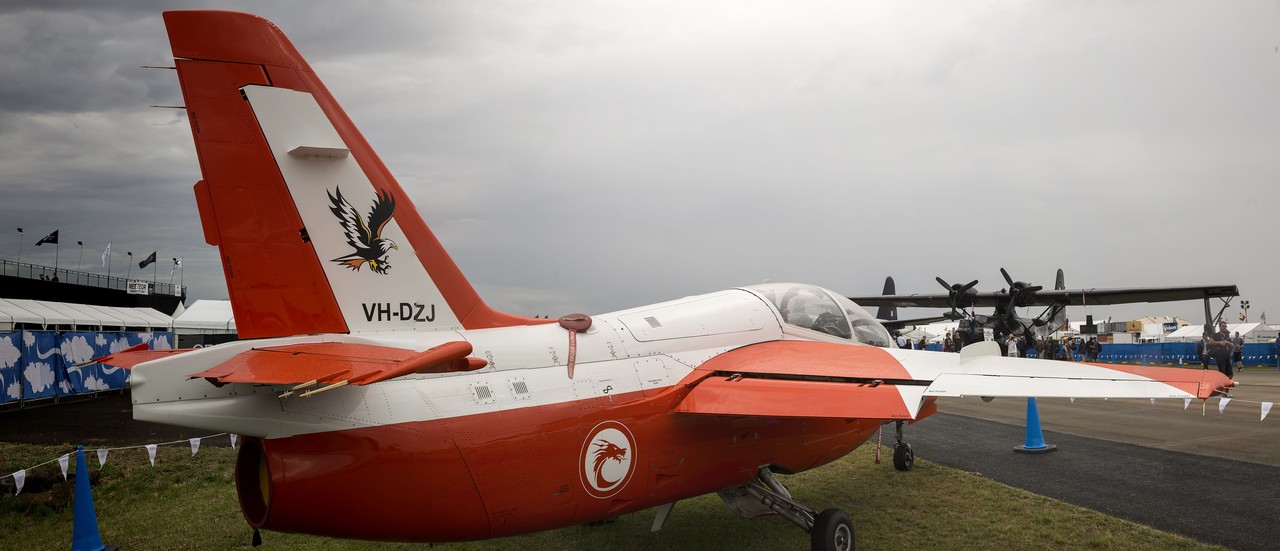
Service History
The S-211 carved out a specialized niche as an affordable jet trainer for air forces transitioning from piston-powered aircraft. Singapore became the launch customer in 1983, ordering an initial batch of six aircraft in knocked-down form for local assembly by SAMCO, a subsidiary of Singapore Aircraft Industries. The Republic of Singapore Air Force ultimately acquired 30-32 S-211s, which served as the backbone of their pilot training program until 2008. These aircraft provided Singapore with their first indigenous jet training capability, with pilots initially receiving instruction in Australia before the program matured domestically.
The Philippine Air Force operated several S-211s, with approximately three aircraft remaining operational as of recent records. Haiti acquired four aircraft for their air force, while additional examples found their way to various smaller operators worldwide. Despite its modest production run, the S-211 achieved SIAI-Marchetti's goal of providing jet training at turboprop operating costs.
The Manufacturer
SIAI-Marchetti launched the S-211 program in 1976 as a private venture, building on their success with the SF.260 piston trainer. The company, established in Italy's aviation heartland, operated from their Sesto Calende facility near Lake Maggiore. This represented SIAI-Marchetti's ambitious entry into jet aircraft design, marking their evolution from a manufacturer of light aircraft to a producer of military trainers.
The aviation industry's consolidation ultimately absorbed SIAI-Marchetti when Aermacchi acquired the company in 1997, gaining rights to the S-211 design. Aermacchi later became Alenia Aermacchi before merging into Leonardo, Italy's aerospace giant. In 2004, the new ownership announced development of an improved variant initially designated S-311, later renamed M-345, demonstrating the enduring value of the original S-211 concept.
Engine & Technical Innovation
Test pilot Alessandro Ghisleni lifted the first prototype I-SITF from Malpensa on April 10, 1981, powered by the reliable Pratt & Whitney Canada JT15D-4C turbofan. This twin-spool engine, sharing lineage with powerplants used in the Cessna Citation series, delivered 1,131 kilograms of thrust while maintaining exceptional fuel economy. The engine choice proved prescient, offering jet performance with operational costs approaching those of turboprop trainers.
The aircraft featured Martin-Baker Mk 10 ejection seats in tandem configuration, providing both instructor and student with reliable escape systems. SIAI-Marchetti equipped the S-211 with retractable tricycle landing gear and a shoulder-mounted wing design that offered excellent visibility and stable handling characteristics. For light attack missions, the aircraft could mount an M3 .50 caliber machine gun in an AIPI pod with an automatic charger system and approximately 240 rounds of ammunition.
Pilot Perspective
Pilots praised the S-211 for its forgiving handling characteristics and jet-like performance without the complexity of larger military trainers. The aircraft's climb rate of 21.0 meters per second provided spirited performance while maintaining the docile flight characteristics essential for basic jet training. The tandem seating arrangement gave instructors excellent visibility of student pilot actions while maintaining clear forward visibility for both occupants.
The S-211's control response closely mimicked that of operational fighter aircraft, providing students with authentic jet handling experience. Unlike some trainers that required significant adjustment when transitioning to operational aircraft, the S-211's flight characteristics prepared pilots effectively for advanced military jets while remaining safe for inexperienced aviators.
Production & Legacy
SIAI-Marchetti manufactured approximately 60 S-211s between November 1984 and 1994, when assembly line production concluded. While modest compared to other trainer aircraft, this production run achieved the company's objective of establishing a market presence in the jet training sector. The aircraft competed in the U.S. JPATS competition as the S-211A in partnership with Grumman, later Northrop Grumman, but lost to the Boeing T-6 Texan II.
Today, approximately 35 aircraft remain airworthy worldwide, with 12 operating in the United States and about 25 in other countries. These survivors, primarily sourced from surplus Singapore and Philippine Air Force stocks through Australian brokers, have found new life in civilian hands. The second prototype, I-SIJF, is preserved at the Volandia Parco e Museo del Volo in Italy, representing this pioneering Italian jet trainer design.
The S-211's legacy extends beyond its modest production numbers, as it pioneered the concept of economical jet training that influenced subsequent designs. Its spiritual successor, the Leonardo M-345, validates the original concept's enduring relevance in modern pilot training programs.