
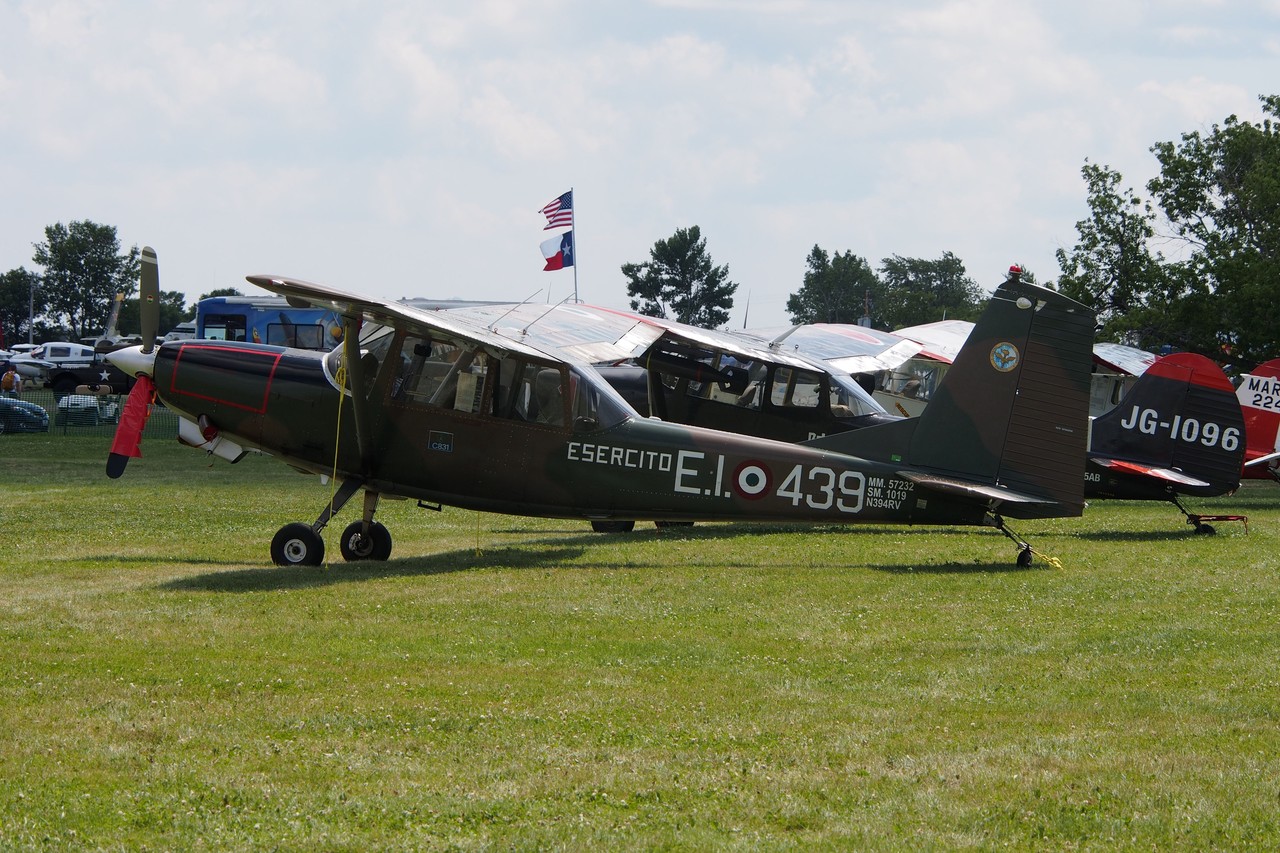
Development and Design Innovation
The SM.1019 emerged from an Italian Army requirement for a modern short takeoff and landing liaison aircraft to replace the aging Lycoming-powered Aermacchi AM.3C. SIAI-Marchetti's approach was revolutionary yet practical: take the proven airframe of the Cessna O-1 Bird Dog and transform it with turboprop power. The prototype, which first flew on May 24, 1969, was actually a remanufactured Cessna O-1 fitted with a 317-horsepower Allison 250-B15C turboprop engine.
This turboprop conversion delivered dramatic performance improvements over the original piston-powered design. The SM.1019 achieved a cruise speed of 175 mph at 10,000 feet compared to the Bird Dog's 104 mph, while the service ceiling increased to 25,000 feet. The enhanced power required significant structural modifications including thicker wing skinning, reinforced airframe structure, and a larger vertical stabilizer to manage the additional horsepower and torque effects.
Production Variants and Military Service
A second prototype, designated SM.1019A, took flight on February 18, 1971, leading to the production model known as the SM.1019EI. The Italian Army became the primary operator, receiving all 80 production aircraft manufactured between 1969 and 1979. These aircraft retained the tandem seating arrangement optimized for observation missions, with the rear seat positioned higher to provide excellent forward visibility for the observer.
The SM.1019EI featured wing hardpoints capable of mounting up to 500 pounds of ordnance including rocket pods, bombs, and machine gun containers, transforming the peaceful liaison aircraft into a capable light attack platform when required. Production variants utilized the Allison 250-B15G engine, while later aircraft received the more powerful 400-horsepower Allison 250-B17B, though this was typically derated to 350 shaft horsepower.
Beyond Italian service, the Somali Air Force operated six SM.1019s in 1981, though these were eventually retired. The Italian Army continued operating the type until 2001, representing over three decades of military service.
SIAI-Marchetti Heritage
SIAI-Marchetti represented one of Italy's most significant aircraft manufacturers, with roots tracing back to the pioneering days of aviation. The company built a reputation for producing reliable, well-engineered aircraft that often incorporated innovative solutions to military and civilian requirements. The SM.1019 exemplified this philosophy, demonstrating how existing proven designs could be dramatically improved through powerplant modernization rather than complete redesign.
Technical Excellence and Performance
The Allison 250 turboprop series proved an ideal match for the SM.1019's mission requirements. These engines, originally developed for helicopter applications, provided exceptional reliability and power-to-weight ratios. The 250-B15G variant delivered smooth operation and fuel efficiency that extended the aircraft's endurance to an impressive 8 hours and 45 minutes, with a maximum range of 832 miles from 85 gallons of fuel carried in four wing tanks.
The SM.1019's short-field capabilities remained exceptional, requiring only 367 feet for takeoff and just 300 feet for landing. This performance, combined with the aircraft's 1,800 feet-per-minute climb rate, made it ideally suited for operations from rough forward airstrips and confined landing zones typical of military liaison missions.
Civilian Legacy and Warbird Community
Following military retirement in 2001, numerous SM.1019s found new life in civilian hands. Warbird enthusiasts particularly valued the type's unique combination of military heritage, turboprop performance, and relatively economical operating costs. In mid-2002, eight examples arrived in Australia in shipping containers for conversion to civilian configuration, with the first three registered as VH-JKW, VH-XAH, and VH-XAT in November 2002.
The United States became home to the largest civilian SM.1019 population, with 20 to 25 examples on the civil registry. These aircraft found diverse roles including airshow performances, fire patrol spotting, and recreational flying. The Pacific Coast Air Museum operates one example as part of its active flight wing, helping preserve the type's operational heritage.
Tragic Reminder and Safety Legacy
The SM.1019 gained unwanted attention following a fatal accident on July 24, 2021, when former US Navy F-14 pilot Dale "Snort" Snodgrass crashed N28U at Lewiston-Nez Perce County Airport in Idaho. The NTSB determined the probable cause was failure to remove flight control locks, serving as a stark reminder of the importance of proper pre-flight procedures regardless of pilot experience level.
Enduring Significance
The SM.1019 represents a successful example of evolutionary aircraft design, proving that dramatic performance improvements could be achieved through intelligent powerplant selection rather than complete airframe redesign. Its 10-year production run and 32-year military service life demonstrated the soundness of SIAI-Marchetti's engineering approach, while its continued civilian operation ensures this unique turboprop liaison aircraft remains a living part of aviation history.