
Service History
The S-208 carved out a specialized niche in both civilian and military aviation markets during its twelve-year production run. By February 1973, SIAI-Marchetti had delivered approximately 80 aircraft to operators spanning Europe and Africa, demonstrating the type's appeal beyond its Italian origins. The aircraft's versatility proved its greatest asset, with variants configured for liaison duties, training operations, agricultural work, and ambulance service.
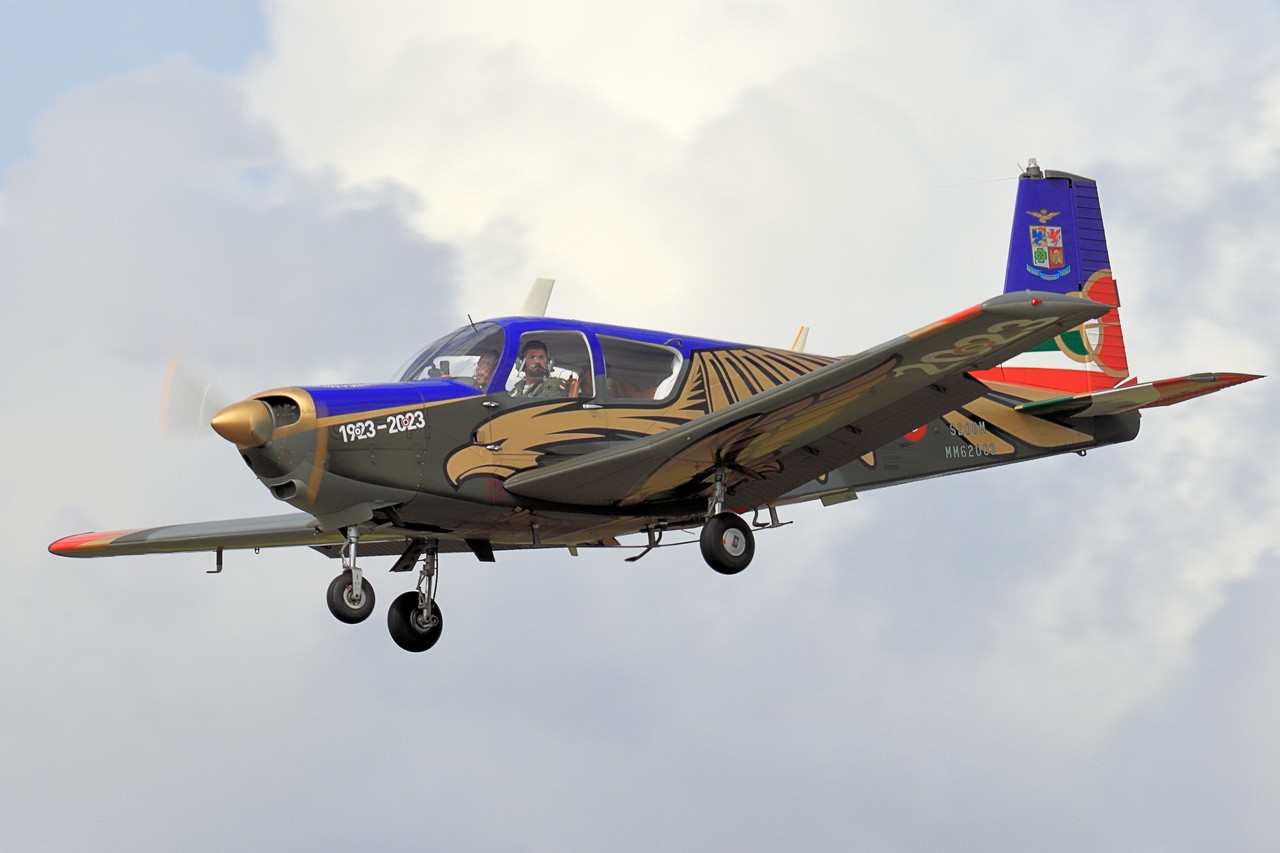
The Italian Air Force became the S-208's most significant operator, acquiring 44 S-208M military variants for liaison and training missions. This military adoption validated the aircraft's robust design and reliable performance characteristics. The service operated these aircraft alongside other SIAI-Marchetti types, creating operational synergies and maintenance efficiencies.
The Manufacturer
SIAI-Marchetti traced its origins to 1915, originally operating under the Savoia-Marchetti name before rebranding in 1943. The company established its reputation during aviation's golden age with innovative designs like the S.55 flying boat, which captured 14 world records in 1926. During World War II, SIAI-Marchetti produced the SM.79 Sparviero, recognized as one of the world's fastest medium bombers of its era.
Allied bombing severely damaged the company's manufacturing facilities during the war's final months, but SIAI-Marchetti rebuilt and continued aircraft production in the postwar period. The S-208 represented the company's expertise in small aircraft design, building upon decades of experience in both military and civilian aviation markets.
Design & Development
The S-208's development began with the earlier S-205 program, which commenced design work in March 1964. By April 1965, three S-205 prototypes had been completed, providing the foundation for the more powerful S-208 variant. The two aircraft shared approximately 60 percent of their structural components, allowing SIAI-Marchetti to leverage existing tooling and manufacturing processes while incorporating significant improvements.
The S-208's all-metal construction and retractable landing gear configuration reflected contemporary design practices for high-performance general aviation aircraft. Engineers optimized the design for both efficiency and versatility, enabling the aircraft to fulfill multiple roles from private transportation to specialized military missions.
Engine & Technical Performance
Powering the S-208 was a single Avco Lycoming IO-360-A1A engine producing 200 horsepower. This inline piston engine featured a 2,000-hour overhaul interval and a recommended 12-year service life before major overhaul, providing operators with predictable maintenance costs and scheduling. The engine's fuel consumption averaged 9.5 gallons per hour at 75 percent power settings.
The aircraft's performance specifications reflected its role as a high-speed general aviation platform. With a maximum gross weight of 2,866 pounds and empty weight of 1,632 pounds, the S-208 could carry substantial payload while maintaining impressive performance margins. Its 57-gallon fuel capacity enabled a maximum range of 810 nautical miles.
Pilot Perspective
Pilots appreciated the S-208's responsive handling characteristics and impressive climb performance of 870 feet per minute. The aircraft's low stall speed of 45 knots provided comfortable approach speeds, while its 623-foot landing distance enabled operations from shorter airfields. These characteristics made the S-208 particularly suitable for European operations, where airfield lengths often imposed constraints on aircraft selection.
The aircraft's service ceiling of 17,650 feet allowed operations above most weather systems, while the retractable landing gear contributed to its 137-knot cruise speed. The combination of performance and efficiency made the S-208 competitive with other high-performance singles of its era.
Production & Legacy
Production continued through 1980, with manufacturing concentrated at SIAI-Marchetti's Italian facilities. The S-208AG variant expanded the aircraft's utility into agricultural and medical evacuation roles, demonstrating the basic design's adaptability to specialized missions.
Today, examples of the S-208 continue to appear in aircraft registries, with at least one aircraft remaining registered in the United States as of December 2023. While total production numbers remained modest compared to mass-produced general aviation types, the S-208 represented SIAI-Marchetti's successful entry into the international high-performance single-engine market during the late 1960s and 1970s.