
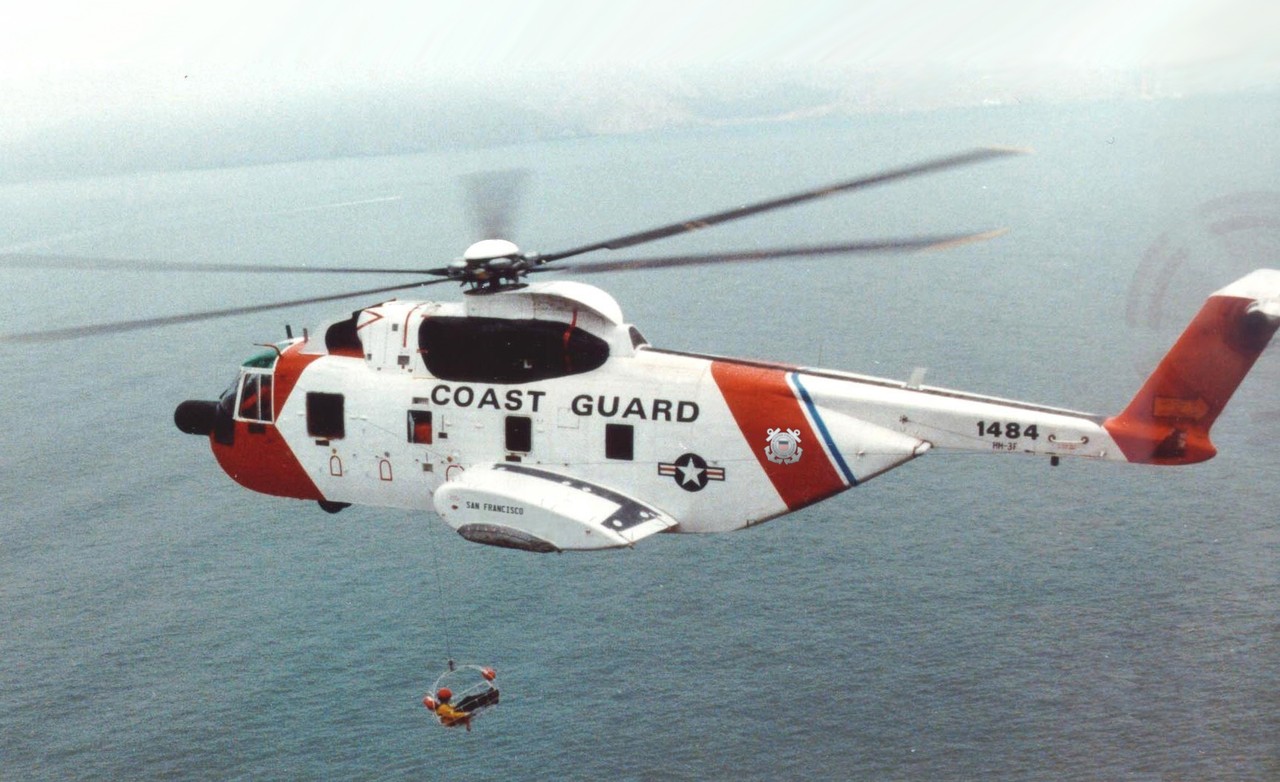
Military Service and Combat Legacy
The S-61R earned its reputation as the backbone of American search-and-rescue operations during the Vietnam War, where it served primarily with the United States Air Force under the designation CH-3 and HH-3. The aircraft's most famous variant, the HH-3E "Jolly Green Giant," became synonymous with daring pilot rescue missions deep in enemy territory. Between 1963 and 1975, these helicopters extracted countless downed airmen from hostile areas, often under intense ground fire.
The Air Force operated two primary variants: 44 CH-3C aircraft for general transport and pilot recovery, first delivered on December 30, 1963, and 65 CH-3E/HH-3E helicopters specifically configured for combat search-and-rescue missions beginning in 1965. The HH-3E featured improved engines, armor plating, and defensive armament, making it capable of surviving in contested airspace while maintaining its 4-hour endurance capability.
Design Innovation and Development
Sikorsky developed the S-61R as a private venture after losing the military's HRX competition, adapting their successful S-61 Sea King design for land-based operations. The engineering team, building on founder Igor Sikorsky's pioneering helicopter work, removed the amphibious hull and boat-like configuration of the Sea King, replacing it with a conventional fuselage and tricycle landing gear.
The most significant innovation was the addition of a hydraulically-operated rear loading ramp, introduced with the CH-3C variant. This feature enabled rapid loading and unloading of troops, equipment, and casualties without requiring the aircraft to shut down engines. The ramp could accommodate vehicles, artillery pieces, or allow paratroopers to exit during flight operations.
Sikorsky Aircraft Corporation
Founded in 1923 by Russian immigrant Igor Sikorsky, Sikorsky Aircraft had already established itself as America's premier helicopter manufacturer by the time of the S-61R's development. The company achieved the first practical helicopter flight in America with the VS-300 in 1939 and produced the world's first production helicopter, the R-4, in 1942.
United Aircraft Corporation acquired Sikorsky in 1929, providing the resources necessary for large-scale helicopter production. The company later became part of United Technologies Corporation in 1975, then Raytheon Technologies in 2020, and currently operates as the Sikorsky division of RTX Corporation. Throughout these ownership changes, Sikorsky maintained its position as a leading helicopter manufacturer.
Powerplant and Performance
The S-61R's twin General Electric T58 turboshaft engines provided the reliability and power necessary for demanding military operations. Early CH-3C variants used T58-GE-1 engines producing 1,050 shaft horsepower each, while later CH-3E and HH-3E models received more powerful T58-GE-5 and T58-GE-10 engines rated at 1,500 and 1,400 shaft horsepower respectively.
General Electric developed the T58 series in the late 1950s as a compact, lightweight turboshaft engine. The engine's modular design allowed for rapid field maintenance, crucial for military operations. This powerplant combination gave the S-61R a maximum cruise speed of 143 knots and a service ceiling of 21,000 feet, with an impressive initial climb rate of 2,220 feet per minute.
International Service
Beyond American military service, the S-61R found success with international operators. The Italian Air Force acquired 22 AS-61R helicopters, designated HH-3F, built under license by Agusta beginning in 1974. These aircraft served in search-and-rescue and combat search-and-rescue roles, demonstrating the design's versatility across different operational environments.
The S-61 family, including civilian variants, eventually served operators in more than 30 countries. While the pure military S-61R had limited international sales compared to its naval S-61 sibling, it established the foundation for numerous derivative designs.
Production and Legacy
Sikorsky manufactured 173 S-61R helicopters between 1963 and 1980, with production ending on June 19, 1980. This represented a focused production run compared to the broader S-61 family, which totaled more than 794 aircraft across all variants. The concentrated military focus of the S-61R reflected its specialized role rather than broad commercial appeal.
Today, several S-61R aircraft survive in museums, including examples at the National Museum of the United States Air Force at Wright-Patterson Air Force Base in Ohio. The helicopter's influence extends beyond its direct service record, as lessons learned from S-61R operations contributed to the development of modern search-and-rescue helicopters like the HH-60 Pave Hawk.
The S-61R's cultural impact endures through its prominent role in Vietnam War films and documentaries, where the distinctive silhouette of the "Jolly Green Giant" became an enduring symbol of American military rescue operations. Its legacy lives on in current military doctrine, where the principles of combat search-and-rescue pioneered by S-61R crews remain fundamental to modern air operations.