
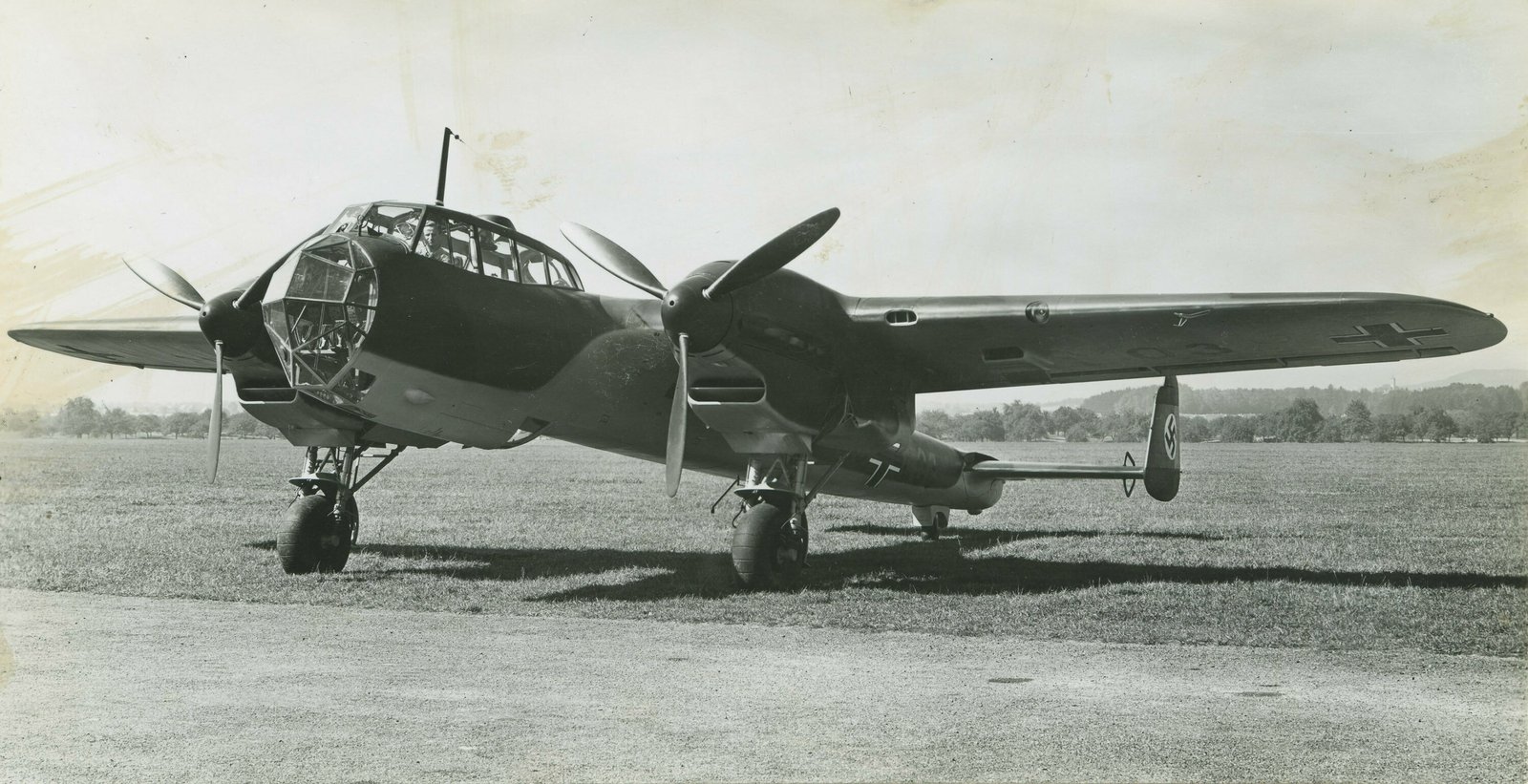
The Dornier Do 215 was a twin-engine aircraft developed by the German manufacturer Dornier at its Oberpfaffenhofen plant near Munich. Emerging as an evolution of the Dornier Do 17 family, the Do 215 maintained the characteristic slim fuselage known as the "Flying Pencil." While originally conceived for the export market, the onset of World War II led to the redirection of most airframes into the service of the Luftwaffe. This shift was exemplified by an order of 18 Do 215 A-1 aircraft placed by Sweden in December 1939 to replace French Breguet 694s; however, a German export embargo in September 1940 resulted in these aircraft being retained for German military use.
Technical improvements over the Do 17 were primarily driven by the installation of more powerful liquid-cooled V-12 piston engines. The aircraft utilized the Daimler-Benz DB 601 series; specifically, the DB 601 Ba variant provided 1,175 PS (1,159 hp / 864 kW) per engine, while the Do 215B family utilized DB 601A engines rated at 1,100 hp. These powerplants allowed for a maximum speed of 470 km/h at 4,000 m, though some sources cite 485 km/h for the Do 215B. The aircraft featured a wingspan of 18.0 m, a length of 15.79 m, and a wing area of 55 m². With a loaded weight of 8,800 kg and a crew of four, it achieved a range of 2,450 km and a service ceiling between 8,200 m and 9,000 m.
In military service, the Do 215 operated in diverse roles including light bombing and long-range reconnaissance. It saw action during the Battle of Britain, in Norway, and on the Eastern Front. Specific units included the 4.(F)/Aufkl.Gr.Ob.d.L. operating over the UK and 1.(F)/124 starting in May 1940. The airframe was also adapted for night-fighter operations, most notably in the Do 215 B-5 variant. Beyond the Luftwaffe, the Royal Hungarian Air Force operated the type, receiving four aircraft in summer 1942 and seven more in August 1943, deploying them over Serbia and Romania, and later against the Red Air Force from October 1944. Additionally, three aircraft were sold to the USSR. Production occurred between 1939 and 1941, with total numbers cited inconsistently as either 101 or 105 units. The final surviving example was captured by British forces in Austria in May 1945.