
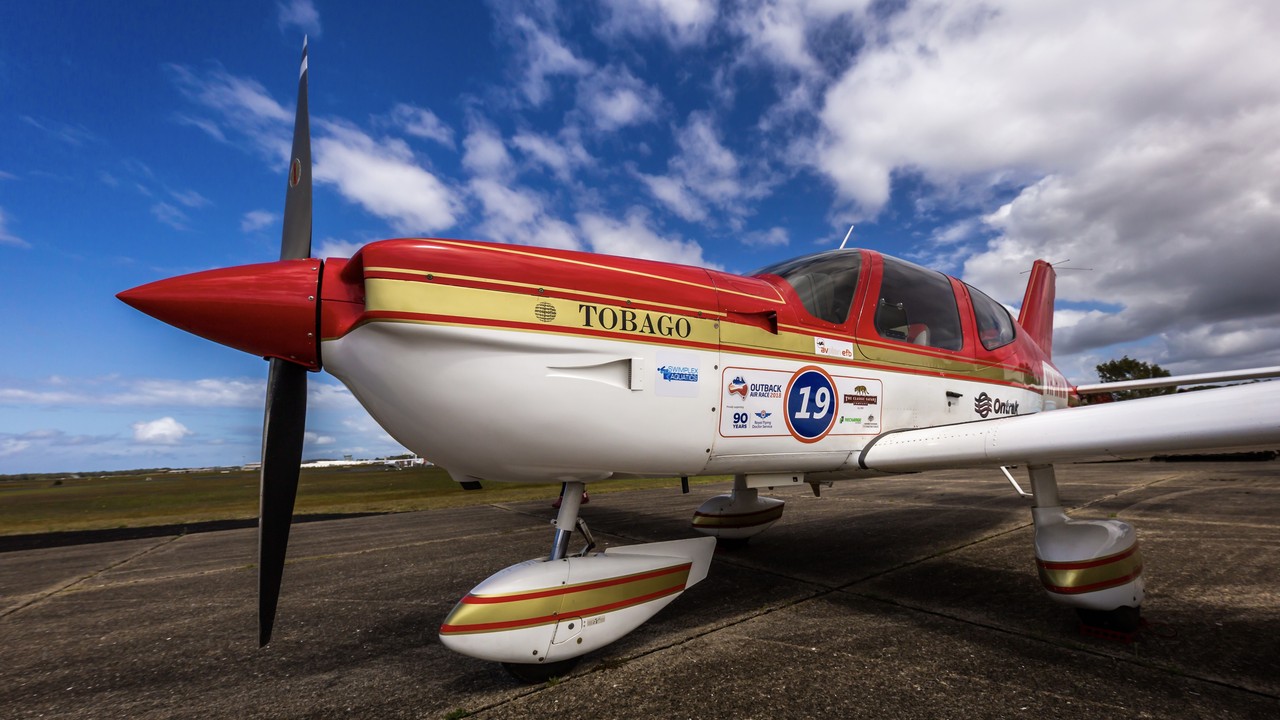
Service History
The TB-10 Tobago carved out a significant niche in the general aviation training and touring market, with its largest single customer being the Civil Aviation Administration of China (CAAC). In December 1993, CAAC confirmed an order for 43 aircraft from the TB series, including 38 TB-200 Tobago XLs, representing the largest single order ever received for the TB family at that time. This substantial order demonstrated the aircraft's appeal as a training platform in international markets.
During peak production years in the early 1990s, SOCATA manufactured approximately 12 TB-series aircraft per month at the start of 1993, though this declined to roughly 8 aircraft per month by mid-year. By mid-2004, production had dropped significantly to a maximum of 30 aircraft annually before ending in 2005 after 26 years of continuous production.
The Manufacturer
SOCATA (Société de Construction d'Avions de Tourisme et d'Affaires) operated from its Tarbes, France facility and represented the culmination of a complex French aerospace lineage. The company traced its roots through Morane-Saulnier, the original developer of the Rallye series, and Potez, which acquired Morane-Saulnier's facilities following bankruptcy. These companies eventually became part of Sud Aviation, one of several nationalized French aerospace entities that merged into Aerospatiale in 1970.
Originally established as a subsidiary of Aerospatiale, SOCATA later became part of Airbus and adopted a distinctive assembly philosophy. The company completed aircraft only after receiving customer orders, enabling customer-specified modifications and optional equipment installations. Starting in 1992 with the TB-9 Tampico, SOCATA opened a production facility in the United States, though primary manufacturing remained in France.
Design and Development
The TB-10 emerged from SOCATA's strategic decision during the mid-1970s to completely replace their existing Rallye series with a more modern aircraft family. Announced at the 1977 Paris Air Show, the first prototype flew on September 23, 1977, but was lost during spin testing on December 15 of the same year. A second prototype, fitted with a 134-kilowatt (180-horsepower) engine, continued development through 1979 as Rallye production wound down and TB family manufacturing commenced.
The aircraft received French type certification on April 26, 1979, from the Directorate General for Civil Aviation, making it the first TB-series model to achieve certification. Design engineers positioned the TB-10 as a medium-performance cross-country cruiser, emphasizing the combination of speed, simplicity, luxury, and efficiency.
Distinctive design features included gull-wing doors positioned over each wing for cabin access and an unusual tail configuration with the vertical stabilizer and rudder positioned forward of the stabilator. Two ventral strakes mounted under the aft fuselage provided additional directional stability.
Engine and Technical Specifications
The TB-10 Tobago was powered by a single Textron Lycoming O-360-A1AD engine producing 180 horsepower. This four-cylinder piston engine featured a time between overhauls of 2,000 hours and was paired with a Hartzell constant-speed propeller designed to deliver maximum performance throughout all flight phases while maintaining moderate fuel consumption.
The Lycoming O-360 was described by SOCATA as "the most commonly used engine of this type in the world," providing proven reliability for the general aviation market. In 1993, SOCATA introduced the TB200XL variant, which replaced the standard engine with a 200-horsepower Lycoming IO-360-A1B6.
Performance Characteristics
The TB-10 demonstrated solid performance figures that appealed to both training organizations and private owners. With a gross weight of 2,535 pounds and empty weight of 1,477 pounds, the aircraft provided a maximum payload of 937 pounds with a fuel capacity of 53 gallons.
Cruise performance reached 132 knots indicated airspeed with a range of 632 nautical miles. At 75 percent power, the engine consumed 11.2 gallons per hour. The aircraft achieved a rate of climb of 790 feet per minute and a service ceiling of 13,000 feet. Takeoff distance measured 1,066 feet, extending to 1,657 feet over a 50-foot obstacle, while landing distances were 623 feet and 1,394 feet respectively.
The stall speed of 51 knots indicated airspeed provided comfortable handling characteristics for training operations and student pilots.
Production Legacy
Most TB-series aircraft were manufactured between 1977 and 2000 as "generation one" aircraft, with a second generation launched in 2000 featuring a larger cabin and aerodynamic improvements. The TB-10's 26-year production span from 1979 to 2005 demonstrated sustained market demand for mid-performance, single-engine aircraft in the general aviation sector.
Although production ended in 2005, SOCATA continues to provide product support for the TB-10 Tobago, ensuring continued airworthiness for the existing fleet. The aircraft represents a successful transition from SOCATA's earlier Rallye series to a more modern, higher-performance family that established the company's reputation in international general aviation markets.