
Development and Design Origins
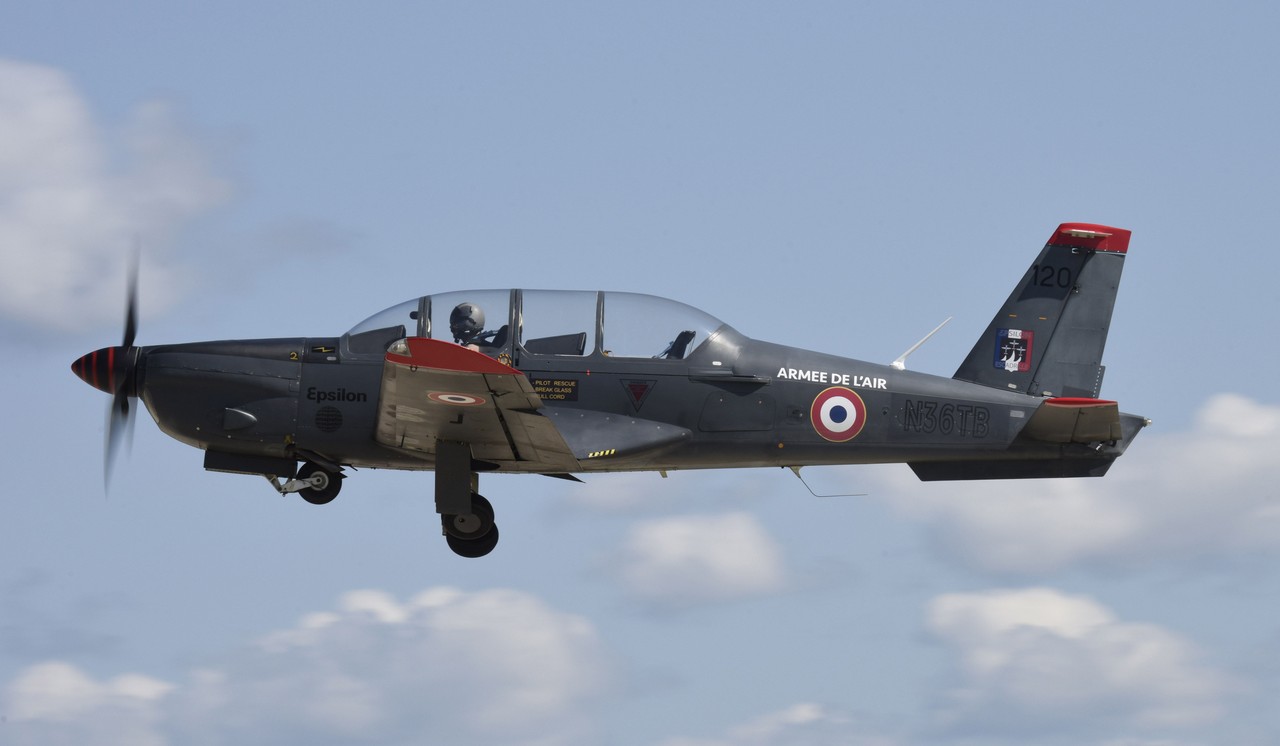
The TB-30 Epsilon emerged from the French Air Force's urgent need to replace the aging Fouga Magister in basic training roles. SOCATA's engineering team, working under Aérospatiale's guidance, derived the design from their successful TB-10 Tobago civilian aircraft. The military requirement called for a tandem two-seat trainer with a 300-horsepower piston engine, three-hour endurance capability, and significantly lower operating costs than jet trainers.
SOCATA announced the project at the Farnborough Airshow in September 1978, with the first prototype taking flight on December 22, 1979. However, initial flight testing revealed serious handling deficiencies that demanded immediate redesign. Engineers swept back the vertical fin, added a ventral strake, enlarged the tailplane, and modified the wingtips to an elliptical shape, extending the wingspan from 7.4 to 7.59 meters. The redesigned prototype flew on October 31, 1980, demonstrating vastly improved flight characteristics.
Military Service and Operations
The French Air Force became the TB-30's primary operator, ordering the first 30 aircraft in March 1982 and eventually acquiring 150 units. Deliveries began in 1983, with the type entering operational service at CEAM Mont-de-Marsan in September 1984. The aircraft served as an intermediate trainer, preparing pilots for the transition to jet aircraft while providing aerobatic training capabilities with stress limits of +6/-3 G.
Beyond France, the Epsilon found modest export success. Portugal acquired 18 aircraft beginning in October 1987, with OGMA locally assembling these units starting in January 1989. The Portuguese Air Force utilized the type for basic pilot training throughout the late 1980s and beyond. Togo purchased 3-4 TB-30A variants delivered from 1986, equipped with four underwing hardpoints capable of carrying 480 kilograms of ordnance including 68mm rocket pods and 120-kilogram bombs for counter-insurgency operations. Senegal acquired two aircraft for training purposes.
The Manufacturer's Legacy
SOCATA, originally the Société de Construction d'Avions de Tourisme et d'Usage Général, operated as Aérospatiale's light aviation division during the TB-30's development. Aérospatiale itself had formed in 1970 through the merger of Sud-Aviation and Nord-Aviation, continuing until 2000 when it merged into EADS (now Airbus). Following corporate restructuring, SOCATA became EADS Socata, eventually transitioning to Daher ownership in 2008. The company rebranded as Daher in 2017 and continues operations today, maintaining its focus on general aviation aircraft.
Technical Specifications and Performance
The TB-30 Epsilon featured a single Lycoming AEIO-540-L1B5D engine, a six-cylinder air-cooled horizontally opposed powerplant producing 224 kilowatts (300 horsepower). This fuel-injected engine drove a two-bladed Hartzell HC-C2YR-4 variable-pitch constant-speed propeller and was specifically designed for inverted flight operations essential to aerobatic training.
The aircraft demonstrated impressive performance characteristics with a maximum cruise speed of 358 kilometers per hour (193 knots) and a never-exceed speed reaching 520 kilometers per hour. Its operational ceiling extended to 7,010 meters with a climb rate of 9.4 meters per second. Range capabilities reached 1,300 kilometers with an endurance of 3 hours and 45 minutes, exceeding the original three-hour requirement.
Weighing 932 kilograms empty with a maximum takeoff weight of 1,250 kilograms, the Epsilon provided substantial payload capacity for training equipment and fuel. The aircraft's metal airframe construction ensured military-grade durability while maintaining the cost advantages of piston-engine operation.
Production and Current Status
SOCATA manufactured approximately 174 TB-30 Epsilon aircraft between 1983 and 1989, representing a modest but successful production run for a specialized military trainer. All aircraft were built in France except for the 18 Portuguese units assembled locally by OGMA.
The French Air Force retired its Epsilon fleet in 2019 after 35 years of service, marking the end of the type's primary operational role. However, several aircraft remain active with other operators, and at least one example (N8385E, serial 134) maintains civil registration in the United States with FAA certification valid through 2028.
Evolution and Legacy
The TB-30's design served as the foundation for the TB-31 Oméga, a turboprop-powered variant that first flew on November 9, 1985. This evolution demonstrated the basic design's adaptability, though the Oméga remained primarily an experimental testbed rather than achieving production status.
The Epsilon's legacy lies in its role as an effective intermediate trainer that successfully bridged the gap between basic flight instruction and advanced jet training. While never achieving the widespread adoption of some contemporary trainers, it proved the viability of modern piston-engine military aircraft and demonstrated SOCATA's capability in the specialized military training market.