
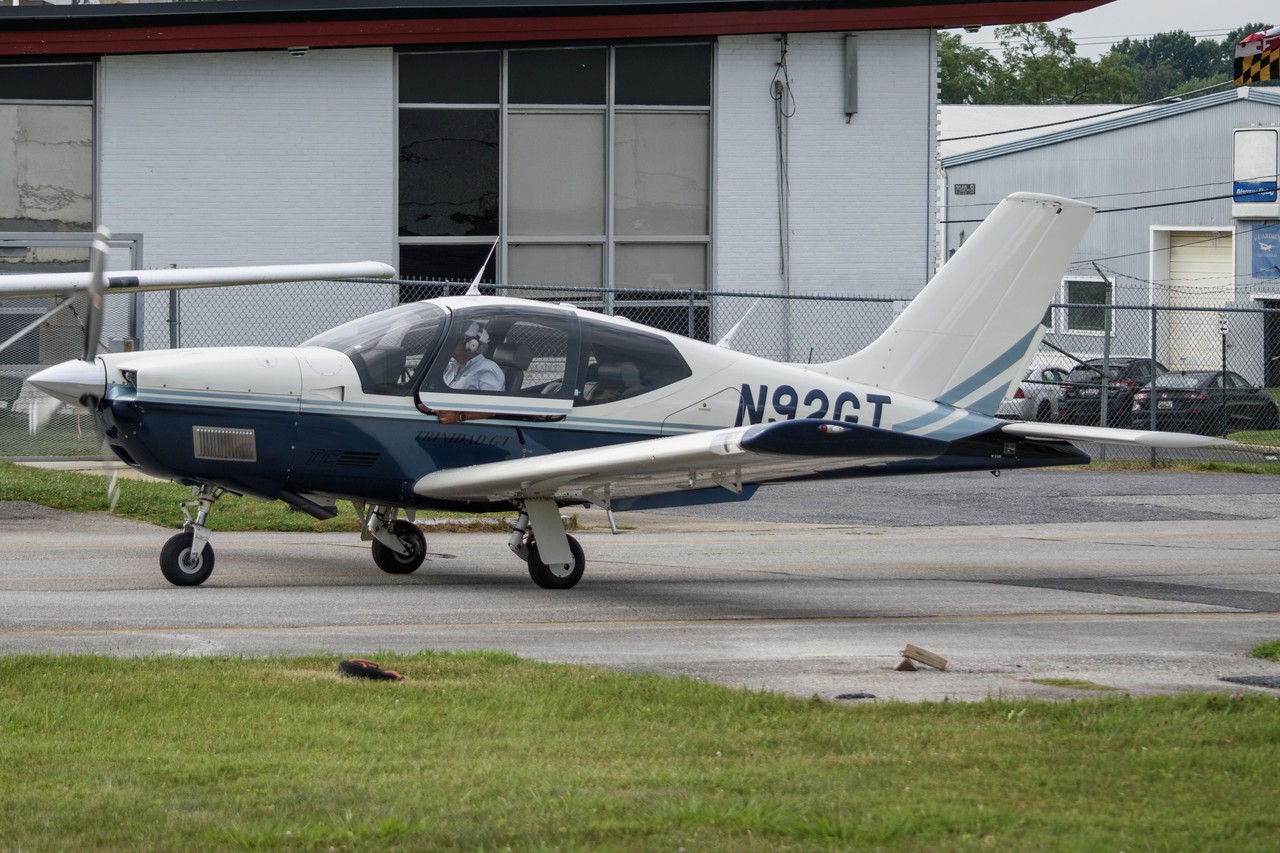
Development and Certification
SOCATA launched the TB-21 Trinidad TC development program in the mid-1970s as part of an ambitious project to replace their successful Rallye series with an entirely new family of aircraft. The prototype took to the skies on November 14, 1980, from the company's Tarbes facility, marking the beginning of what would become one of France's most sophisticated general aviation designs. French certification followed on December 18, 1981, with the first production aircraft (F-WDBB) delivered on March 23, 1982.
American certification proved more challenging, with FAA type approval finally secured on January 27, 1984, and full certification achieved in March 1986. This delay reflected the complex regulatory environment surrounding turbocharged aircraft certification during the mid-1980s.
The Manufacturer Legacy
SOCATA (Société de Construction d'Avions de Tourisme et d'Affaires) operated as the general aviation division of Aérospatiale, the French government-owned aerospace conglomerate. Based in Tarbes, France, the company represented France's primary effort to compete with American dominance in the light aircraft market. SOCATA later transitioned through various corporate restructurings, becoming part of EADS Socata before production activities were terminated by 2012.
The company's engineering philosophy emphasized modular construction, where the TB-10, TB-20, and TB-21 variants shared common fuselages, wings, and empennage components. This approach allowed flexible production scheduling based on customer demand while reducing manufacturing costs across the entire product line.
Engineering Excellence
French engineers designed the TB-21 around a constant-chord wing featuring a single milled spar running tip-to-tip, following established French aerospace traditions. The fuselage mounted atop this continuous wing structure, creating exceptional structural integrity while maximizing internal volume. The wing's substantial thickness accommodated both the aircraft's 86.2-gallon fuel system and the retractable Messier-Hispano-Bugatti landing gear within a relatively compact airfoil.
Powering the Trinidad TC was the Lycoming TIO-540 turbocharged engine, delivering 250 horsepower through a Hartzell three-bladed constant-speed propeller. This powerplant enabled operations up to 25,000 feet, making the aircraft suitable for high-altitude cross-country flying and instrument training in challenging weather conditions.
Commercial Success and Training Applications
The TB-21 found particular success in commercial pilot training programs worldwide. The French Direction Générale de l'Aviation Civile (DGAC) ordered 19 aircraft specifically for airline pilot training, recognizing the type's advanced systems and high-altitude capability. By May 1985, combined orders for TB-20 and TB-21 variants totaled 154 aircraft, demonstrating strong international market acceptance.
China emerged as a major customer when the Civil Aviation Administration of China (CAAC) confirmed a December 1993 order for 43 TB-series aircraft, including 5 TB-20 Trinidads alongside 38 TB-200 Tobago XLs. This order represented the largest single purchase in TB-series history and established the type as a standard trainer in Chinese aviation education.
Pilot Experience
Pilots appreciated the TB-21's predictable handling characteristics and sophisticated systems integration. The aircraft's turbocharged engine provided consistent power output regardless of altitude, while the retractable gear configuration offered both training value and improved cruise performance. The spacious cabin accommodated four to five occupants comfortably, making it equally suitable for training missions and personal transportation.
Modern TB-21 examples have been extensively upgraded with glass cockpit avionics, including Garmin GTN 750 and GTN 650 WAAS navigation systems. Many aircraft now feature digital attitude indicators, advanced autopilots, and TKS anti-ice protection systems, transforming them into capable all-weather platforms.
Production and Current Status
SOCATA manufactured the TB-21 Trinidad TC from 1984 until approximately 2006, when the final three TB-series aircraft were delivered. The exact production count for the TB-21 variant remains undocumented, though approximately 1,750 aircraft across the entire TB series were completed during the program's lifespan.
A mid-2000s attempt to relocate TB-series production to a planned facility in Bacau, Romania, ultimately failed to materialize, leading to the program's termination by 2012. However, significant numbers of TB-21 aircraft remain active in civilian service worldwide, supported by ongoing parts availability and maintenance programs. The type continues serving flight training organizations and private owners who value its combination of performance, reliability, and sophisticated systems.