
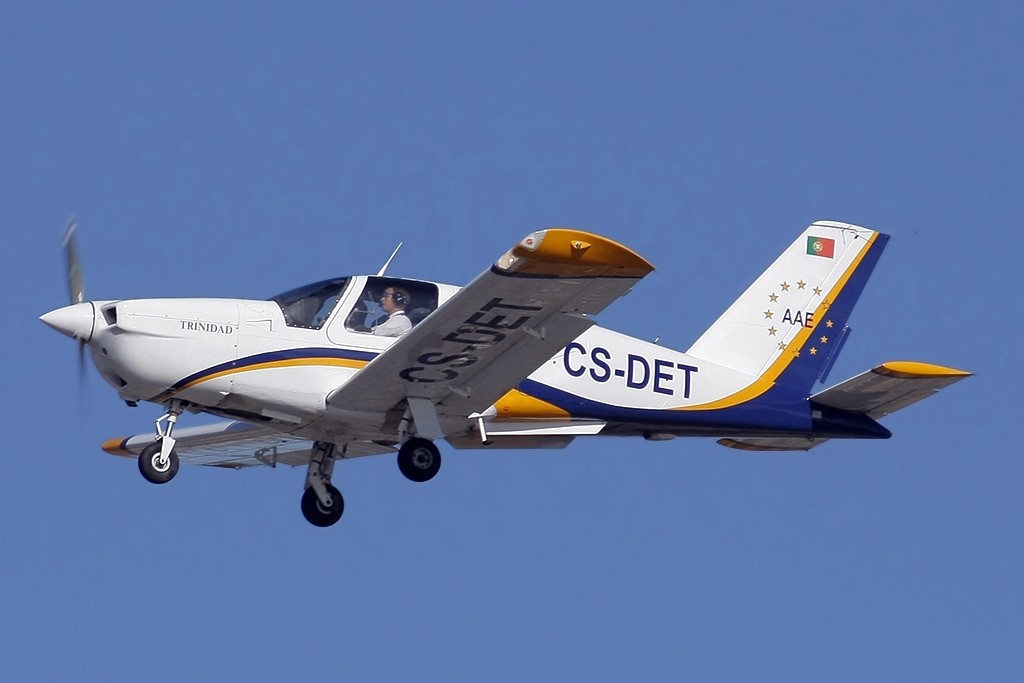
Market Impact and Service History
The TB21 Trinidad TC carved out a distinctive niche in general aviation by offering European engineering as an alternative to established American singles like the Mooney and Beechcraft Bonanza. By the mid-1980s, approximately 260 TB-series aircraft operated on the U.S. registry, demonstrating successful penetration of the competitive American market. The French civil aviation authority (DGAC) recognized the aircraft's training potential, ordering 19 units by May 1985 specifically for commercial airline pilot instruction programs.
The Trinidad TC's turbocharged Lycoming TIO-540-AB1AD engine provided sustained climb performance and high-altitude capability that made it particularly suitable for instrument flight rules (IFR) training and cross-country touring. Flight schools appreciated the aircraft's predictable handling characteristics and robust construction, while private owners valued its combination of speed and cabin comfort.
The Manufacturer's Evolution
Socata (Société de Construction d'Avions de Tourisme et d'Usage General) developed the TB series in the mid-1970s as the general aviation division of the French government-owned aerospace conglomerate Aérospatiale. The company had previously achieved success with the Rallye series, producing over 3,500 units worldwide before transitioning to the more sophisticated Trinidad line.
To support American operations, Aérospatiale established Aerospatiale General Aviation (AGA) near Dallas, Texas, sharing facilities with Aerospatiale Helicopter Corp in Grand Prairie during the 1980s. The parent company later merged into EADS (eventually becoming part of Airbus), with Socata continuing as EADS Socata by 2007. Today, the company operates as Daher, having evolved from Daher-Socata, and focuses primarily on the TBM turboprop series rather than piston-engine aircraft.
Engineering Innovation and Design Philosophy
The Socata engineering team designed the TB21 as part of the "Caribbean" family, which included the TB-9 Tampico, TB-10 Tobago, and TB-20 Trinidad variants. This approach maximized production efficiency by sharing common fuselage, wing, and empennage structures across the line while varying powerplants and equipment levels.
The Trinidad TC incorporated several advanced features for its era, including a low-parts-count monocoque fuselage requiring just 600 man-hours to construct - significantly less than competing designs. The cabin featured reinforced glass-fiber construction over a load-bearing tub, while the wing incorporated 6 degrees 30 minutes of dihedral for enhanced stability. Built-in oxygen systems accommodated the aircraft's high-altitude capabilities.
When Socata introduced the "Generation Two" (GT) variants in 2000, improvements included a carbon-fiber cockpit roof that increased headroom, computer-controlled turbocharging, and updated avionics. The GT prototype (F-WWRG) first flew on April 21, 1999, receiving certification on January 31, 2000.
Technical Specifications and Performance
The Lycoming TIO-540-AB1AD engine, manufactured by Textron's Lycoming division, represented proven technology from the TIO-540 series that had entered production in the 1960s. The turbocharged configuration enabled the Trinidad TC to maintain power output at higher altitudes where naturally aspirated engines would struggle, making it particularly effective for mountain flying and weather avoidance.
Pilots appreciated the aircraft's responsive controls and stable instrument flight characteristics. The retractable landing gear system provided clean aerodynamics for improved cruise performance, while the spacious cabin accommodated four to five occupants in comfort comparable to larger aircraft. Some examples featured propeller deicing systems using Hartzell three-blade propellers for enhanced all-weather capability.
Production History and Legacy
French certification came on December 18, 1981, with the first production aircraft (F-WDBB) delivered on March 23, 1982. FAA type approval followed on January 27, 1984, enabling U.S. deliveries that began in summer 1983. The turbocharged TB21TC variant received American certification in March 1986.
Total production of TB-20 and TB-21 variants reached approximately 700 units, contributing to an overall TB-20/21 worldwide population of about 830 airframes. The "Generation Two" era saw modest production numbers, with 8 units delivered in 2001 and 14 in 2002. Production effectively ended around 2006 with the delivery of the final three TB aircraft, transitioning to build-to-order by 2008 before full discontinuation in 2012.
Today, many first-generation Trinidad aircraft remain active, supported by Daher with modern upgrades including Garmin glass cockpit retrofits. The type's reputation for reliability and distinctive European styling maintains strong resale values in the used aircraft market, cementing its position as a successful alternative to American-built singles in the high-performance four-seat segment.