
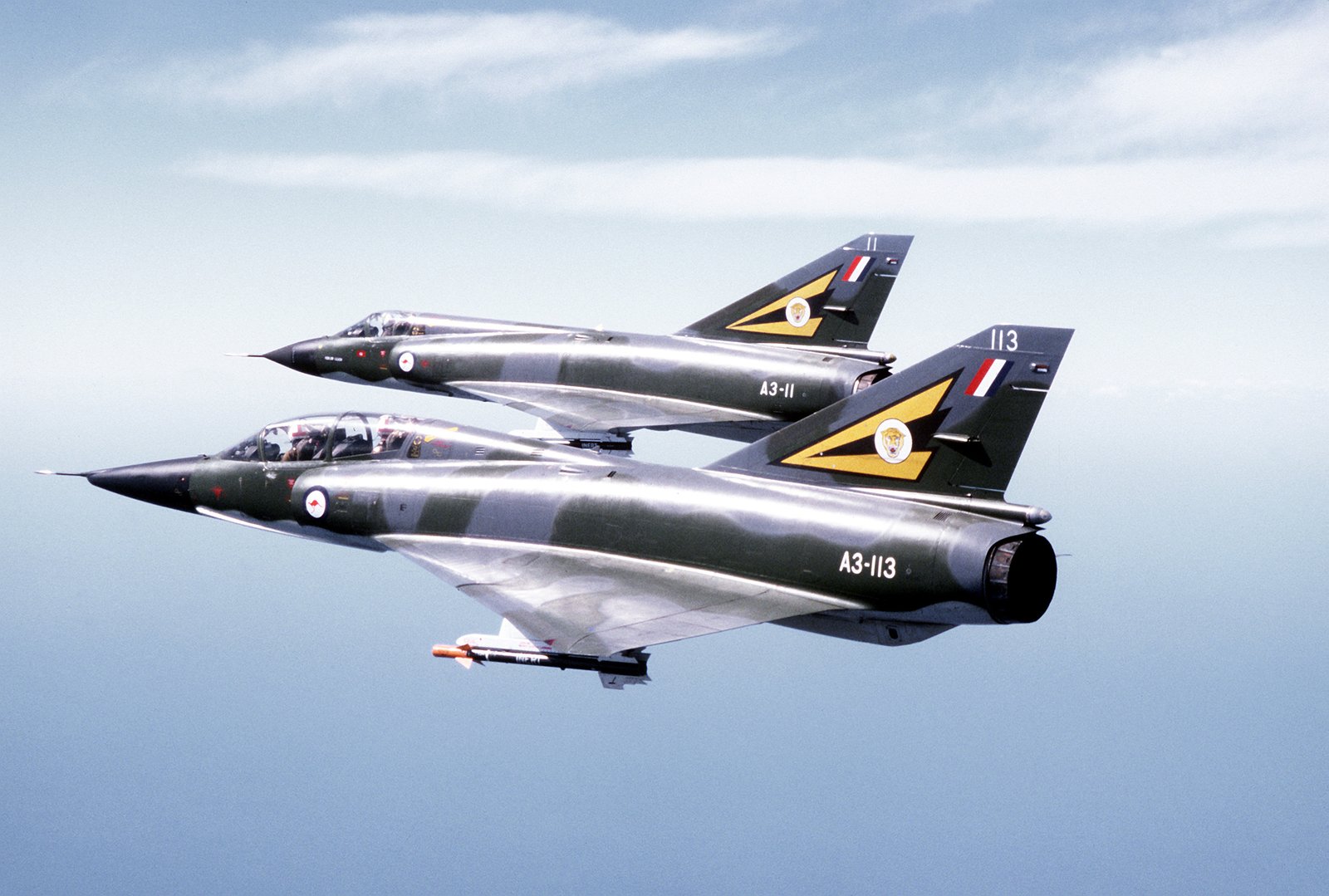
The Dassault Mirage is not a single aircraft model but a comprehensive family of supersonic combat aircraft produced by the French firm Dassault Aviation (historically referred to as Dassault-Breguet). The series began with the Mirage III, designed at the end of 1955 as a single-engine bomber-fighter featuring a delta wing. The Mirage III was a landmark achievement in European aviation, becoming the first Western European combat aircraft to exceed Mach 2 in level flight. Since 1958, Dassault produced 1,401 aircraft across approximately 90 variants of the Mirage III, Mirage 5, and Mirage 50 series, which served in 21 different countries and accumulated 3 million flying hours.
As the family evolved, Dassault developed the Mirage F1 to succeed the Mirage III. Diverging from the family's signature delta wing, the F1 utilized a conventional swept wing with high-lift devices to improve take-off and landing performance, allowing it to land at approximately 125 knots. The Mirage F1 prototype first flew on December 23, 1966, and the first production aircraft was delivered to the French Air Force on March 14, 1974. Production continued until 1992, with approximately 720 aircraft built, including 473 exported to nations such as Spain, Greece, Kuwait, and Iraq.
In the late 1970s, Dassault introduced the Mirage 2000 as a lightweight, high-agility multirole fighter. Returning to the delta-wing configuration and incorporating fly-by-wire flight controls, the Mirage 2000 prototype first flew in 1978, with the first production model, the 2000C, flying on November 20, 1982. Approximately 600 units were produced, with half of the total being exported to countries including India, Taiwan, and the UAE. Production of the series concluded on November 23, 2007, with the final delivery to the Hellenic Air Force.
Operationally, the Mirage family has seen extensive combat. The Mirage III performed notably during the 1967 Six-Day War with the Israeli Air Force. The Mirage 2000 made its combat debut in the 1991 Gulf War and maintained 100% availability during operations in Kosovo. While the aircraft served in various roles—including air-superiority, reconnaissance, and nuclear strike—they remained exclusively military assets with no documented civil or commercial service.