
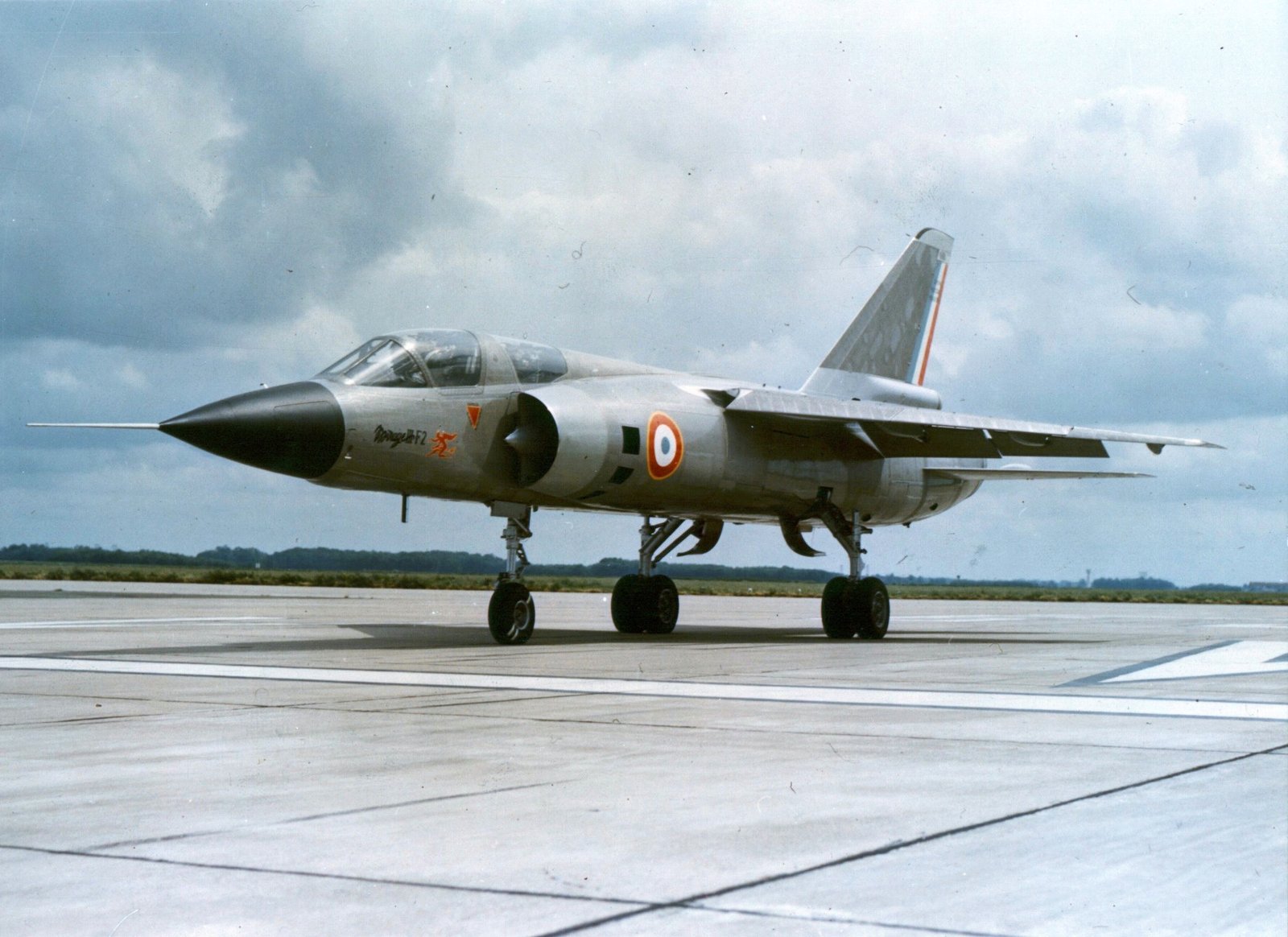
The Dassault Mirage F2 was a specialized prototype aircraft developed by Dassault Aviation to explore the capabilities of high-performance, twin-seat fighter and ground-attack configurations. Rather than entering mass production, the aircraft was designed as a technical experiment to evaluate the integration of powerful turbofan engines and a high-mounted swept wing arrangement. Its primary significance lies in its role as a developmental stepping stone, providing critical data that informed the subsequent Mirage G variable-geometry aircraft program.
The aircraft's flight testing began at Istres, where the prototype first took to the air on 12 June 1966, with Jean Coureau serving as the pilot. The initial flight configuration utilized a Pratt & Whitney TF30 turbofan engine, which provided a rated thrust of 89 kN (20,000 lbf). Following this initial phase, the aircraft underwent a re-engining process to accommodate a French-made powerplant. On 29 December 1966, the Mirage F2 completed its second flight, powered by a SNECMA TF306 turbofan.
Technically, the Mirage F2 was a substantial aircraft for its class, featuring a length of 17.60 meters, a wingspan of 10.50 meters, and a height of 5.80 meters. It was designed to carry a crew of two and had an empty weight of 9,500 kg, with a maximum takeoff weight reaching 18,000 kg. In terms of performance, the prototype was capable of reaching a maximum speed of 2,333 km/h, which corresponds to Mach 2.2, and could operate at a service ceiling of 20,000 meters.
Because the Mirage F2 remained a prototype project, it never entered operational military service and saw no combat deployments. There were no production variants or commercial applications of the design. Consequently, the aircraft's legacy is defined by its contribution to French supersonic aviation and turbofan experimentation rather than operational history. As the program did not transition to production, there is no surviving operational fleet associated with the F2.