
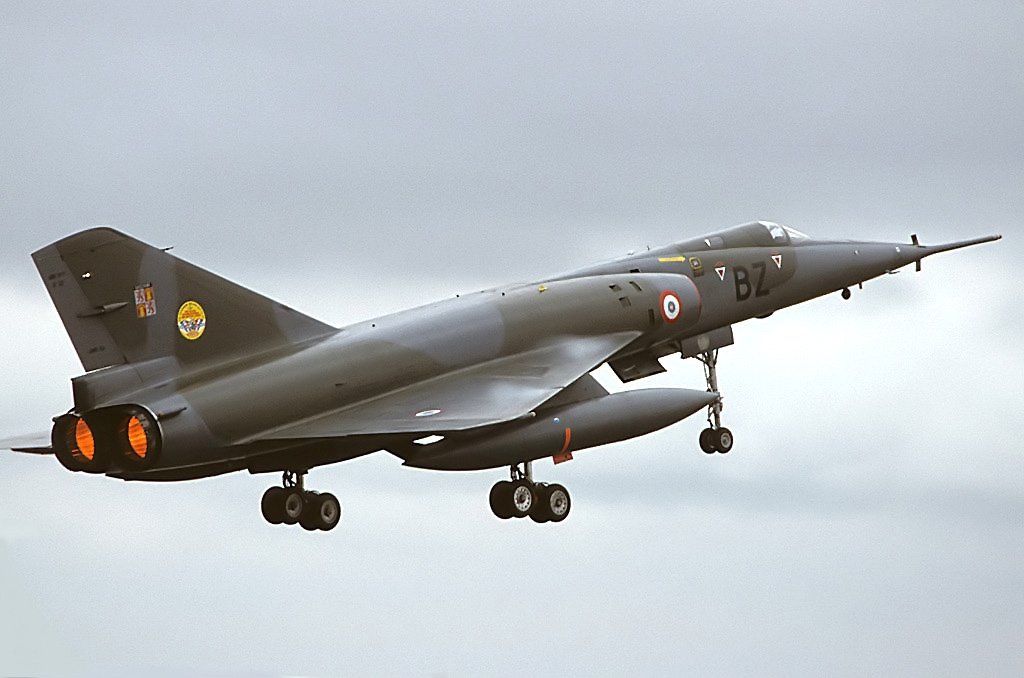
The Dassault Mirage IV was developed to provide France with an independent strategic strike capability, serving as the airborne component of the nation's nuclear deterrent force. The aircraft originated from a 1956 concept for a twin-engine night-fighter, which was subsequently enlarged into a strategic bomber design. Ordered in April 1957, the prototype, designated Mirage IV 01, made its maiden flight on 17 June 1959 at Melun-Villaroche, piloted by Roland Glavany.
Production of the 62 aircraft occurred between December 1963 and November 1966. Dassault Aviation acted as the prime contractor, coordinating with various state-owned and private companies. The airframes were manufactured at the Saint-Cloud factory, a process taking approximately 18 months per unit, before being transferred to Melun-Villaroche for final adjustments. The first production aircraft took flight on 7 December 1963 at Mérignac, with René Bigand as the pilot.
Technically, the Mirage IV was powered by two SNECMA Atar 9K series turbojet engines. It was designed for high-altitude, high-speed strategic penetration and became the first operational European nuclear bomber capable of sustained flight over Mach 2; notably, it was the only European aircraft of its era able to maintain Mach 2 for more than 30 minutes.
Operated exclusively by the French Air Force (Armée de l’Air), the aircraft initially carried AN-11 and later AN-22 nuclear bombs. Until 1971, the Mirage IV was France's sole nuclear deterrent. The fleet evolved through several standards: in 1972, 12 aircraft were converted to the Mirage IVR reconnaissance standard, and in 1979, 18 aircraft were upgraded to the Mirage IVP standard to carry the ASMP nuclear cruise missile, which entered service in 1986. Beyond its nuclear role, the aircraft conducted reconnaissance missions over Chad in 1974 and other operational areas. By 1996, the Mirage 2000 replaced the Mirage IV in the nuclear strike role, leaving the remaining fleet to focus on reconnaissance until the type's final retirement in 2005.