
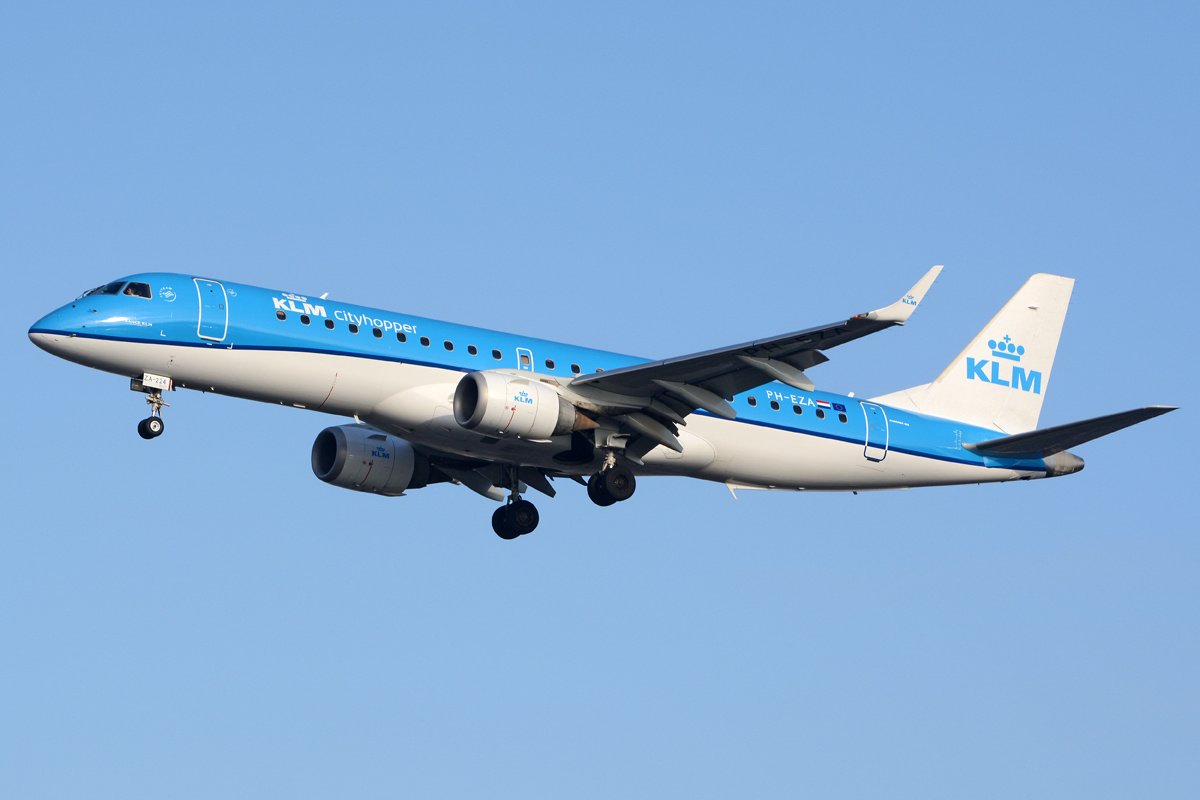
Service History
The E195 carved out a crucial niche in regional aviation by bridging the gap between smaller regional jets and narrow-body mainline aircraft. British carrier Flybe became the launch operator on September 22, 2006, with 14 firm orders and 12 options, demonstrating the aircraft's viability for European short-haul operations. The type enabled airlines to efficiently serve routes with passenger demand exceeding the capacity of 70-90 seat regional jets while maintaining the operational economics that made turboprops attractive.
By 2023, over 1,000 aircraft across the entire E-Jet family had been delivered, with the E195 representing the high-capacity end of this successful program. Major operators included JetBlue Airways, which became the launch customer for the broader E190 family on November 8, 2005, and Air Canada, which operated 45 E190s until retirement in May 2020. American Airlines also utilized the type until 2020, while European carriers like LOT Polish Airlines integrated the E-Jet family starting with their first E170 delivery on March 17, 2004.
The Manufacturer
Empresa Brasileira de Aeronáutica, founded in 1969 as a Brazilian state enterprise, developed the E195 as part of its strategy to compete directly with Bombardier and other regional aircraft manufacturers. Following privatization in 1994, Embraer underwent significant restructuring that positioned the company for global expansion and technological advancement. By the time of the E195's development, Embraer had established itself as the world's leading manufacturer of commercial jets seating up to 150 passengers.
The company weathered a potential major change between 2018-2020 when Boeing attempted to acquire Embraer's commercial aviation division, but the deal ultimately collapsed. Today, Embraer continues operations under its original name with facilities spanning the Americas, Africa, Asia, and Europe, having delivered over 8,000 aircraft total across all programs. The company maintains its headquarters in São José dos Campos while operating additional facilities including the Gavião Peixoto test and production center.
Engine & Technical Innovation
General Electric's CF34-10E engines power the E195, representing an evolution of proven turbofan technology optimized for high-cycle regional operations. The CF34 series, which debuted with the CF34-1A variant in 1989, provided the reliability essential for airlines operating multiple daily rotations on short-haul routes. These engines enabled the E195 to achieve the performance necessary for its 108-seat capacity while maintaining fuel efficiency competitive with turboprop alternatives.
The aircraft incorporated advanced Honeywell avionics systems, though initial development experienced delays in this area. Design leadership came from Embraer teams including figures like Mauro Kern, who served as airline market programmes vice-president during the aircraft's development phase. The E195's stretched fuselage design represented a significant departure from earlier ERJ derivatives, marking Embraer's transition to an entirely new aircraft family announced at the Paris Air Show on June 14, 1999.
Development & Flight Testing
Crosshair, the Swiss regional carrier, provided the initial impetus for the E195's development with commitments for up to 15 aircraft alongside ERJ-170 orders in June 1999. The aircraft's maiden flight occurred on December 7, 2004, departing from São José dos Campos and remaining airborne for nearly two hours of initial testing. Flight testing continued at Embraer's Gavião Peixoto facility, where engineers validated the aircraft's performance across its operational envelope.
Full-rate production commenced in 2002 as part of the broader E-Jet program, with plans calling for monthly output of four E-190/195 aircraft by 2006, increasing to seven or eight per month by mid-2007. This production ramp reflected growing airline interest in the 100-seat category and Embraer's confidence in market demand for efficient regional jets.
Performance & Operations
The E195 achieves a maximum speed of approximately 890 kilometers per hour with a service ceiling exceeding 12,500 meters. Range performance reaches 2,800-4,000 kilometers depending on passenger load and operational conditions, enabling airlines to serve diverse route structures from short regional hops to longer thin routes. The aircraft requires a two-person flight crew and can accommodate up to 136 passengers in high-density single-class configurations.
Operational versatility proved key to the E195's success, allowing carriers like Flybe to replace turboprop fleets while maintaining route economics. The type's capacity enabled airlines to upgrade service on routes previously served by smaller aircraft while avoiding the complexity and costs associated with larger narrow-body jets.
Legacy & Evolution
The original E195 established the foundation for Embraer's continued success in the regional jet market, leading directly to the E195-E2 variant that entered service with enhanced fuel efficiency and updated systems. The E2 generation, exemplified by the E195-E2's certification in April 2019, achieves 24 percent better fuel consumption compared to the original E195 design.
Many original E195 aircraft remain in active service with operators including JetBlue and Georgian Airways, while cargo conversion programs announced in March 2022 promise extended operational life for the type. The aircraft's influence on regional aviation extends beyond its direct service record, demonstrating that Brazilian engineering could successfully compete in the global airliner market and paving the way for continued innovation in efficient regional transportation.