
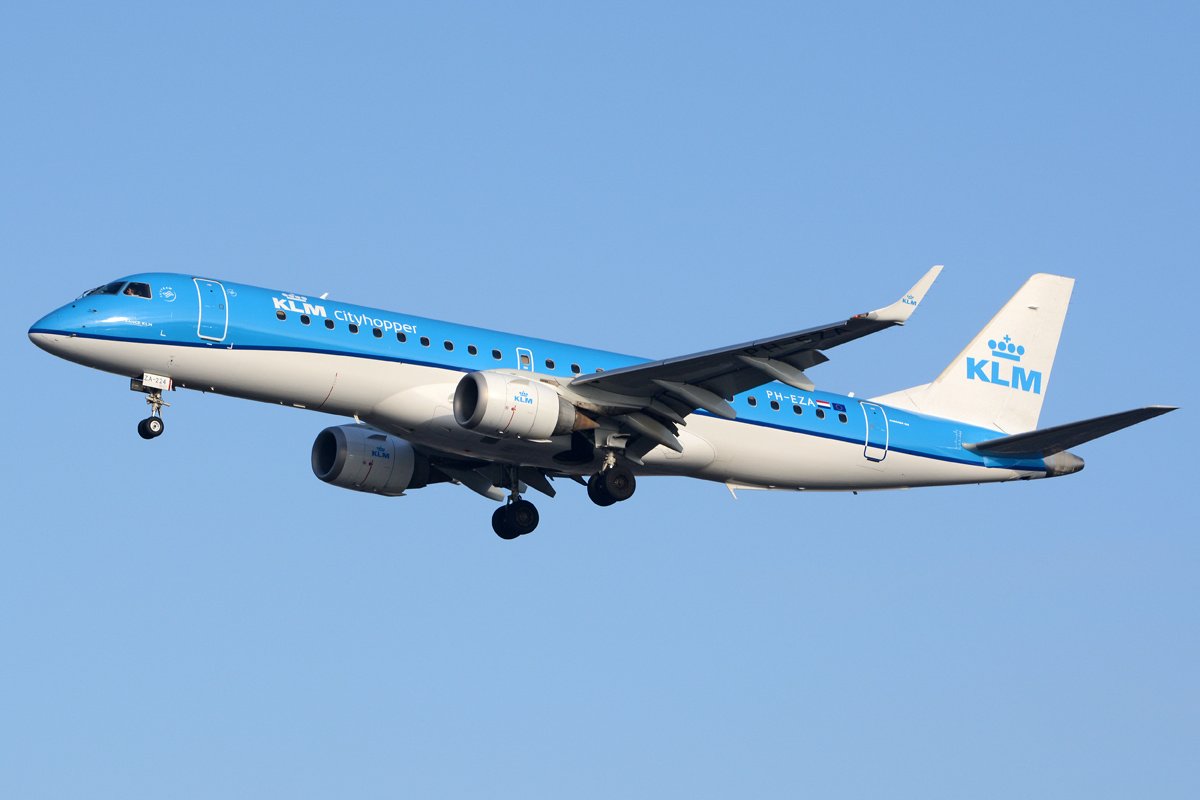
Commercial Dominance and Market Impact
The E190-E2 entered commercial service on April 24, 2018, with Norwegian carrier Widerøe as its launch customer, marking a pivotal moment in regional aviation evolution. Within its first year of operation, Widerøe achieved an impressive 98.5% dispatch reliability with their E190-E2 fleet, demonstrating the aircraft's operational maturity. By June 2018, the airline's first three aircraft had accumulated 413 flight hours across 332 cycles while maintaining 99.35% dispatch reliability and 97.74% schedule reliability.
The aircraft quickly gained traction among regional carriers seeking improved economics on medium-range routes. Air Astana, Chinese GX Airlines, Helvetic Airways, Azul, and Virgin Australia Regional Airlines joined the growing operator base, recognizing the E190-E2's superior fuel efficiency and passenger comfort advantages over first-generation regional jets.
The Manufacturer: Embraer's Aviation Legacy
Empresa Brasileira de Aeronáutica S.A., commonly known as Embraer, launched the E2 program in November 2011 as an ambitious modernization of their successful E-Jet series. The Brazilian aerospace giant formally announced the program at the 2013 Paris Air Show, committing to deliver improved fuel consumption, reduced emissions, and enhanced passenger experience. Embraer's dedication to the project required extensive certification testing, accumulating 46,000 ground test hours and 2,200 flight hours before achieving type certification from Brazilian ANAC, FAA, and EASA authorities on February 28, 2018.
The company's persistence in regional aviation development has established Brazil as a major force in commercial aircraft manufacturing, competing directly with established manufacturers in the 100-150 seat market segment.
Engine Technology and Performance Breakthrough
The E190-E2's performance centers on its Pratt & Whitney PW1900G geared turbofan engines, each producing 98 kilonewtons (22,000 pounds) of thrust. These advanced powerplants feature 190-centimeter (73-inch) fans with a 12:1 bypass ratio, contributing significantly to the aircraft's fuel efficiency gains. The engines enabled Embraer to increase the aircraft's maximum range to 2,880 nautical miles in January 2018, exceeding original performance projections discovered during flight testing.
However, early operations revealed combustor life issues that were shorter than expected, requiring retrofitting of initial production aircraft before delivery to customers. Despite this early challenge, the PW1900G has proven reliable in service, contributing to the aircraft's strong dispatch reliability records.
Pilot and Operational Characteristics
The E190-E2 operates with a two-pilot crew and features modern avionics systems that reduce pilot workload while enhancing safety margins. The aircraft achieves a service ceiling of 41,000 feet and requires 1,615 meters for takeoff and 1,215 meters for landing, making it suitable for a wide range of airport environments. Its 13,500-liter fuel capacity supports the extended range capabilities that distinguish it from earlier regional jets.
Regulatory authorities granted ETOPS 120 approval in March 2024, allowing the aircraft to operate on extended overwater routes up to 120 minutes from suitable diversion airports, expanding its operational flexibility for airlines.
Production Achievements and Market Position
Embraer priced the E190-E2 at US$53.6 million in 2013, positioning it competitively against other regional jets in its class. The aircraft contributed to a significant production milestone when Embraer delivered the 1,900th E-Jet overall on September 8, 2025, an E190-E2 delivered to Virgin Australia Regional Airlines bearing a special commemorative decal.
The broader E-Jet family has accumulated over 1,900 orders, with approximately 300 aircraft remaining in the backlog as of 2025. The E190-E2's success has validated Embraer's strategy of evolutionary rather than revolutionary development, building upon proven designs while incorporating advanced technologies.
Legacy and Future Impact
The E190-E2 has established itself as the foundation aircraft of the E2 family, paving the way for larger variants including the E195-E2, which received EASA certification in November 2023 as the largest aircraft approved for London City Airport operations. This regulatory achievement demonstrates the family's design versatility for challenging airport environments.
As airlines continue replacing older regional jets with more fuel-efficient aircraft, the E190-E2 represents the modern standard for 100-seat regional operations, combining operational economics with environmental responsibility that defines contemporary aviation requirements.