
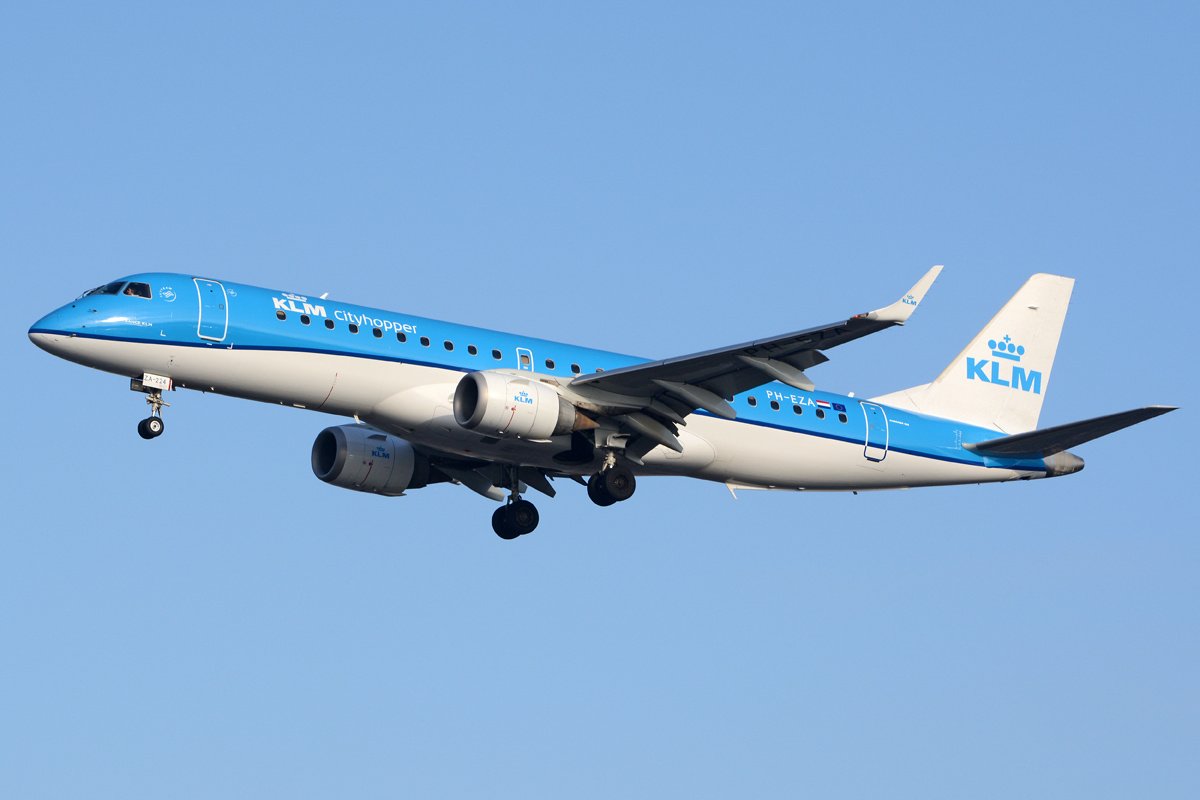
Service History
The E190 transformed regional aviation by offering mainline comfort in a right-sized aircraft for thin routes. JetBlue Airways became the launch customer with a substantial order of 100 aircraft in April 2003, taking their first delivery in 2005. The airline's enthusiastic adoption validated Embraer's vision of a larger regional jet that could compete with narrow-body aircraft on shorter routes.
By 2018, the entire E-Jet family had accumulated over 25 million flight hours with an impressive 99.9 percent dispatch reliability rate. The aircraft proved particularly successful in North America, where Embraer captured 80 percent of the 76-seat market share by 2018. Major operators included Air Canada, which configured their 45 E190s with 9 business class and 88 economy seats before retiring the type in May 2020, and American Airlines, which also retired their fleet in 2020.
The Manufacturer
Embraer, founded in 1969 as Empresa Brasileira de Aeronáutica, emerged from Brazil's government aerospace initiative before being privatized in 1994. The company had previously found success with the ERJ-145 regional jet series, but the E-Jet program represented a bold leap into larger aircraft categories.
The E-Jet family was announced as an entirely new design on June 14, 1999, at the Paris Air Show, initially designated as the ERJ-170/190 series. This marked Embraer's departure from previous ERJ derivatives toward a completely fresh approach to regional aviation. The company overcame initial certification delays and rollout challenges to establish rapid global support networks.
Engine & Technical Details
The E190 utilized twin GE CF34-10E high-bypass turbofan engines, which provided the reliability and fuel efficiency crucial for regional operations. These powerplants had proven themselves on earlier regional jets and offered operators familiar maintenance procedures and parts availability.
The aircraft featured a four-abreast narrow-body configuration that provided passengers with a more comfortable experience than typical regional jets of the era. The fuselage design allowed for larger overhead bins and wider aisles compared to three-abreast regional aircraft, while maintaining the efficiency advantages of a smaller aircraft.
Design innovations included modern avionics systems and improved aerodynamics that delivered better fuel efficiency than competing aircraft in the 100-seat category. The flight deck incorporated contemporary glass cockpit technology, reducing pilot workload and training requirements.
Production & Legacy
Production of the E190 began following certification, with the aircraft entering service in 2005. The broader E-Jet family reached significant milestones, with Embraer delivering the 1,500th E-Jet on December 18, 2018. While exact E190 production numbers remain part of the larger E-Jet total exceeding 1,700 aircraft, the variant represented a crucial component of the family's success.
The original E-Jet family spawned the next-generation E2 series, launched in June 2013. The E190-E2, which first flew on May 23, 2016, and received certification on February 28, 2018, offered 16 percent better fuel efficiency than the original E190. However, U.S. scope clauses limiting regional carrier aircraft size prevented widespread E2 adoption in the crucial American market.
Manufacturing continues at Embraer's São José dos Campos facility in Brazil, though production has shifted primarily to the E175 variant due to U.S. market restrictions on larger regional jets. The E175 remains popular with American regional carriers operating under major airline brands.
Current Operations
Hundreds of E190s remain in active service worldwide as of 2023. JetBlue continues operating the type as a key component of their fleet, while international carriers like Georgian Airways maintain E190 operations. The aircraft's versatility has allowed it to serve routes ranging from high-frequency shuttle services to longer regional routes that would be uneconomical for larger narrow-body aircraft.
The E190's success established Embraer as the third-largest commercial aircraft manufacturer globally, competing directly with Airbus and Boeing in specific market segments. The aircraft demonstrated that regional jets could offer passenger comfort approaching that of mainline aircraft while maintaining the operational economics necessary for thin route profitability.
The type's legacy continues through the E2 family, which incorporates lessons learned from nearly two decades of original E-Jet operations. The fundamental design philosophy pioneered by the E190 – bridging regional and mainline capabilities – remains relevant in contemporary airline route planning and fleet optimization strategies.