
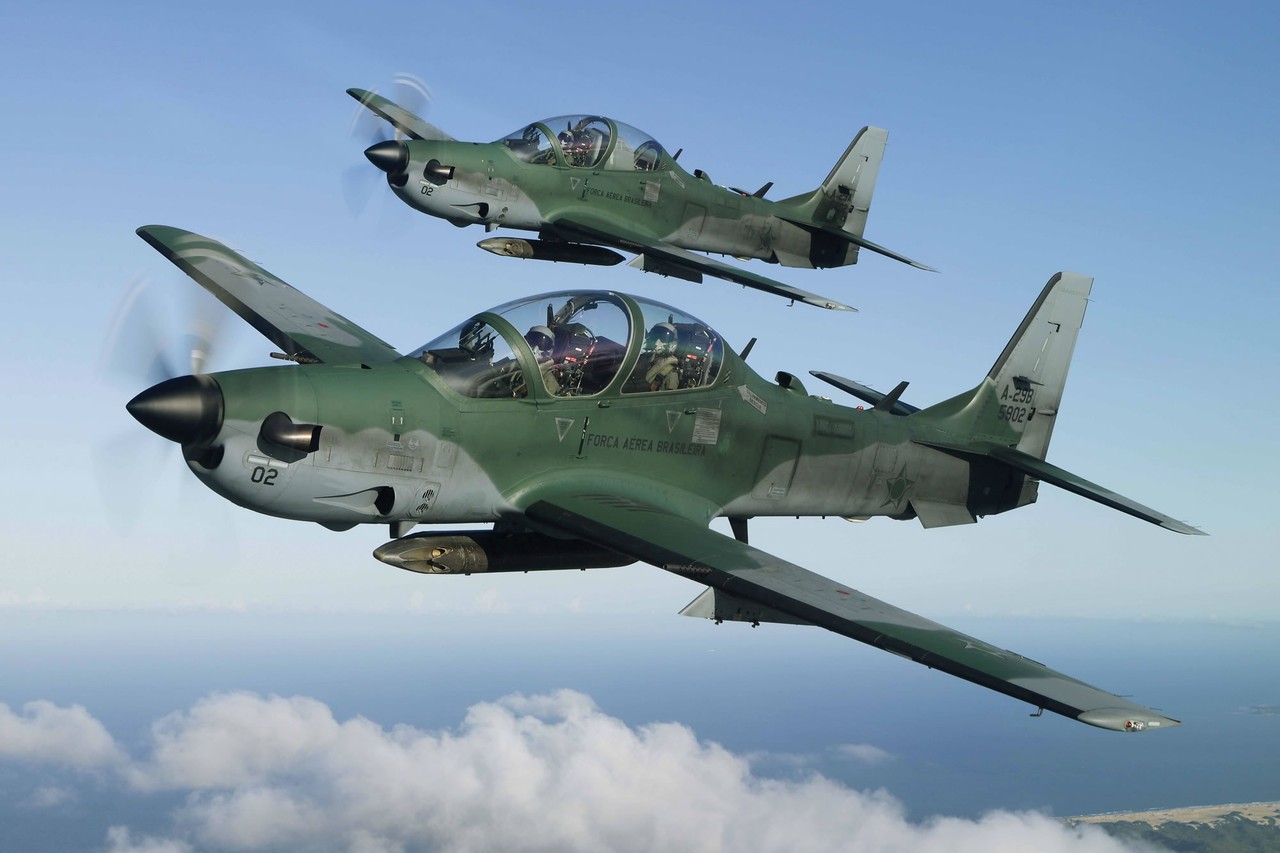
Service History
The Super Tucano entered Brazilian Air Force service in 2003 and quickly established itself as the dominant platform in the turboprop trainer market. By April 2023, more than 260 aircraft had been delivered to air forces across four continents, representing one of the most successful military aircraft export programs of the 21st century. The aircraft operates with 16 nations including Afghanistan, Angola, Chile, Colombia, Indonesia, Nigeria, and the Philippines, demonstrating its versatility across diverse operational environments and climate conditions.
Operational History
Beyond its primary training role, the Super Tucano has proven exceptionally capable in counter-insurgency operations and border patrol missions. The aircraft's combination of modern avionics, significant payload capacity, and relatively low operating costs made it particularly attractive to air forces conducting internal security operations. All variants feature Martin-Baker "zero-zero" ejection seats, allowing crew survival even at ground level with no forward speed—a critical safety feature for low-altitude combat missions.
The United States Air Force conducted extensive evaluations of the type, designated A-29, for potential light attack missions, while several South American air forces have employed the aircraft in anti-drug operations along remote border regions.
The Manufacturer
Embraer began as Empresa Brasileira de Aeronáutica in 1969 as a government-sponsored entity before transitioning to private ownership in 1994. The company had previously achieved international success with the original EMB-312 Tucano, which saw 650 aircraft built by 1998. This experience in the turboprop trainer market positioned Embraer perfectly to develop the more capable Super Tucano variant.
Today, Embraer remains one of the world's largest aircraft manufacturers, producing commercial airliners, military aircraft, and business jets. The Super Tucano program established the company's credentials in the international military market and continues to generate significant export revenue.
Development and Design
Development began in January 1991 under the initial designation EMB-312H, announced at the Paris Air Show in June 1991. The proof-of-concept prototype first flew on September 9, 1991, featuring a 1.37-meter fuselage extension, strengthened airframe, cockpit pressurization, and enhanced engine compared to the original Tucano. The extensive modifications necessitated redesignating the aircraft as EMB-314.
Two refined prototypes flew in 1993—the second on May 15 and the third on October 14—incorporating lessons learned from initial flight testing. A significant milestone came with the August 18, 1995 signing of a $50 million development contract for two single-seat prototypes, with the first flying in May 1996.
Engine and Technical Specifications
The production Super Tucano is powered by a Pratt & Whitney PT6A-68A turboprop engine producing 1,250 shaft horsepower, driving a four-bladed constant-speed propeller. The engine features single-level combined control for both throttling and propeller pitch adjustment, simplifying pilot workload. Earlier development variants utilized the more powerful PT6A-67R producing 1,424 shaft horsepower, while some configurations feature uprated versions generating up to 1,600 horsepower with five-bladed Hartzell propeller systems.
The aircraft carries 694 liters of internal fuel and meets both FAR Part 23 Appendix A and military specifications. The stepped tandem cockpit configuration provides excellent visibility for both instructor and student, while the low-mounted wing design contributes to the aircraft's fully aerobatic capabilities.
Production and Legacy
Production commenced in February 2002 at Embraer's Brazilian facilities, with first deliveries beginning in December 2003. The Brazilian Air Force formalized its commitment with an order for 76 aircraft plus 23 options on August 8, 2001. International production expanded to include OGMA in Portugal and Sierra Nevada Corporation in the United States for A-29 export variants.
The Dominican Republic Air Force became the first export customer, ordering 10 aircraft on August 20, 2001. Initial market projections estimated potential sales of 500 aircraft over 10 years—a target that proved conservative given the aircraft's continued production success more than two decades after first flight.
The Super Tucano's success stems from its optimal balance of performance, cost-effectiveness, and operational flexibility. Unlike pure jet trainers, its turboprop powerplant provides realistic preparation for pilots destined for transport and utility aircraft while offering genuine combat capability for light attack missions. The aircraft represents the evolution of military aviation training from simple flight instruction to comprehensive mission preparation, incorporating modern avionics and weapons systems in a proven, reliable platform.