
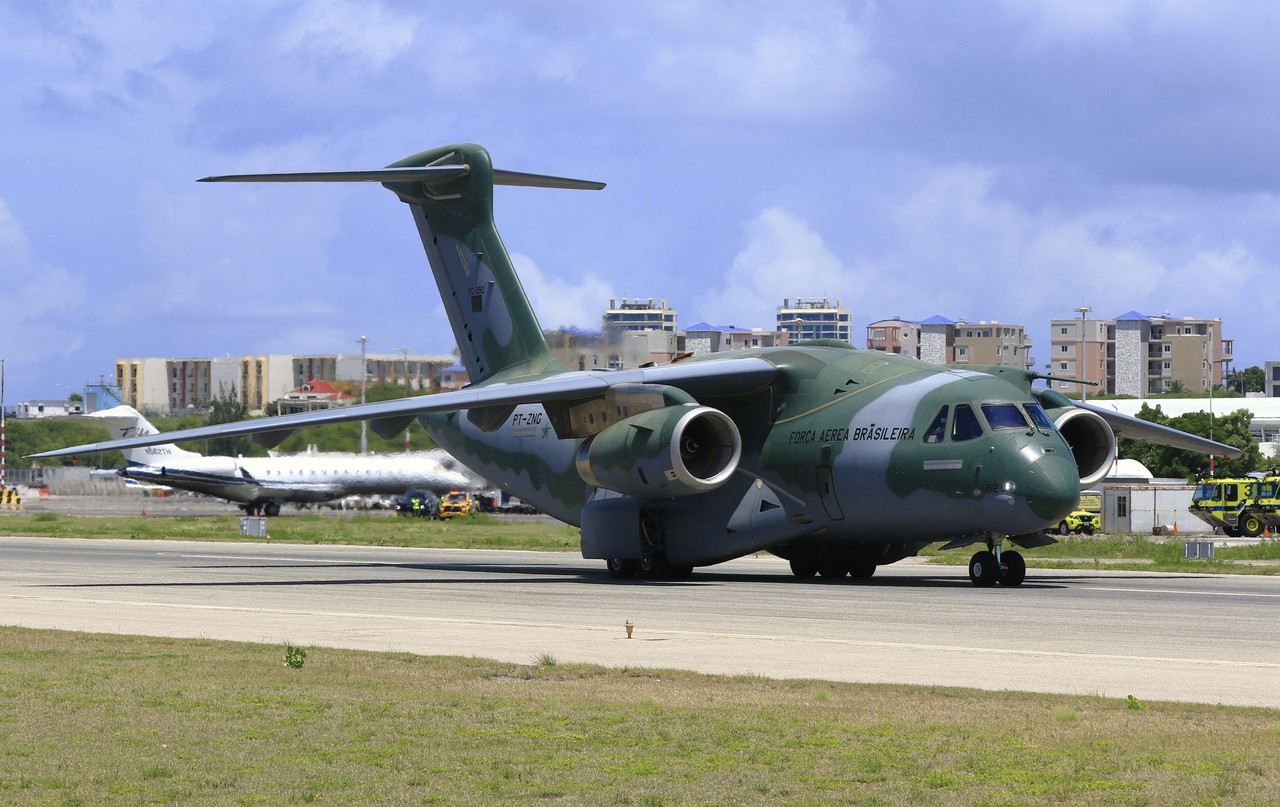
Breaking into the Military Transport Market
The C-390 Millennium emerged from Embraer's strategic decision in the mid-2000s to penetrate the lucrative military transport sector, historically dominated by American and European manufacturers. On April 14, 2009, the Brazilian government awarded Embraer a $1.5 billion contract for two prototypes, marking the company's most ambitious military project to date. The aircraft achieved its maiden flight on February 3, 2015, from Embraer's facility in Gavião Peixoto, Brazil.
Unlike competitors that relied on incremental improvements to decades-old designs, Embraer developed the C-390 entirely from scratch. The company deliberately avoided adapting its successful E190 airliner, instead creating new fuselage, wing, and flight deck designs optimized for military operations. This clean-sheet approach enabled incorporation of modern technologies unavailable to older transport aircraft designs.
Service with the Brazilian Air Force
The Brazilian Air Force became the launch customer with an initial order for 28 aircraft announced at the 2010 Farnborough Airshow. The first production C-390 completed its maiden flight on October 6, 2018, followed by delivery to the Brazilian Air Force on September 4, 2019. Within the first 3.5 years of operational service, Brazilian C-390s accumulated over 8,200 flight hours across 6,000 flights, achieving an impressive 99.5 percent mission completion rate and approximately 80 percent technical availability.
The aircraft demonstrated its versatility through various mission profiles including cargo transport, medical evacuation, and humanitarian relief operations. During the COVID-19 pandemic, Brazilian C-390s transported medical supplies and equipment across South America, proving the aircraft's operational value beyond traditional military roles.
Embraer's Manufacturing Heritage
Embraer, founded in 1969 as Empresa Brasileira de Aeronáutica, established itself as Brazil's premier aerospace manufacturer through decades of successful regional aircraft production. The company began manufacturing large aircraft in 1985 with the EMB Brasilia, gradually building expertise that culminated in the ambitious C-390 program. Unlike many aerospace companies that disappeared through consolidation, Embraer remains an independent Brazilian corporation and continues active C-390 production today.
The C-390 program showcased Embraer's ability to orchestrate complex international partnerships. Major subcontractors included Argentina's Fábrica Argentina de Aviones for the tail cone and cargo door, BAE Systems for the fly-by-wire flight control system, and Rockwell Collins for avionics integration. Boeing briefly partnered with Embraer from 2012 to 2013 for marketing rights in key regions, though their joint venture announced in November 2019 dissolved within six months.
Turbofan Technology Advantage
The C-390's most significant technical innovation lies in its powerplant selection: two International Aero Engines V2500-E5 turbofans, each producing 31,330 pounds of thrust. This marked the V2500 engine's first military application and represented a fundamental departure from the turboprop engines powering competing aircraft like the C-130 Hercules. The turbofan configuration provides higher cruise speeds and improved fuel efficiency at typical transport altitudes.
Rockwell Collins supplied the advanced Line Fusion Suite avionics package, integrating modern glass cockpit displays with sophisticated navigation and communication systems. BAE Systems developed the fly-by-wire flight control system, replacing traditional mechanical controls with electronic interfaces that reduce pilot workload and improve safety margins during challenging military operations.
Operational Performance
Pilots praise the C-390's modern cockpit design and automated systems that significantly reduce crew workload compared to older transport aircraft. The fly-by-wire system provides consistent handling characteristics across the flight envelope, while the turbofan engines deliver smooth power delivery and reduced noise levels. The aircraft's 21-metric-ton cargo capacity matches or exceeds many competing designs while offering superior speed and altitude performance.
The C-390 achieved Brazilian civil type certification on October 23, 2018, meeting stringent FAR Part 25 Air Transport Category standards equivalent to U.S. Federal Aviation Regulations. This certification level, typically reserved for commercial airliners, demonstrates the aircraft's advanced safety systems and structural integrity.
International Expansion
Embraer's global ambitions for the C-390 include establishing international production capabilities. In April 2023, Brazil and Portugal announced plans for potential C-390 assembly in Portugal by OGMA to serve European customers. This strategy mirrors successful aerospace companies that establish regional production to reduce costs and improve customer support.
The aircraft's designation evolved from KC-390 to C-390 Millennium in November 2019, reflecting Embraer's focus on the global market beyond Brazil's initial tanker requirements. As of recent production reports, Embraer has manufactured at least four aircraft including two prototypes, with additional units progressing through the production pipeline to fulfill Brazil's 28-aircraft order and anticipated international sales.
Legacy and Future Prospects
The C-390 Millennium represents Brazil's successful entry into the exclusive club of nations capable of designing and manufacturing large military transport aircraft. Its modern systems and performance capabilities position it as a credible alternative to aging C-130 fleets worldwide, potentially capturing significant market share as military operators seek 21st-century replacements for their Cold War-era transports.