
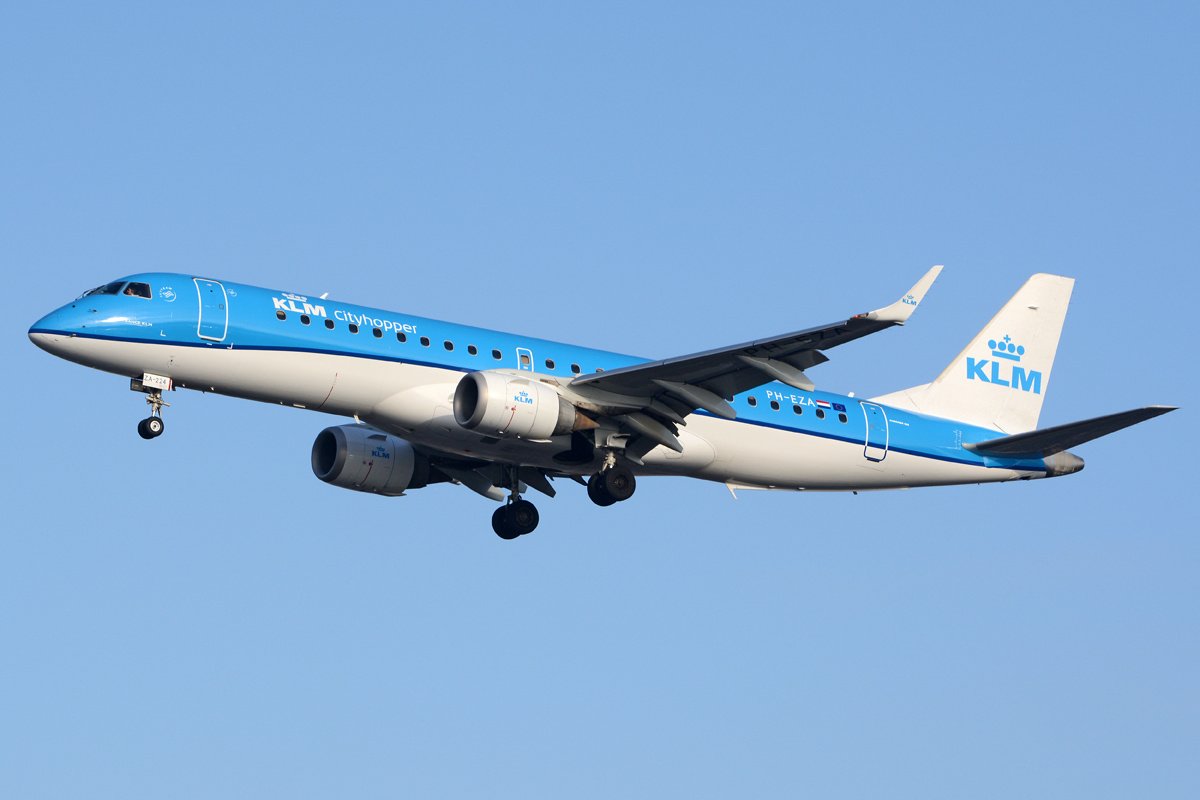
Market Transformation
The ERJ-170-200 fundamentally transformed regional aviation by filling the crucial 70-80 seat market segment that had been poorly served by existing aircraft. When Embraer launched the E-Jet program in March 1997, regional carriers were forced to choose between cramped 50-seat regional jets and oversized mainline aircraft. The E75S and its sister variants captured an remarkable 80 percent of the North American 76-seater market, demonstrating the aircraft's precise market positioning.
Development and Design Excellence
Embraer's engineering team, building on their success with the ERJ 135/145 family, designed an entirely new aircraft rather than simply stretching existing models. The program involved 16 risk-sharing partners and 22 suppliers beginning in 2000, representing a sophisticated international collaboration. The base E170 prototype achieved first flight on February 19, 2002, launching a comprehensive six-aircraft test program that led to rapid certification across Brazil, Europe, and the United States by February 2004.
The E75S variant features a stretched fuselage extending 1.78 meters beyond the base E170, optimizing passenger capacity while maintaining the aircraft's short-wing configuration for enhanced airport compatibility. This design decision proved prescient, as the short wing allows operations at airports with restricted gate spacing and taxiway limitations.
Embraer's Strategic Success
Founded by the Brazilian government in 1969 and privatized in 1994, Embraer leveraged the E-Jet family to become the world's third-largest aircraft manufacturer by the early 2000s, trailing only Boeing and Airbus. The company's São José dos Campos facility, where a dedicated E-Jet factory began full production in 2002, became the center of Brazil's aviation manufacturing excellence.
Boeing's attempted acquisition of Embraer's commercial aviation division between 2018-2020 ultimately collapsed amid regulatory challenges, allowing Embraer to maintain its independence and continue developing both first-generation E-Jets and the newer E2 series.
Technical Innovation
The ERJ-170-200's twin General Electric CF34-8E engines deliver exceptional reliability and efficiency. Each engine produces 62.3 kN of thrust, enabling the aircraft to achieve a maximum speed of Mach 0.78 and a service ceiling of 41,000 feet. The CF34 series, derived from the proven CFM56 core, contributed to the E-Jet family's outstanding 99.9 percent dispatch reliability record and accumulation of over 25 million flight hours by 2018.
The aircraft's 2,200 nautical mile range and 2,244-meter takeoff distance at maximum takeoff weight of 40,370 kilograms provide operators with exceptional flexibility for regional route networks. These performance characteristics allow efficient operation from smaller airports while maintaining schedule reliability on longer regional routes.
Commercial Service Record
LOT Polish Airlines pioneered E-Jet operations with the first E170 delivery on March 17, 2004, while Air Canada launched E75S operations in July 2005. The aircraft quickly gained traction with major operators including JetBlue, which ordered 100 E190s in 2003, and Republic Airlines, which received the 1,000th E-Jet on September 13, 2013.
Significant delivery milestones include Kenya Airways receiving the 900th E-Jet in October 2012, and Horizon Air taking delivery of the 1,500th E175 on December 18, 2018. These achievements underscore the sustained market demand for Embraer's regional jet concept.
Production Legacy
By December 2018, the broader E-Jet family reached 1,500 units delivered, with over 1,600 total deliveries achieved by recent counts. While exact production figures for the E75S variant alone remain proprietary, the overall program's success established Embraer's dominance in the regional jet market.
Currently, 114 Embraer 170-series aircraft, including E75S variants, remain in active service with 14 carriers worldwide according to recent ch-aviation data. The aircraft's continued relevance stems partly from US airline scope clause restrictions that limit larger regional jets, maintaining demand for the E75S's optimal size category.
Industry Impact
The ERJ-170-200 succeeded as Embraer's first all-new design of the 21st century, bridging the gap between the earlier ERJ family and today's E2 generation. Its comfortable four-abreast seating configuration and larger cabin windows addressed passenger comfort concerns that had limited earlier regional jets' acceptance.
Production continues for first-generation E-Jets due to their proven economics and scope clause compatibility, ensuring the E75S remains relevant in contemporary regional aviation markets. The aircraft's legacy lies not merely in its technical achievements, but in proving that emerging manufacturers could successfully challenge established players through focused innovation and market understanding.