
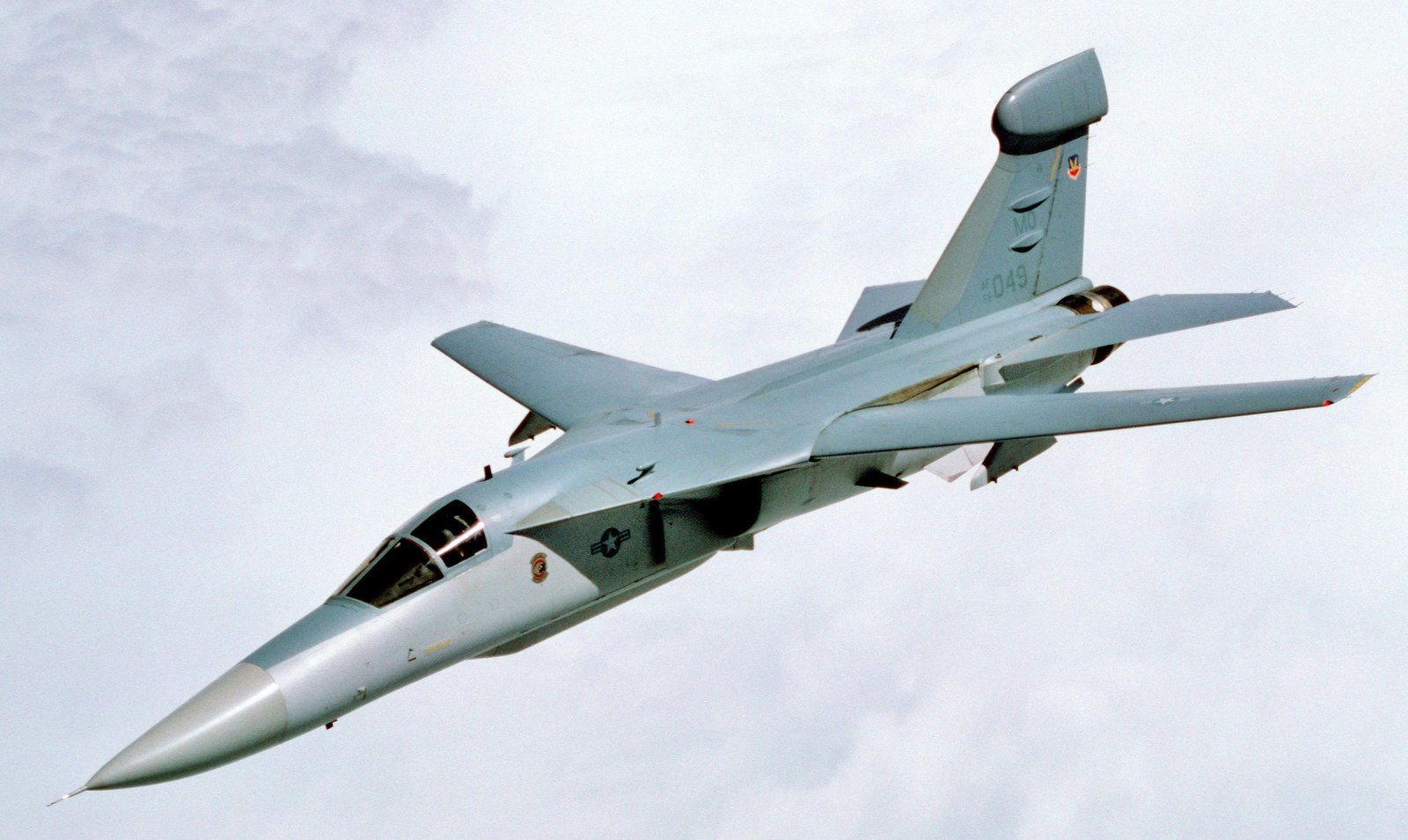
The General Dynamics EF-111A Raven was a specialized electronic-warfare conversion of the F-111A, developed by Grumman for the United States Air Force. Rather than being a clean-sheet design, the Raven program began in 1972, with the conversion contract awarded in 1974. The aircraft was designed to transform a high-speed tactical platform into a dedicated jamming asset capable of stand-off, escort, and penetration missions. This was achieved through the addition of fin-tip antennas and a large canoe-shaped radome located under the fuselage. The crew consisted of two members: a pilot and an Electronic Warfare Officer in the right seat, the latter of whom focused on managing the jamming suite rather than flight operations.
The first fully equipped prototype, designated the "Electric Fox," took its maiden flight on 10 March 1977. Production involved the conversion of 42 existing F-111A airframes, with deliveries to combat units starting in 1981 and concluding in 1985. Power was provided by two Pratt & Whitney TF30-P-109 afterburning turbofans, each capable of producing 20,840 lb of thrust. These engines allowed the EF-111A to reach a maximum speed of 1,452 mph at high altitudes, with performance figures indicating Mach 1.2 at sea level and Mach 2.2 at 60,000 ft. The aircraft had a maximum takeoff weight of 87,478 lb and a service ceiling of 55,400 ft.
In military service, the Raven operated primarily with the 390th Electronic Combat Squadron, based first at Mountain Home Air Force Base in Idaho and later at Cannon Air Force Base in New Mexico. The EF-111A saw extensive combat deployment, including Operation El Dorado Canyon in 1986, Operation Just Cause in 1989, and Operation Desert Storm in 1991. During the latter, on 17 January 1991, Captains James Denton and Brent Brandon were credited with causing an Iraqi Dassault Mirage F1 to crash, marking the only aerial victory ever credited to an F-111-type aircraft. However, the conflict also saw the loss of aircraft 66-0023 on 13 February 1991, which crashed during an evasive maneuver, resulting in the deaths of Captains Douglas L. Bradt and Paul R. Eichenlaub. This was the only EF-111A lost in combat and one of only three lost throughout the type's history. The Raven also supported Operation Deliberate Force in the mid-1990s before being retired in June 1998. Today, a Raven is held in the collection of the National Museum of the U.S. Air Force, where it has been placed in storage.