
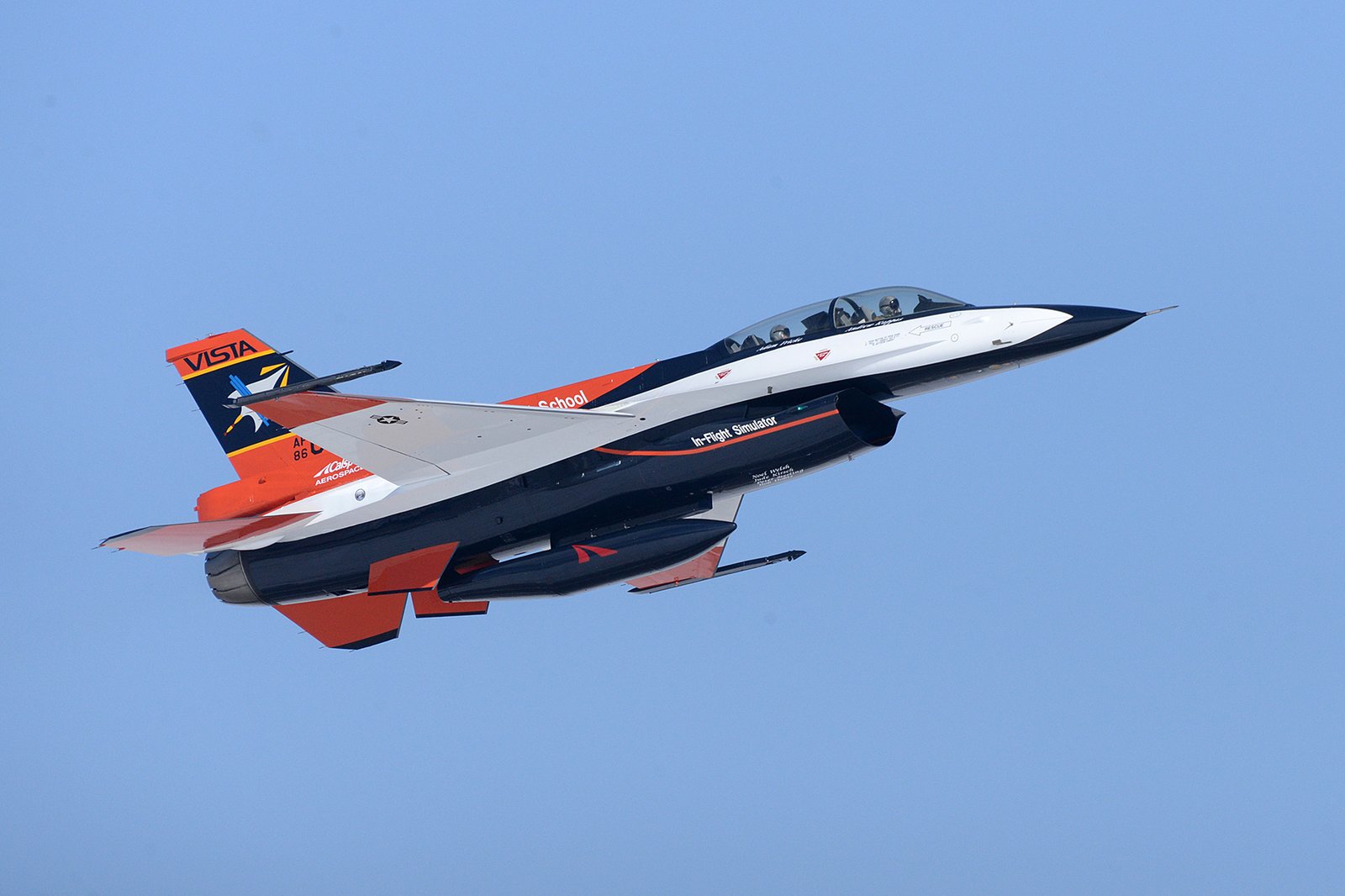
The General Dynamics X-62A VISTA is a one-of-a-kind experimental aircraft utilized by the U.S. Air Force Test Pilot School (USAF TPS) as a variable-stability, in-flight simulator and a sophisticated testbed for autonomy and artificial intelligence. The aircraft is based on a single General Dynamics F-16D Block 30 airframe, specifically USAF serial 86-0048. While the base airframe was produced by General Dynamics, the VISTA conversion and subsequent upgrades were conducted by Lockheed Martin Skunk Works in collaboration with the Calspan Corporation.
First flying in 1992 as the NF-16D VISTA, the aircraft became a cornerstone of the USAF TPS curriculum, allowing student test pilots to safely experience diverse stability and control characteristics. On June 14, 2021, the U.S. Air Force formally recognized the aircraft as a national asset and redesignated it as the X-62A, integrating it into the X-plane experimental series. The aircraft is powered by a single General Electric F110-GE-100 afterburning turbofan engine, which provides approximately 28,984 lbf of thrust.
The X-62A is distinguished by its VISTA Simulation System (VSS), which allows it to replicate the performance of other aircraft by altering flight-control laws in real time. Recent Mission Systems Upgrades (MSU) have integrated an AESA radar, open-systems mission computer architecture, and multiple datalinks, including TTNT, CMDL, and DAS. Furthermore, the integration of the System for Autonomous Control of the Simulation (SACS) has enabled the aircraft to support the Skyborg program and the Viper Experimentation and Next-gen Operations Model – Autonomy Flying Testbed (VENOM-AFT).
Operating out of Edwards Air Force Base, California, under the 412th Test Wing, the X-62A has achieved significant milestones in AI-controlled flight. In 2023, the aircraft was flown by an AI system in mock dogfights against a human-piloted F-16, marking a critical advancement in human-machine teaming. The aircraft typically carries a crew of two—a student test pilot and an instructor or safety pilot—though AI experiments may be conducted with only a safety pilot on board.