
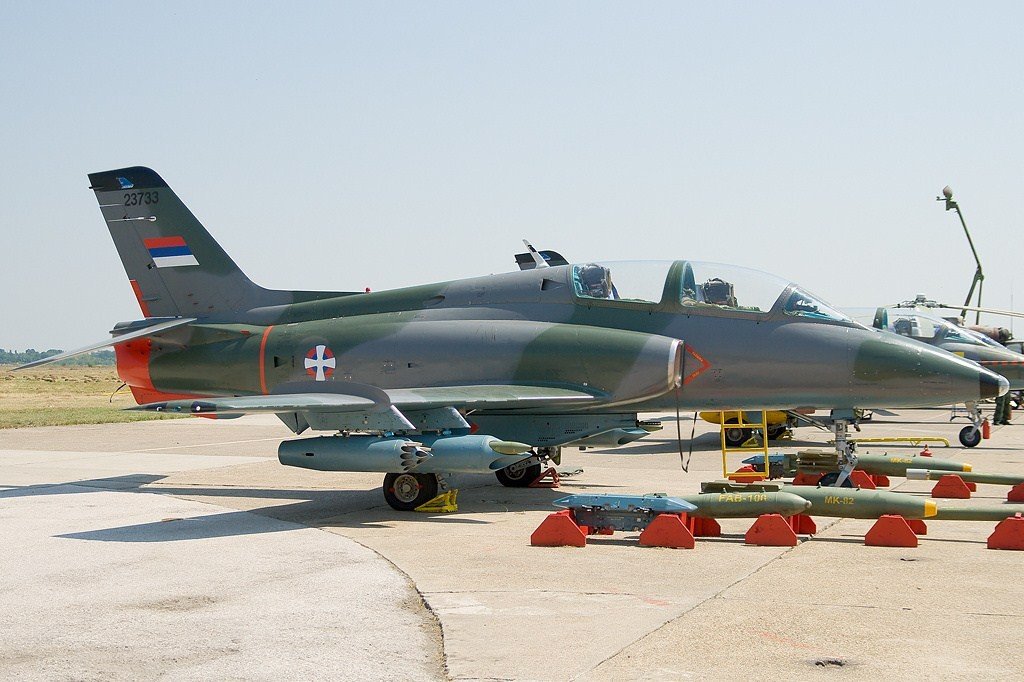
Design and Development
The SOKO G-4 Super Galeb, designated as the N-62 by the Yugoslav Air Force, was developed by the Aeronautical Technical Institute (VTI) at Žarkovo in Belgrade. Designed as a modern successor to the G-2 Galeb and a replacement for the Lockheed T-33 Shooting Star, the G-4 was intended to serve as a dual-role platform for advanced transitional training and light ground-attack missions. The aircraft first took flight on either July 17 or 18, 1978, depending on the source. It features a two-seat tandem cockpit and a single turbojet engine, offering enhanced performance and weapons capabilities compared to its predecessor.
Production History
Serial production of the G-4 was carried out by the SOKO aircraft factory in Mostar, Yugoslavia. While some records indicate production began in 1983, others state full production commenced in 1984. A total of 85 airframes were manufactured before production ceased in 1991 due to the outbreak of the Yugoslav civil war, which disrupted SOKO's operations. Following the conflict, SOKO ceased to exist as an active aircraft manufacturer.
Military Service and Combat
The G-4 saw extensive use during the Yugoslav wars of the 1990s, operating in combat roles over Bosnia and Croatia. It was employed primarily for close air support and light strike missions, utilizing unguided rockets and bombs. The aircraft is equipped with multiple underwing and fuselage hardpoints capable of carrying approximately 4,000 lb of external ordnance, and it can be fitted with a ventral gun pod containing a 23 mm GSh-23L twin-barrel cannon. Despite operating in environments with hostile air defenses, the G-4 demonstrated notable survivability; reports indicate only three or four aircraft were lost to enemy fire. One specific instance highlighted its robustness when an aircraft hit by a FIM-92 Stinger missile successfully returned to base and was repaired by replacing its entire rear section.
Performance and Legacy
Designed for efficiency and versatility, the G-4 reaches maximum speeds between 865 and 910 km/h, with a service ceiling ranging from 12,500 to 13,000 meters and a range of 1,300 to 1,800 km. The aircraft remains in limited service today, operated by the Serbian Air Force (approximately 24 units), the Montenegro Air Force (approximately 17 units), and the Myanmar Air Force (6 units, with one reported as operational). To extend its service life, a modernization project known as the G-4MD has been proposed to upgrade the aircraft's avionics. A preserved example of the type is currently on display at the Aeronautical Museum in Belgrade.