
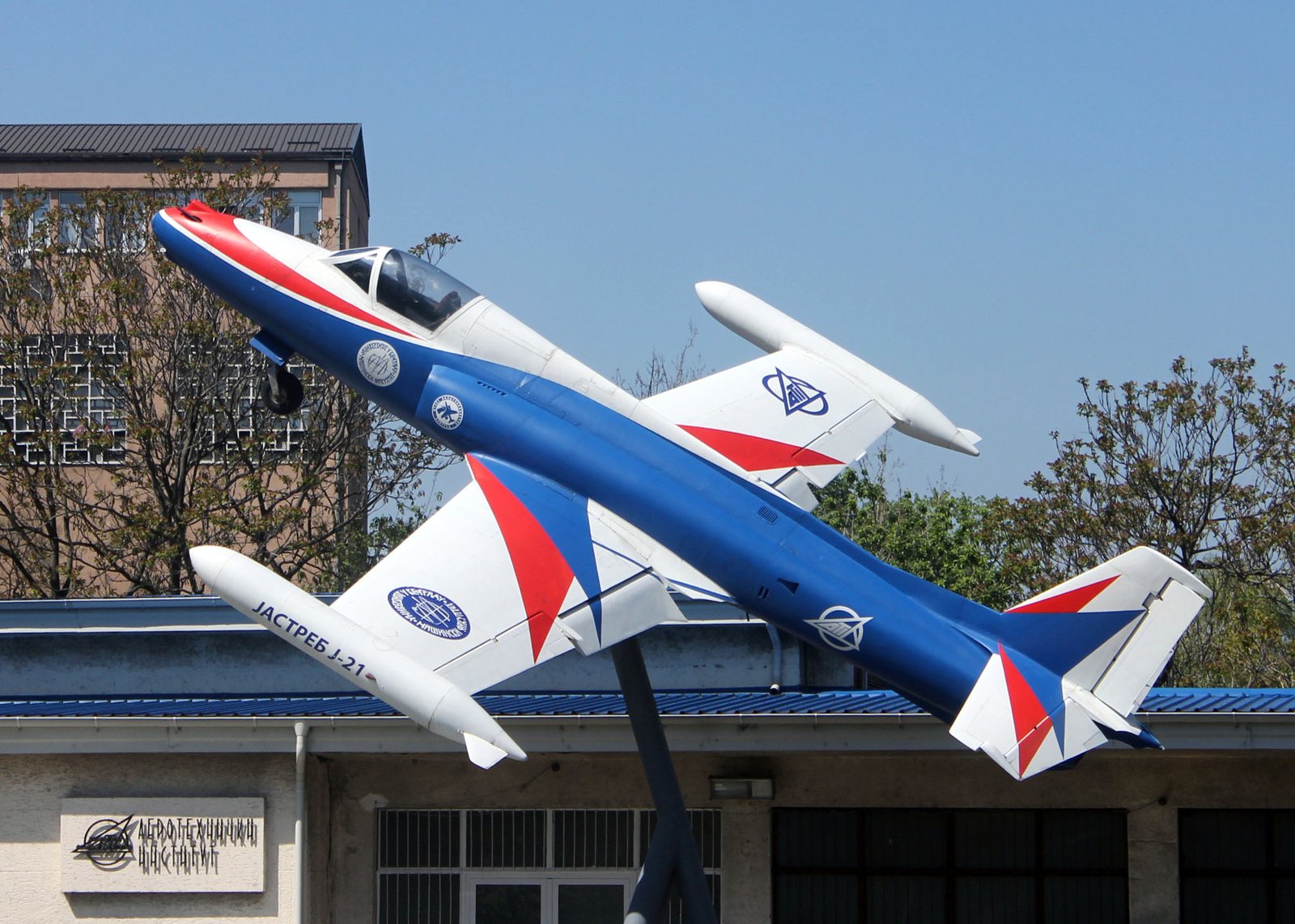
The Soko J-21 Jastreb was developed as a single-seat light attack and reconnaissance aircraft, derived from the G-2 Galeb trainer. Designed by the Military Technical Institute (VTI) and the Aeronautical Technical Institute (ATI) in Belgrade, the J-21 was optimized for ground-attack missions rather than training. It featured a more powerful engine and heavier armament than its predecessor to effectively engage invading columns. The aircraft first flew on July 19, 1965, and officially entered service with the Yugoslav Air Force on December 31, 1968, where it gradually replaced the American-supplied F-84G Thunderjets.
Production took place at the SOKO factory in Mostar, located in the Socialist Republic of Bosnia and Herzegovina, SFR Yugoslavia. Series production occurred between 1968 and 1977, with a total of 121 airframes built. The aircraft was powered by a single turbojet engine, providing a maximum speed of 820 km/h and a service ceiling of 11,500 meters. Its armament consisted of three 12.7 mm Browning AN/M3 heavy machine guns and eight hardpoints capable of carrying up to 2,000 lb of rockets and bombs.
Beyond Yugoslavia, the J-21 saw extensive export service. Operators included the Libyan Air Force, the Zaire Air Force, and the Zambia Air Force. Several variants were produced to meet different operational needs: the J-21E for export, the RJ-21 and RJ-21E for tactical reconnaissance, and the NJ-21, a two-seat advanced weapons trainer.
The J-21's combat history is extensive. During the Yugoslav Wars of the 1990s, it was used for close air support in Croatia and Bosnia and Herzegovina; notably, some Serbian J-21s were shot down by USAF F-16s during Operation Deliberate Force in 1995. It also saw action in the First Congo War (1996–1997) under Zaire and was operated by the Free Libyan Air Force during the 2011 Libyan Civil War. Today, very few aircraft remain in service. One notable surviving airframe was converted into an artificial reef off the coast of Croatia near the island of Krk.