
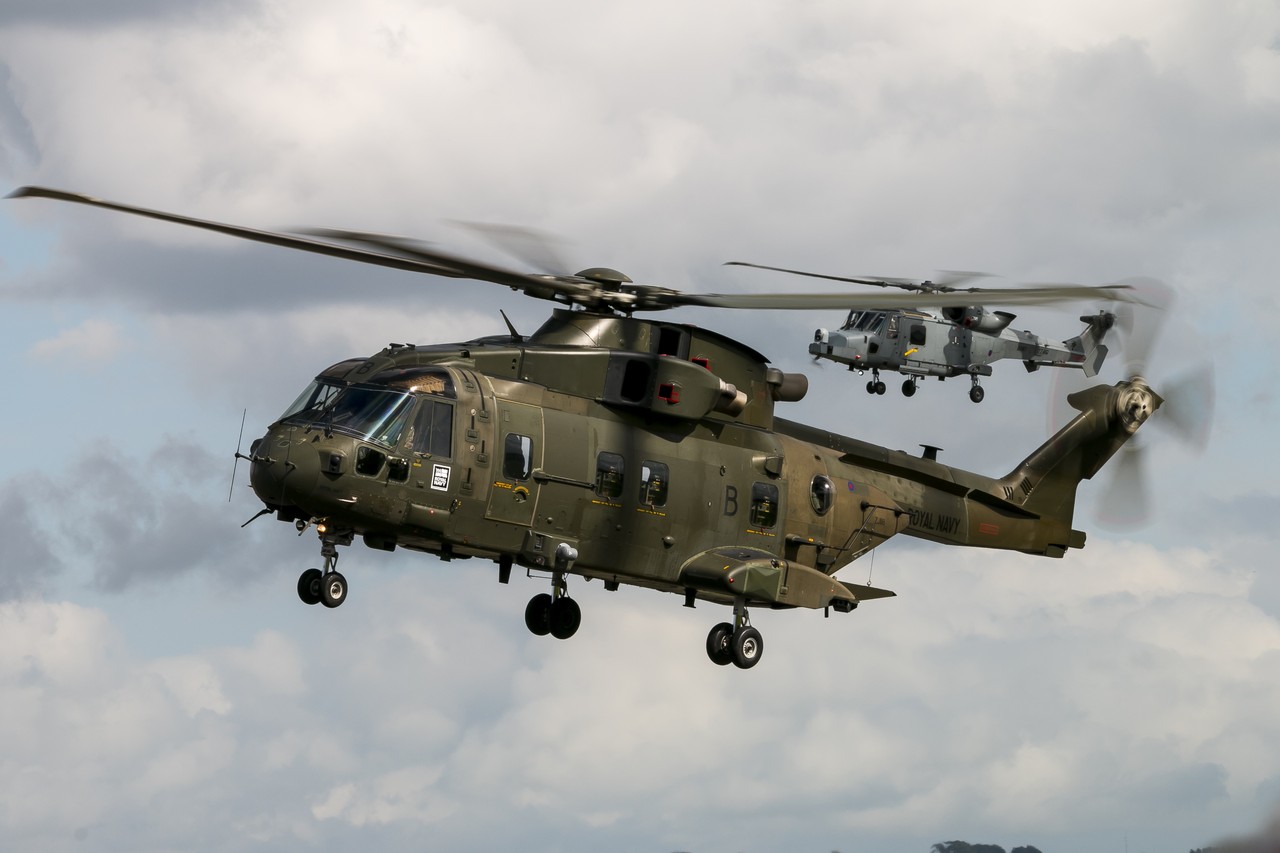
Service History
The AW159 Wildcat achieved initial operational capability with the British Army on August 29, 2014, followed by Royal Navy certification in January 2015. By the end of 2015, the United Kingdom had established full operational capability with 62 aircraft delivered—34 AH1 variants for battlefield reconnaissance and utility missions with the British Army, and 28 HMA2 maritime variants for the Royal Navy's anti-surface warfare and anti-submarine operations.
The helicopter has accumulated over 100,000 fleet flight hours by June 2024, demonstrating its reliability in challenging operational environments. During extensive trials, Wildcat crews completed 390 deck landings, including 148 at night and 76 using night vision goggles, proving its maritime capabilities aboard naval vessels.
International Operations
Beyond British service, the Republic of Korea Navy became the first export customer, receiving their initial deliveries in 2016. Korean Wildcats operate with specialized armament including K745 Blue Shark torpedoes, Spike NLOS missiles, and Thales FLASH dipping sonar systems. The Philippine Navy acquired two units with serials ZZ549 and ZZ550, while Algeria has placed orders with deliveries expected to complete around 2027.
By 2022, over 70 Wildcats had been delivered worldwide, with broader estimates reaching 100 units including all export variants. The helicopter's versatility allows it to fulfill diverse mission profiles from battlefield reconnaissance to maritime patrol, search and rescue, and anti-submarine warfare.
The Manufacturer
Leonardo Helicopters, originally AgustaWestland, developed the Wildcat at their Yeovil facility in Somerset. The company formed in 2000-2001 through the merger of Italy's Agusta and Britain's Westland Helicopters, later rebranding as Leonardo in 2016-2017 following parent company Finmeccanica's corporate restructuring.
Westland, founded in 1915 as Westland Aircraft Works, had pioneered British helicopter production after World War II and created the original Lynx helicopter in the 1970s. Today, Leonardo employs over 3,300 people at Yeovil specifically for Wildcat production and support, maintaining the aircraft's manufacturing heritage while serving as part of Italy's aerospace industry giant.
Engine and Technical Innovation
The Wildcat's propulsion comes from two LHTEC CTS800-4N turboshaft engines, each producing 1,361 horsepower for a combined output of 2,722 horsepower. LHTEC, a joint venture between Honeywell and Rolls-Royce established in 1983, designed these engines to provide exceptional power-to-weight ratios enabling the helicopter's impressive 10.1 meters per second climb rate.
Key innovations include BERP IV main rotor blades, fully integrated avionics with tactical processors, and advanced sensor suites. The maritime variants feature Seaspray 7000E radar and L-3 Wescam MX-15Di forward-looking infrared systems, while specialized variants carry HELRAS or FLASH dipping sonars for anti-submarine operations.
Performance and Pilot Experience
The Wildcat measures 15.24 meters in length with wings extended, reducing to 13.49 meters with rotors folded for shipboard storage. Its 12.80-meter wingspan narrows to a 3.05-meter fuselage width, with an overall height of 3.73 meters. The main rotor disc encompasses 128.7 square meters.
With an empty weight of 3,300 kilograms, the helicopter achieves a maximum cruise speed of 264 kilometers per hour and maintains a service ceiling of 4,570 meters. Standard range extends to 490 kilometers on internal fuel, expanding to 963 kilometers in ferry configuration. Mission endurance typically lasts 2 hours and 30 minutes under standard conditions.
Production and Legacy
Production commenced in October 2007, with the first production aircraft flying in April 2011. Manufacturing continues as of 2026, with Leonardo restarting production lines to fulfill export contracts including Algeria's order. A scheduled total of 78 units represents the current production target, though broader international interest may expand this figure.
The Wildcat's armament flexibility allows operators to configure aircraft for specific mission requirements. Army variants typically mount two FN MAG 7.62mm machine guns, while naval versions carry M3M .50 caliber weapons. Advanced variants can deploy Martlet lightweight multirole missiles, Stingray torpedoes, or Mk.11 depth charges depending on operational needs.
As the modern successor to the proven Lynx family, the AW159 Wildcat represents British helicopter engineering's evolution into 21st-century multirole operations, combining traditional reliability with advanced avionics and weapons systems suitable for contemporary military requirements.