
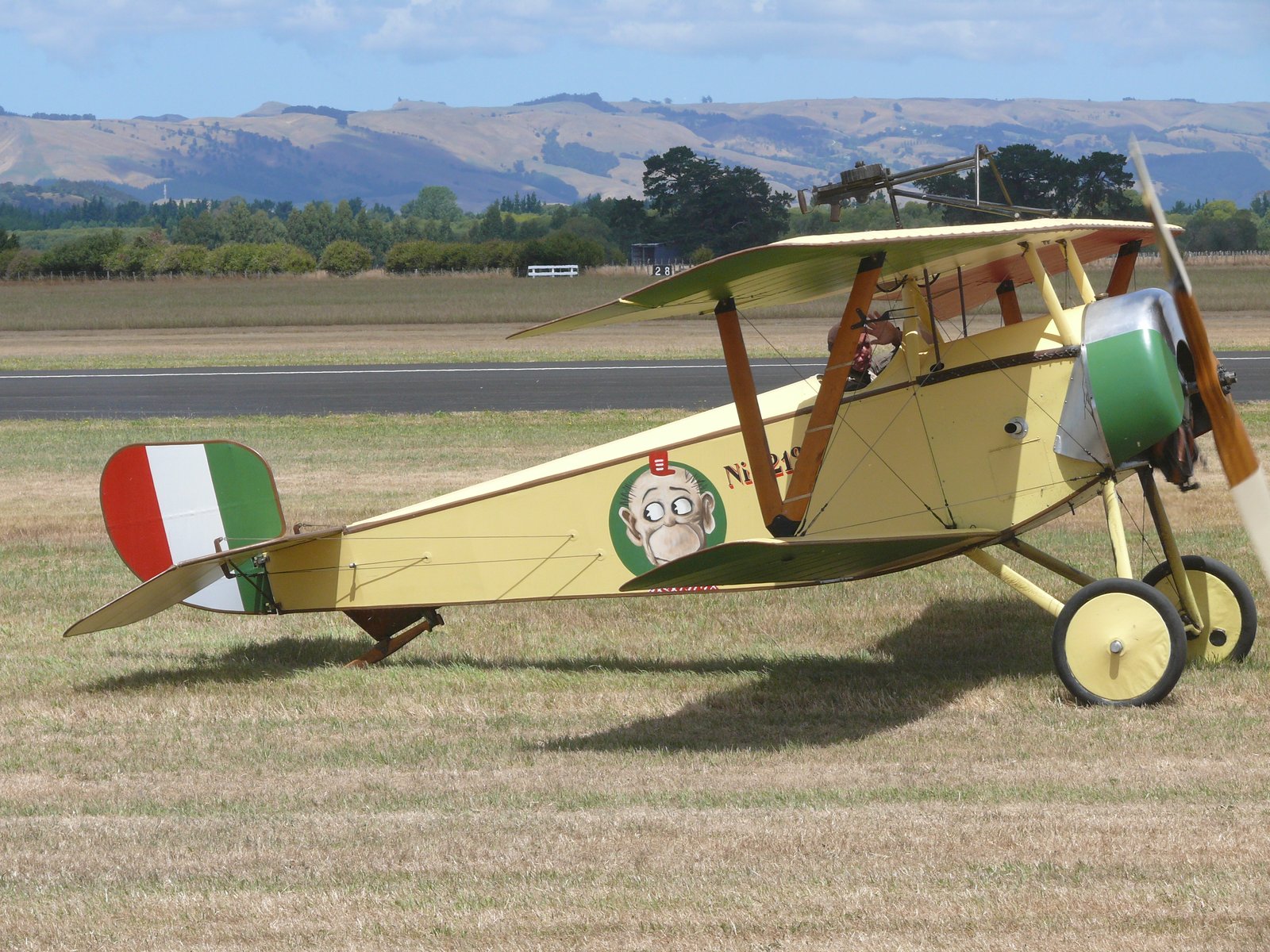
The Nieuport 11 was a French single-seat sesquiplane fighter designed by Gustave Delage. Originally conceived as a racing aircraft, the design was adapted into a fighter to meet the urgent demands of wartime aviation. The aircraft became a cornerstone of Allied aerial strategy during World War I, specifically noted for its role in reversing German air dominance over the Western Front in early 1916, a period known as the Fokker Scourge.
Production began in France through the Nieuport company. While the total number of aircraft produced is unknown, the type saw significant licensed production in Italy, where the company Macchi manufactured 646 units. The aircraft entered frontline service in January 1916, with 90 units already operational on the French front within that first month. This rapid deployment allowed the Nieuport 11 to play a major role during the Battle of Verdun in February 1916.
Technically, the Nieuport 11 was powered by a single Le Rhône 9C piston rotary engine. It was designed for agility and lightness, featuring a characteristic vee-strut wing arrangement that influenced subsequent Nieuport fighter designs. For armament, the aircraft typically carried one Lewis machine gun mounted above the wing center section, allowing the pilot to fire clear of the propeller arc. Some specialized versions were further modified to carry Le Prieur rockets on the struts, which were utilized for attacks against airships and observation balloons.
Operational use extended across several Allied nations. The Aéronautique Militaire of France, the Royal Naval Air Service of Britain, the Imperial Russian Air Service, and the Aviation Militaire Belge of Belgium all utilized the type. Additionally, the Corpo Aeronautico Militare of Italy operated the aircraft, and at least one unit was transferred from the RNAS to Romania in 1916. The aircraft was flown by several prominent French aces, including Charles Nungesser, Georges Guynemer, and de Rose, and was also employed by the Lafayette Escadrille.
Performance specifications for the aircraft include a top speed of 97 mph, a range of 155 miles, and a service ceiling of 15,000 feet. By March 1916, the Nieuport 11 began to be replaced by the improved Nieuport 17. Although it was largely superseded by newer fighters by late 1916 and 1917, many remained in service as trainers. Today, the aircraft's legacy is preserved through reproductions, such as the 1962 example built by Joseph Pfiefer and Walter Addems in Porterville, California, which is housed at the San Diego Air & Space Museum.