
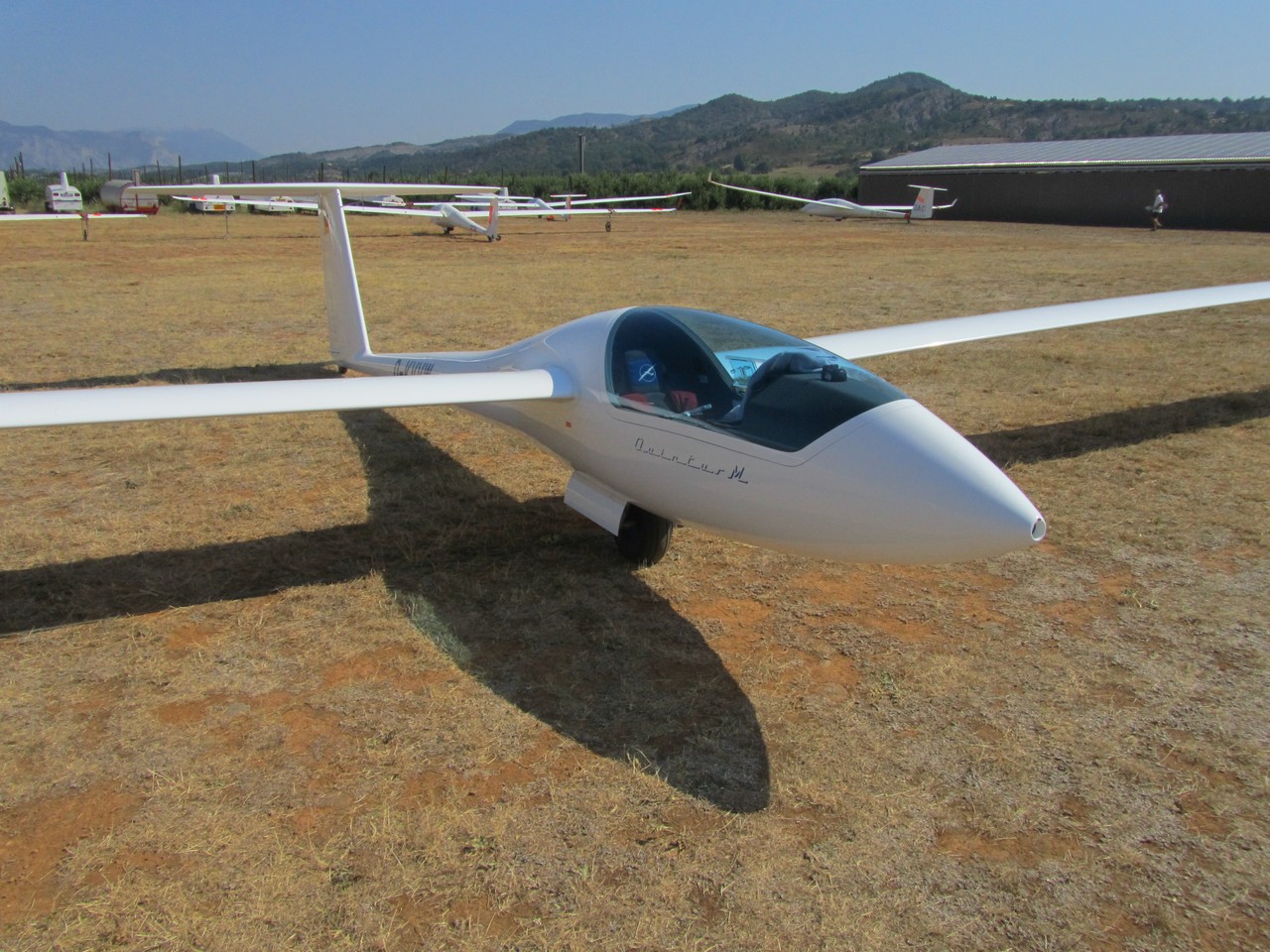
Revolutionary Design Philosophy
The Quintus emerged from an unconventional approach to sailplane design that challenged decades of conventional wisdom. While most glider manufacturers pursued lighter wing loadings for better performance, the joint development team from Lange Aviation and Schempp-Hirth deliberately engineered the Quintus with a wing loading of 58 kilograms per square meter—20 percent higher than competing designs. This radical departure was specifically intended to improve climb rates in thermal conditions, targeting the demanding Open-Class competition market where every advantage matters.
Professor Loek Boermans of Delft University of Technology contributed crucial aerodynamic expertise to the 18-meter inner wing sections, while the outer panels feature Maughmer winglets for enhanced efficiency. The resulting wing employs the advanced Delft DU 97-127/15 airfoil across its 14.7 square meters of surface area.
Manufacturing Heritage
Schempp-Hirth brought eight decades of sailplane manufacturing experience to the Quintus project. Founded on January 4, 1935, by Martin Schempp and Wolf Hirth in Göppingen, Germany, the company began with just four employees in municipal construction facilities. By year's end, the workforce had grown to 25 people including two apprentices, necessitating relocation to larger facilities in Kirchheim/Teck during 1937-1938.
The company's resilience became evident during World War II, when Schempp-Hirth manufactured DFS Habicht training gliders and Messerschmitt Bf 109 tailplane assemblies. Post-war Allied restrictions forced a complete production shift to civilian goods including beds, wheelbarrows, radio cabinets, and furniture until 1951, when aircraft manufacturing restrictions were lifted and sailplane production resumed.
Technical Innovation
The Quintus incorporates several advanced systems that distinguish it from conventional gliders. The 52.2-kilowatt Solo 2625-02i combustion engine provides self-launching capability, eliminating dependence on tow aircraft or ground-based winch systems. This piston powerplant enables the 500-kilogram empty-weight aircraft to reach operational altitude independently before engine shutdown for pure gliding flight.
With overall dimensions of 7.83 meters in length and the 23-meter wingspan creating an aspect ratio of 36, the Quintus achieves exceptional aerodynamic efficiency. The substantial water ballast capacity of 250 kilograms allows pilots to optimize wing loading for varying atmospheric conditions, bringing maximum takeoff weight to 850 kilograms.
Operational Characteristics
The Quintus features a steerable tailwheel landing gear configuration that enhances ground handling compared to conventional sailplane layouts. This design choice reflects the aircraft's role as a self-launching motorglider rather than a pure sailplane requiring ground support equipment.
The high wing loading that defines the Quintus translates into specific flight characteristics that experienced competition pilots appreciate in thermal soaring conditions. The increased wing loading allows faster penetration between thermals while maintaining the climb performance advantage that justified the unconventional design approach.
Production and Market Position
By February 2016, Schempp-Hirth had completed 15 Quintus aircraft, reflecting the specialized nature of the Open-Class competition market. Unlike mass-production general aviation aircraft, high-performance sailplanes serve a limited clientele of serious competition pilots and affluent recreational soaring enthusiasts willing to invest in cutting-edge technology.
The Quintus competes in the most demanding category of gliding competition, where regulations permit unlimited wingspan and sophisticated technical solutions. This Open-Class environment encourages manufacturers to pursue maximum performance regardless of complexity or cost, making aircraft like the Quintus testbeds for advanced aerodynamic concepts.
Legacy and Continuing Development
The Quintus represents Schempp-Hirth's commitment to pushing sailplane technology boundaries through international collaboration and university research partnerships. The successful integration of Delft University aerodynamic research with practical manufacturing expertise demonstrates how modern sailplane development requires both theoretical knowledge and decades of production experience.
While production numbers remain modest compared to training gliders or recreational aircraft, the Quintus influences broader sailplane development by proving that higher wing loadings can enhance rather than compromise thermal soaring performance. This counterintuitive finding challenges traditional design assumptions and opens new possibilities for future high-performance sailplane development.