
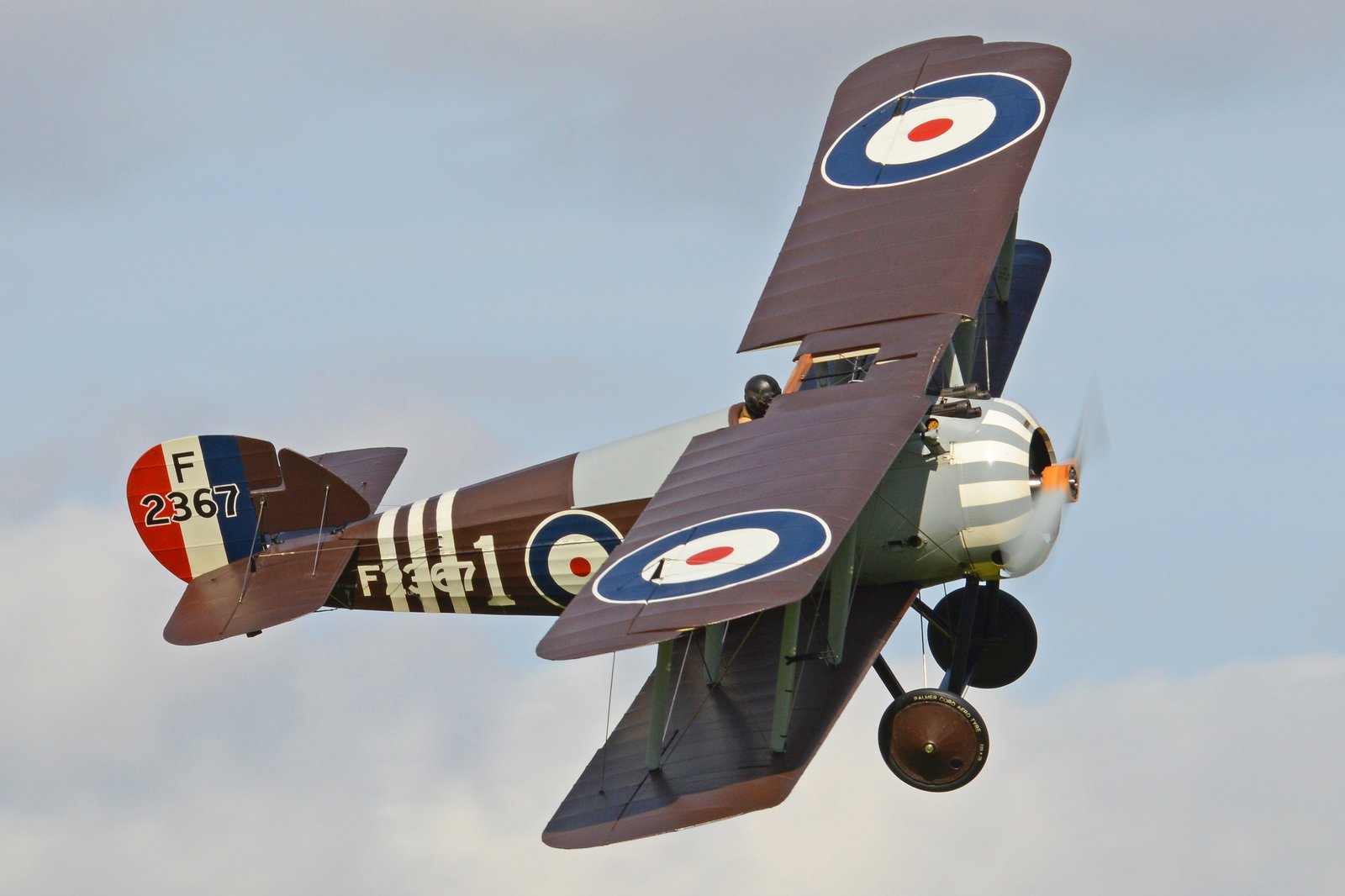
Design and Development
Designed by Herbert Smith of the Sopwith Aviation Company, the 7F.1 Snipe was conceived as the successor to the Sopwith Camel. The aircraft first flew in October 1917, utilizing a design that prioritized stability and pilot ergonomics over the extreme agility of its predecessor. Notable improvements included a wider fuselage, larger wings, and a higher, more open cockpit that significantly enhanced the pilot's upward visibility. The Snipe was specifically engineered to exploit the power of the 230 hp Bentley B.R.2 nine-cylinder air-cooled rotary piston engine, making it one of the most advanced rotary-engined fighters of its era. While the first prototype utilized a 150 hp Bentley B.R.1, the production model standardized the more powerful B.R.2.
Production and Manufacturing
Production began in the spring of 1918. While some literature suggests production totals as high as 1,500 to 1,550 units, more precise records indicate that 497 airframes were completed, as a larger Air Ministry order of 1,700 was drastically reduced at the end of the war. Manufacturing was distributed across several contractors, including the Sopwith Aviation Company in Kingston-upon-Thames, Nieuport & General Aircraft Co. Ltd. in Cricklewood, and Ruston, Proctor & Co. Ltd. in Lincoln.
Military Service
The Snipe entered squadron service on the Western Front on August 30, 1918, though fewer than 100 aircraft reached France before the Armistice. It served primarily as a fighter-escort and air superiority aircraft, though it could carry four small bombs (ranging from 9 kg to 11 kg) for light ground-attack missions. One of the most famous actions involving the type occurred on October 27, 1918, when Canadian ace Major William George Barker, VC, flying with No. 201 Squadron RAF, engaged approximately 15 Fokker D.VII fighters, shooting down three and earning the Victoria Cross.
Post-war, the Snipe became the standard single-seat fighter for the RAF, serving in a night-fighter capacity until 1926, with two-seat trainer variants remaining in service until 1927. Other operators included the Canadian Air Force (No. 1 Squadron) until 1923 and the Brazilian Navy, which operated 12 aircraft. The type also saw action during the British occupation of Germany and the Commonwealth intervention in the Russian Civil War (1919–1920), where at least one aircraft was captured by Bolshevik forces.
Technical Specifications and Legacy
The Snipe featured a wingspan of 31 ft 1 in and achieved a maximum speed of approximately 195 km/h (121 mph) with a service ceiling of 5,945 m (19,500 ft). Its armament consisted of two synchronized 0.303 in Vickers machine guns. Today, only two original complete airframes survive: E8102 at the Canada Aviation and Space Museum and E8105, also preserved in Canada. A 1982 reproduction is displayed at the Museum of Flight in Seattle.