
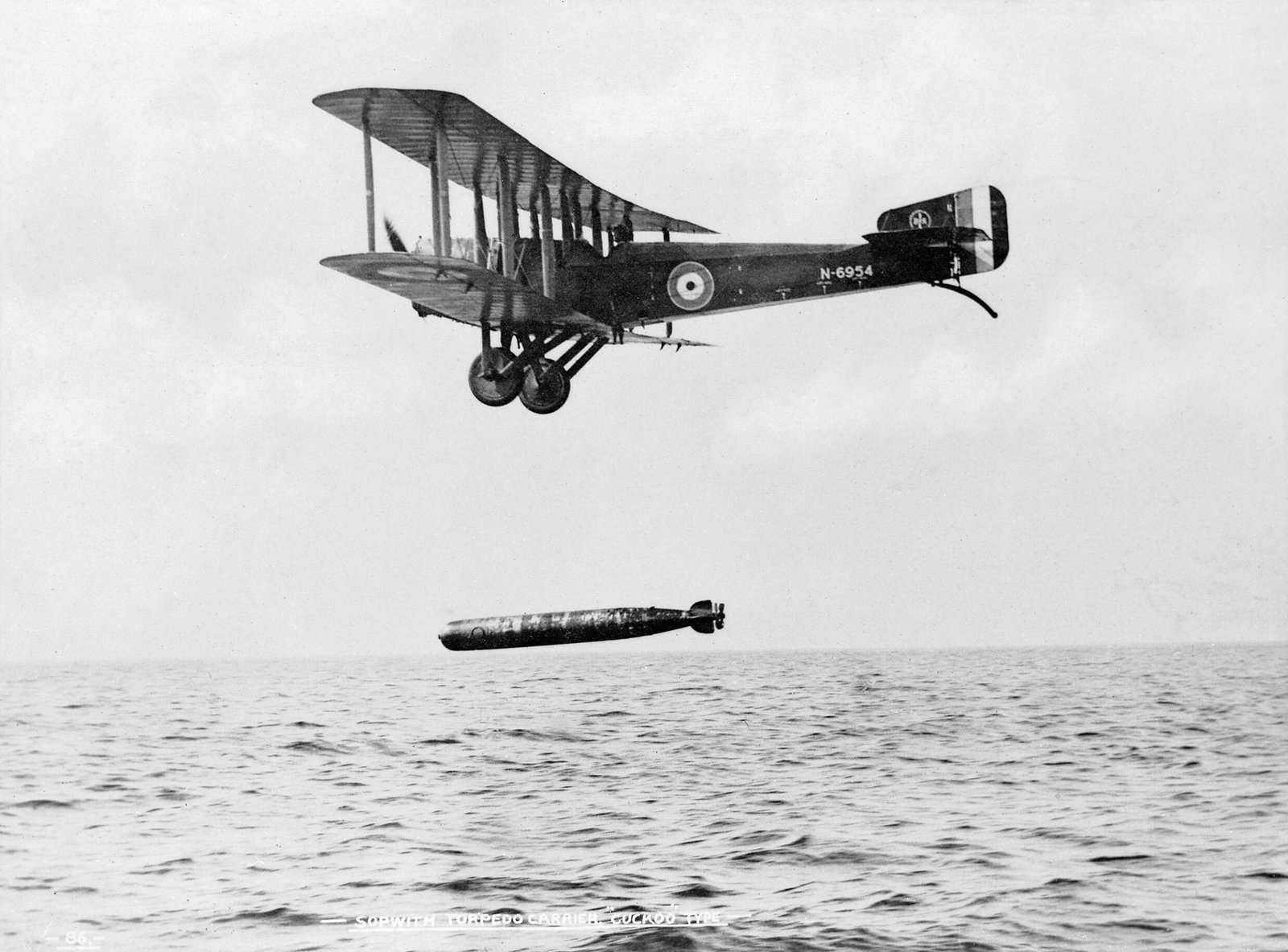
The Sopwith Cuckoo was a groundbreaking development in naval aviation, designed as the first wheeled torpedo-carrying aircraft intended for operation from aircraft carriers. Developed for the Royal Naval Air Service (RNAS) and the Admiralty, the aircraft's requirements were defined with the involvement of Commodore Murray Sueter. The design was led by Sopwith's chief designer, Herbert Smith, resulting in a single-seat biplane capable of carrying a standard 18-inch (45.7 cm) Mark IX torpedo under the fuselage.
The prototype was approved for test flight on June 6, 1917, and flew shortly thereafter. While the Sopwith Aviation Company handled the initial design and prototypes, the bulk of production was subcontracted due to wartime pressures. Production began in February 1918, with the first aircraft delivered in May 1918. A total of 232 aircraft were completed by 1919: 162 by Blackburn Aeroplane & Motor Co. Ltd., 50 by Fairfield Engineering, and 20 by Pegler & Co. Many of these airframes were delivered directly to storage depots in Newcastle and Renfrew.
Technical specifications for the Mk I variant centered on the Sunbeam Arab, a water-cooled V-8 piston engine producing 200 hp. This powerplant allowed the Cuckoo to reach a maximum speed of 103.5 mph at 2,000 feet and a service ceiling of 12,100 feet. Due to reliability issues with the Arab engine, some airframes were later re-engined with the Wolseley Viper (a derivative of the Hispano-Suiza 8) to create the Cuckoo Mk II. The aircraft had a range of 335 miles and an endurance of approximately four hours.
Despite its innovative role, the Cuckoo did not see combat during World War I. British naval planners had envisioned a strike of 100–120 aircraft launched from carriers such as HMS Argus, HMS Furious, HMS Campania, HMS Courageous, and HMS Glorious to attack the German High Seas Fleet, but the Armistice occurred before these operations could be executed. Notably, on July 4, 1918, a Cuckoo performed the first torpedo release from a land-based aircraft during trials in the Firth of Forth. The aircraft served in training and experimental roles—including a small batch of six Mk IIs used by the Imperial Japanese Navy—until it was declared obsolete in 1923. No complete airframes survive today, though the National Museum of Flight in Scotland retains some wing sections.