
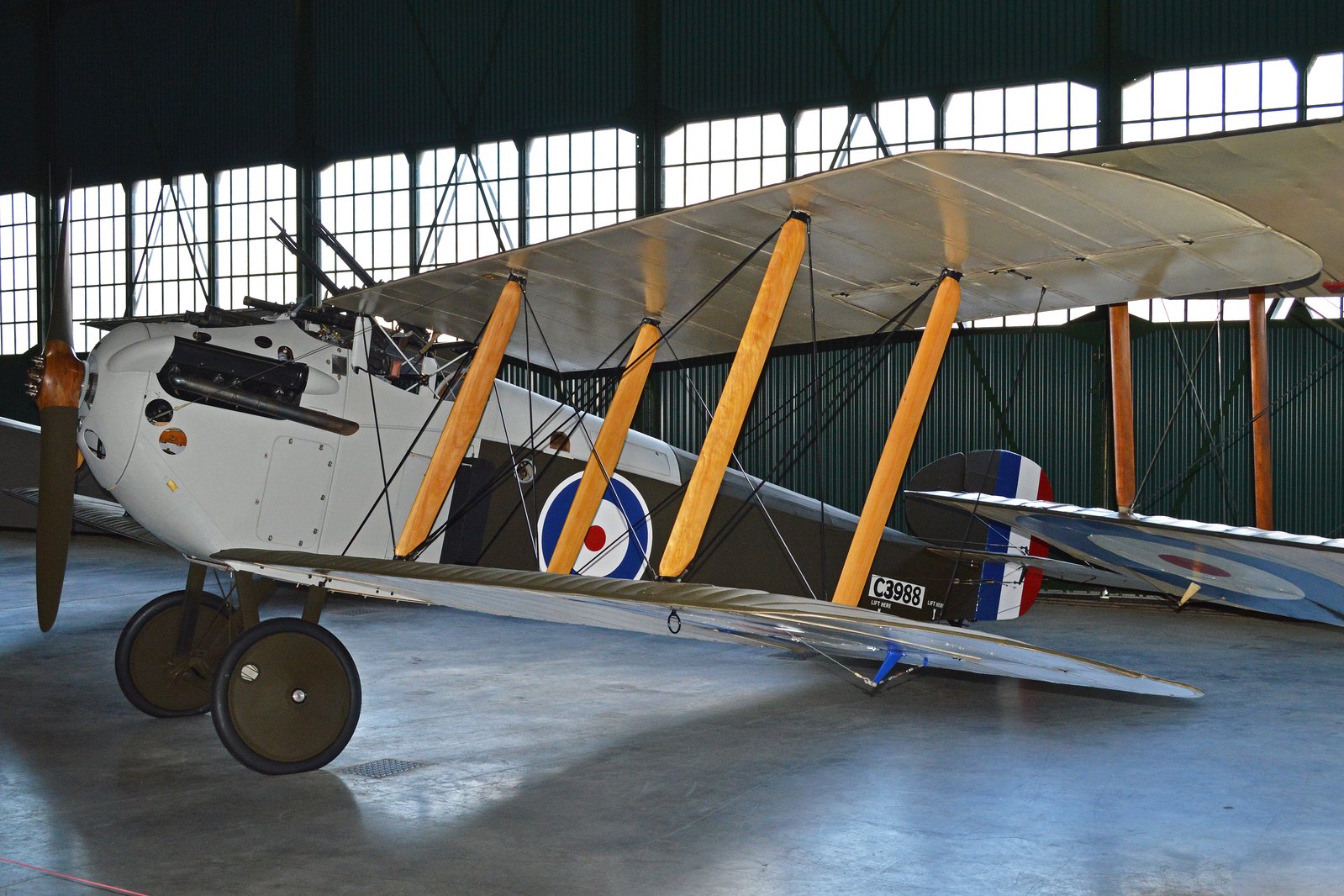
The Sopwith 5F.1 Dolphin was a technically innovative single-seat fighter developed by the Sopwith Aviation Company during the latter stages of World War I. Designed under the direction of chief designer Herbert Smith, the aircraft represented a significant departure from previous Sopwith fighters like the Camel and Pup by utilizing a liquid-cooled inline engine rather than a rotary powerplant. The prototype first flew at Brooklands in 1917, introducing several unconventional design features intended to improve combat effectiveness.
One of the most striking characteristics of the Dolphin was its back-staggered wing layout, where the upper wing was positioned behind the lower wing. This configuration, combined with a low-mounted upper wing and a high cockpit position, provided the pilot with exceptional all-round visibility. Furthermore, the Dolphin is recognized as the world's first single-seat multi-gun fighter; it was equipped with two synchronized .303 in Vickers machine guns in the fuselage and featured a cross-bar above the cockpit capable of supporting two additional .303 in Lewis guns, allowing for a total of four forward-firing weapons.
Production took place at Sopwith's works in Kingston-upon-Thames, Surrey, England, between 1917 and August 1919. While exact production totals are not firmly documented in primary sources, literature suggests approximately 2,072 Mk.I aircraft were ordered, with roughly 1,500 airframes completed. However, many of these lacked engines by the time of the Armistice due to reliability and supply issues with the geared 200 hp Hispano-Suiza 8-series V-8 engines.
The Dolphin entered service in late 1917, with initial frontline patrols beginning in February 1918. It was operated by five Royal Air Force squadrons, including No. 19, No. 23, and No. 79 Squadrons. The aircraft served as both a high-altitude fighter and a ground-attack platform, carrying light bombs during the German Spring Offensive of 1918. American pilot Francis "Frank" Gillet achieved the highest known success with the type, recording 20 victories. The aircraft was declared obsolete in September 1921. Today, no complete airworthy examples survive, though the RAF Museum Cosford preserves a significant artifact: the fuselage of serial C3988.