
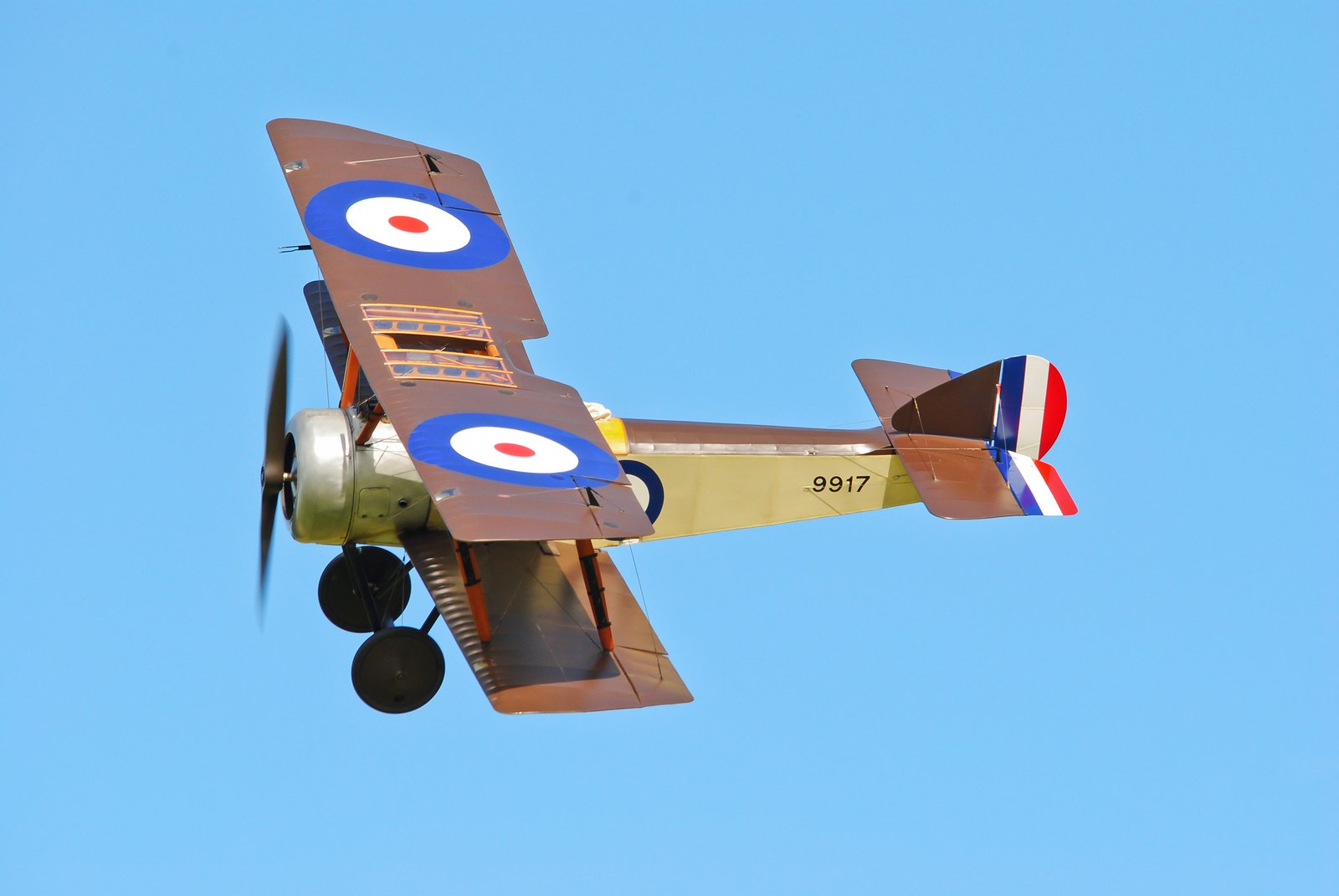
The Sopwith Pup was the first single-seat fighter developed by the Sopwith Aviation Company, evolving from a personal aircraft flown by Harry Hawker in 1915. Designed under the leadership of Thomas Sopwith and chief designer Herbert Smith, the Pup first flew on February 9, 1916. It was characterized by its light, well-balanced controls and maneuverability, which made it a favorite among pilots and allowed it to compete effectively against German Albatros D.II, Fokker D.II, and Halberstadt D.II fighters during the 1916–1917 period.
Production occurred between 1916 and 1918 in the United Kingdom. While exact totals vary by source, estimates range from 1,575 to 1,796 aircraft. The majority were produced by subcontractors: the Standard Motor Company built approximately 850 units, Whitehead Aircraft Co. produced about 820, and William Beardmore & Co. contributed roughly 30, with the remainder built by Sopwith at Kingston-upon-Thames.
Technically, the Pup was powered by air-cooled rotary piston engines. The standard model utilized an 80 hp Gnome rotary engine, capable of reaching a maximum speed of 110 mph. To improve performance, particularly for Home Defence roles, many were up-engined with a 100 hp Gnome Monosoupape. The aircraft was typically armed with a single 0.303 in Vickers machine gun synchronized via Sopwith-Kauper mechanical interrupter gear, though some variants carried a Lewis gun and Le Prieur rockets for anti-Zeppelin missions.
Operational service began in October 1916 with the Royal Naval Air Service (RNAS) and the Royal Flying Corps (RFC). The Pup was a pioneer in naval aviation; RNAS Squadron Commander E. H. Dunning used the type to become the first officer to land on a moving vessel, the HMS Furious, in 1917. Throughout the war, Pups were operated from five aircraft carriers and seven cruisers. On the Western Front, No. 8 (Naval) Squadron achieved 20 victories by the end of 1916, and the type saw heavy action during the battles of Cambrai, Messines, and Ypres.
By spring 1917, the Pup was outclassed by newer German fighters and was gradually transitioned to training and Home Defence duties. Post-war, eleven Pups were provided to the Australian Flying Corps in 1919 as part of the Imperial Gift, later serving as trainers for the Royal Australian Air Force until 1930. Civil use was negligible, with only eight aircraft ever appearing on the civil register. Today, the Pup's legacy survives through museum exhibits and replicas, including a 2002 replica at the Planes of Fame Air Museum and a reconstructed example at the Canada Aviation and Space Museum.