
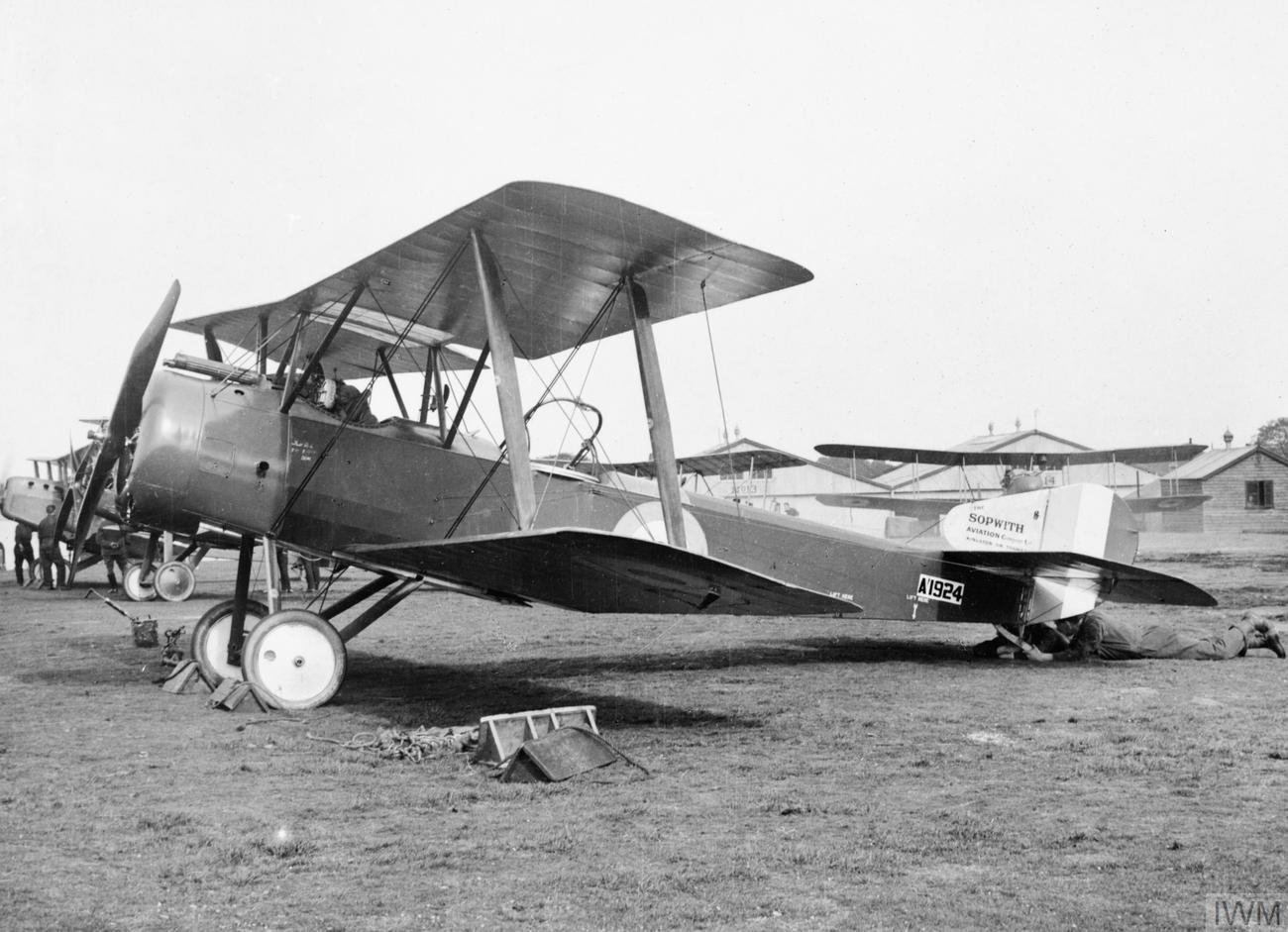
The Sopwith 1½ Strutter was a landmark in British aviation, serving as the nation's first two-seat tractor fighter and the first British aircraft to enter service equipped with a synchronized machine gun. This innovation, utilizing an interrupter gear, allowed the pilot to fire a forward-facing weapon through the propeller arc without causing damage. The aircraft was designed by Fred Sigrist under the leadership of T.O.M. Sopwith, who founded the Sopwith Aviation Company in 1912. The design evolved from a 1914 small biplane concept into a prototype designated the LCT (Land Clerget Tractor), which first took flight in December 1915.
The aircraft earned its distinctive name from its unusual cabane strut arrangement, which combined long and short struts to support the upper wing, visually resembling 'one-and-a-half' struts. Beyond its armament, the design featured technical advancements such as an adjustable tailplane and early pivoting surfaces that functioned similarly to dive brakes. The standard production model was powered by a single 110 hp Clerget 9B nine-cylinder rotary piston engine produced in France, allowing the aircraft to reach speeds of approximately 100 mph.
Production was extensive, with approximately 5,900 aircraft built across various factories. While Sopwith produced the aircraft at Kingston upon Thames in the United Kingdom, the majority were license-built in France, totaling roughly 4,500 examples. Smaller numbers were also manufactured in Japan and Russia. The 1½ Strutter entered service with the Royal Naval Air Service (RNAS) in April 1916 and the Royal Flying Corps (RFC) in July 1916. It played a vital role during the Battle of the Somme and formed the core of No. 3 Wing RNAS, the first unit established as a strategic bombing force.
Though highly effective in 1916, the aircraft faced rapid obsolescence as German fighter technology advanced. By the end of 1917, the RFC had replaced the Strutter in front-line units, though it continued to serve in home-defense roles—including as 'Comic' night fighters—and as trainers. Its utility extended globally; it was used by the Aéronautique Militaire in France, the U.S. Army Air Service, and saw action in the Russian Civil War, the Polish-Soviet War, and the Greco-Turkish War. It is documented to have appeared in military or civil service in at least 20 countries, including Brazil, Mexico, and Afghanistan.
Today, the legacy of the 1½ Strutter is preserved through a small number of surviving airframes and high-fidelity replicas. Only four original aircraft are known to exist. Notable reproductions include a replica of aircraft A8226 at the Royal Air Force Museum, built to original factory drawings, and two flying examples at the Military Aviation Museum in Virginia Beach, including one used in the 2006 film Flyboys.