
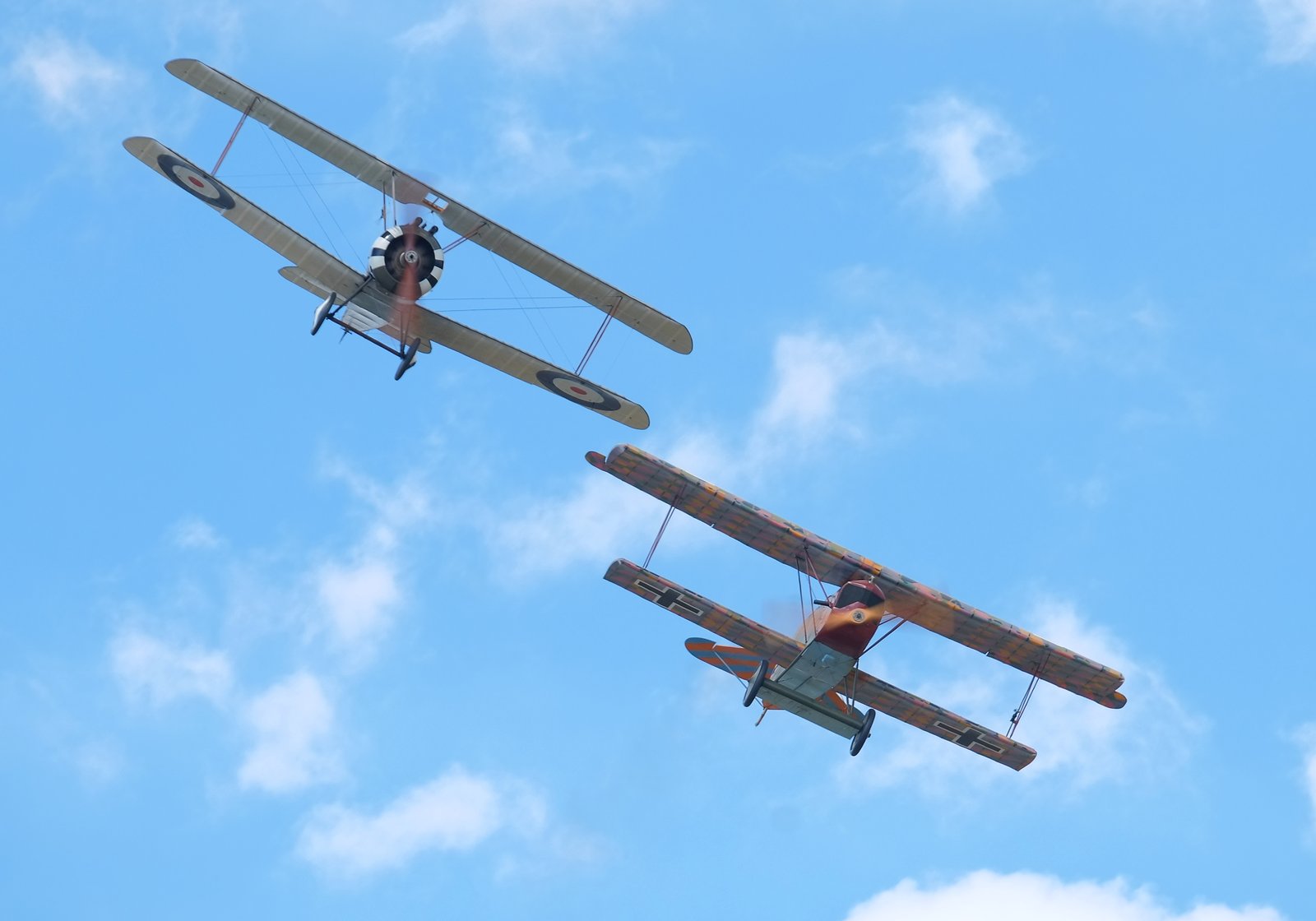
Designed by Thomas Sopwith and built by the Sopwith Aviation Company, the Sopwith Camel was a pivotal British single-seat biplane fighter of World War I. The aircraft was first cleared for flight at Brooklands on December 22, 1916, and entered operational service in July 1917. Production took place between 1916 and 1920, with twelve different manufacturers producing approximately 5,490 aircraft, though some estimates range up to 5,980 units.
The design was characterized by a short-coupled fuselage and a heavy rotary piston engine, which, combined with the placement of the pilot, fuel, and armament, created a mass-centralized configuration. This resulted in an extremely high roll rate and tight turning capabilities, particularly to the right due to gyroscopic effects. While these traits made the Camel a formidable weapon in the hands of skilled pilots, it was notoriously difficult to handle for novices. The aircraft was typically armed with two fixed, forward-firing .303 in Vickers machine guns synchronized to fire through the propeller arc, providing a significant increase in firepower over single-gun fighters of the era.
Powerplants varied across production, with the aircraft utilizing at least six different rotary engines. Common examples included the 130 hp Clerget 9B and the 150 hp Bentley rotary engine used in the 2F.1 shipboard variant. The 2F.1 was a pioneer in naval aviation, operated by the Royal Naval Air Service (RNAS) and launched from lighters, aircraft carriers, and even airships. Notably, on June 1, 1918, during Operation F.3, Camels launched from HMAS Australia and HMAS Sydney engaged enemy fixed-wing aircraft, marking the first recorded ship-launched aircraft engagement of its kind.
Throughout its service, the Camel operated on the Western Front, in Italy, and in home defense roles for the Royal Flying Corps (RFC), the RNAS, and the Royal Air Force (RAF), as well as the U.S. Army and Navy. It is credited with 1,294 aerial victories, the highest of any Allied fighter in the war. Individual successes were notable, such as Major William Barker, who downed 46 enemy aircraft in a single fighter, and Lt (jg) David Sinton Ingalls, the only U.S. Navy fighter ace of WWI. Following the war, the Sopwith Aviation Company entered voluntary liquidation in 1920, leading to the formation of the H.G. Hawker Engineering Company, the ancestor of modern BAE Systems. Today, only seven Sopwith Camels are believed to still exist, with examples preserved at the National Air and Space Museum and the RAF Museum.