
Production and Manufacturer History
The Sopwith Tabloid was developed by the Sopwith Aviation Company, a British firm established in 1912 by Thomas Octave Murdoch ("Tom") Sopwith. The prototype was constructed in autumn 1913 at Brooklands in Weybridge, Surrey. To facilitate further production, Sopwith acquired a former roller-skating rink in Kingston-upon-Thames, Surrey, which served as the factory for the Tabloid and its subsequent derivatives. Production for service use by the Royal Flying Corps (RFC) and Royal Naval Air Service (RNAS) began in the spring of 1914. While exact factory records are unavailable, it is estimated that approximately 43 Tabloids were built. The aircraft's front-line military career was brief, as it was largely replaced by newer Sopwith designs by 1915–1916.
Design and Technical Specifications
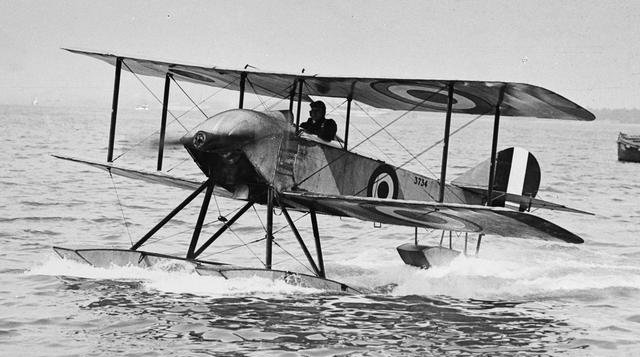
Designed by Harry George Hawker, the Tabloid was a small, single-bay biplane characterized by its compact airframe and high speed, which earned it its name. The aircraft utilized wing-warping for roll control rather than ailerons. The prototype and racing versions were powered by a 100 hp Gnome Monosoupape 9-cylinder rotary piston engine. The landplane version typically featured a wingspan of 25 ft 6 in, a length of 23 ft, and a maximum take-off weight of 1,580 lb. In terms of performance, the service landplane reached a maximum speed of 92 mph, with a range of 315 miles and a service ceiling of 15,000 ft.
Service History
Originally conceived as a two-seat racing and sports aircraft, the Tabloid achieved international fame when pilot Cecil Howard Pixton won the 1914 Schneider Trophy on April 20. Flying a floatplane version of the Tabloid, Pixton averaged 85.403 mph over a 280 km course.
Upon the outbreak of World War I, the Tabloid was adopted by the RFC and RNAS as a fast scout for reconnaissance and as a light bomber. It was involved in some of the first British bombing raids over Germany, including a mission on September 23, 1914. On October 8, 1914, RNAS Tabloids No. 167 and 168 conducted raids from Antwerp; Flight Lieutenant Reginald Marix, flying No. 168, successfully destroyed the Zeppelin Z IX (LZ 25) and its hangar at Düsseldorf using 20-lb bombs. While early models were unarmed, some RNAS variants were later equipped with a .303 in Lewis gun mounted above the propeller.
Legacy
The Sopwith Tabloid is regarded as a foundational aircraft that proved the combat potential of small, agile biplanes over the monoplanes of the era. This design philosophy led directly to the development of the Schneider seaplane and later iconic fighters such as the Sopwith Camel. Although no original Tabloids survive today, the aircraft's influence persists through high-quality replicas.