
Service History
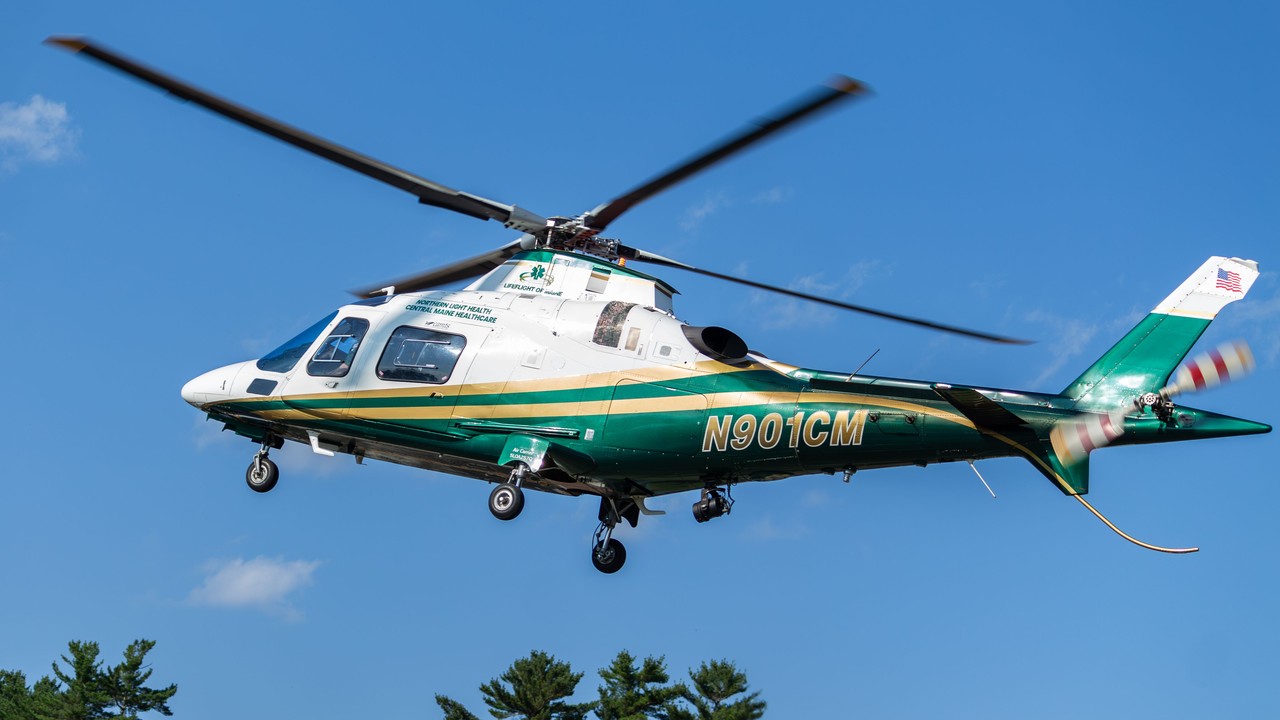
The AW109 Grand carved out a dominant position in the premium light helicopter market, serving operators across 46 countries by 2008. The aircraft found particular success in emergency medical services, with operators like REGA Swiss Air Ambulance utilizing the type for critical transport missions. Its twin-engine configuration provided the redundancy required for over-water flights and operations in challenging terrain, making it a preferred choice for search and rescue operations.
The Grand's commercial success stemmed from its ability to bridge the gap between smaller single-engine helicopters and larger, more expensive twin-engine aircraft. With seating for up to seven passengers, it offered the capacity needed for corporate transport while maintaining the agility of lighter helicopters.
The Manufacturer
Agusta, founded in 1923, pioneered Italian helicopter manufacturing and developed the A109 as the country's first mass-produced rotorcraft. The company underwent significant changes through mergers, first becoming AgustaWestland through its union with GKN Westland Helicopters in 2000-2001, then transitioning to Leonardo Helicopters as part of Leonardo S.p.A. in 2016.
The manufacturer established global reach through strategic partnerships, including a joint venture final assembly line in China with Changhe Aircraft Industries Corporation beginning in 2004. This expansion allowed production to meet growing international demand while maintaining the primary manufacturing base in Italy.
Engine & Technical Innovation
The Grand's advancement over its predecessor, the AW109E, centered on its upgraded powerplant and expanded dimensions. While the earlier model used PW206C engines producing 560 horsepower each, the Grand employed more powerful PW207C engines generating 735 horsepower per unit. This 31% increase in power enabled the aircraft to handle the additional weight and size of the stretched fuselage.
Pratt & Whitney Canada's PW207C engines represented decades of turboshaft development, building on the PW200 series that began production in the 1980s. The engines' reliability proved crucial for the helicopter's certification for single-pilot instrument flight rules operations, expanding its operational envelope significantly.
Design innovations included modified main rotor blades with new tip designs that improved performance and reduced noise. The lengthened cabin provided 20% more passenger space than the standard AW109, while maintaining the type's characteristic speed advantage over competitors like the Bell 206 series.
Performance and Pilot Perspective
The AW109 Grand achieved a maximum takeoff weight of 7,000 pounds, with its twin-engine configuration providing safety margins that single-engine helicopters could not match. Pilots praised the aircraft's handling characteristics and the confidence inspired by engine redundancy during critical phases of flight.
The type's speed capabilities were demonstrated through record-setting flights, including a 2008 round-the-world journey completed by Scott Kasprowicz and Steve Sheik in 11 days, 7 hours, and 2 minutes. Such achievements highlighted the aircraft's reliability and range capabilities for long-distance operations.
Military Applications
While the Grand variant focused primarily on civilian roles, the broader AW109 family found extensive military applications. Various air forces adopted the type for light transport, medical evacuation, and search-and-rescue missions. Military variants underwent trials with TOW missile systems between 1976-1977, demonstrating the platform's adaptability to armed reconnaissance roles.
The aircraft's twin-engine safety proved particularly valuable for military operators conducting missions over water or in hostile terrain where engine failure could prove catastrophic.
Production and Legacy
Production of the AW109 series exceeded 2,000 units across all variants, with the Grand contributing to this total from 2005 onward. Manufacturing continued into the 2010s, with recent serial numbers including aircraft delivered as late as 2016, indicating sustained market demand.
The Grand's legacy lies in its successful expansion of the light twin-engine helicopter market, proving that operators would pay premium prices for additional capacity and safety. The aircraft demonstrated that evolutionary improvements to proven designs could capture significant market share without requiring completely new development programs.
Today, AW109 Grand helicopters remain active worldwide, supported by Leonardo's continuing parts and service network. The type's ongoing operational success reflects the soundness of its original design philosophy and the effectiveness of its targeted improvements over earlier variants.