
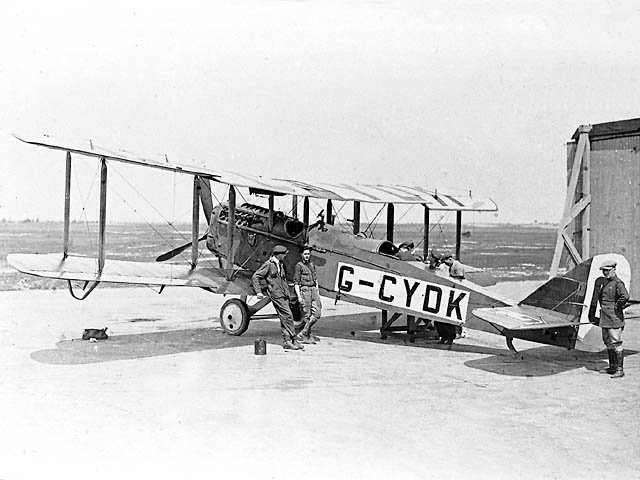
Designed by Geoffrey de Havilland for the Aircraft Manufacturing Company Ltd (Airco), the DH.4 was a two-seat biplane day bomber and reconnaissance aircraft that first flew in August 1916. It represented a significant leap in aviation capability, becoming the first British two-seat light day bomber capable of defending itself through a combination of high speed, a high service ceiling, and defensive armament, which included a forward-firing .303 in Vickers machine gun for the pilot and one or more .303 in Lewis guns for the observer.
Production was extensive in both the United Kingdom and the United States. In Britain, Airco and six subcontractors built 1,449 aircraft between 1916 and 1918. In the United States, the aircraft was known as the "Liberty Plane" and was produced primarily by the Dayton-Wright Airplane Company and Fisher Body Company, with a total of 4,346 units manufactured between 1917 and 1919. This brought the total known production to at least 5,795 aircraft. The American-built DH-4 holds the distinction of being the only U.S.-built landplane to see combat in Europe during World War I.
Technical specifications varied by engine fit. British versions commonly utilized the Rolls-Royce Eagle liquid-cooled V-12 piston engine (including the Eagle III, IV, and VIII variants), while U.S. versions were powered by the 400 hp Liberty L-12 V-12 engine. These powerplants enabled a maximum speed of approximately 143 mph and a service ceiling of around 22,000 feet. The aircraft could carry a bomb load of up to 460 lb on external racks.
Operational service began in France in March 1917. The Royal Flying Corps' No. 55 Squadron flew its first operation on April 6, 1917, targeting railway sidings at Valenciennes. The aircraft was utilized by the RFC, the Royal Naval Air Service (RNAS), and later the Royal Air Force (RAF) for bombing, artillery spotting, and anti-submarine patrols; notably, a naval DH.4 is credited with sinking the German submarine UB-12 on August 12, 1918. U.S. combat operations commenced on August 1, 1918, with the 135th Aero Squadron. By the end of the war, 13 U.S. Army Air Service squadrons and four combined Navy-Marine Corps squadrons were equipped with the type.
Following the war, the DH.4 transitioned into civil service, becoming a primary aircraft for the U.S. Post Office air mail service starting in 1918. It was adapted for various roles, including air ambulance, passenger transport, and forest fire patrol. In the United States, military variants like the DH-4B remained in service until 1932. Today, the aircraft's legacy is preserved in institutions such as the National Museum of the United States Air Force and the Smithsonian National Air and Space Museum, the latter of which houses a Dayton-Wright DH-4 used by Orville Wright for his final flight as a pilot on May 13, 1918.