
Design and Development
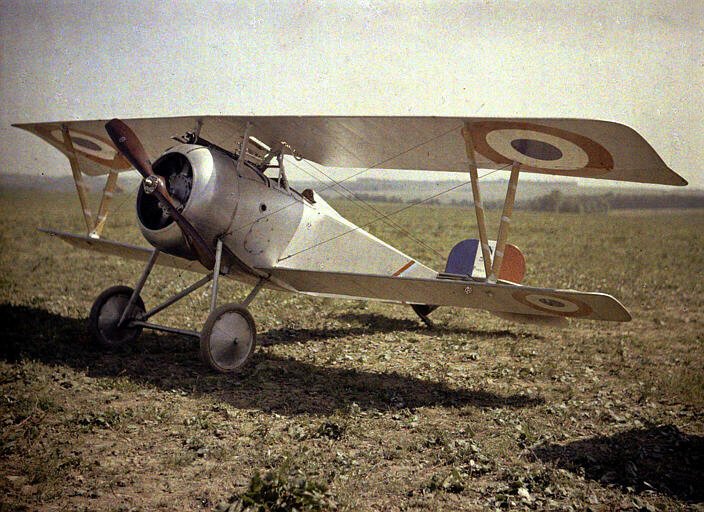
Designed by Gustave Delage, the Nieuport 17 was a French single-seat sesquiplane fighter introduced in March 1916. The aircraft featured a distinctive wing configuration consisting of a full-span upper wing and a smaller lower wing, a design choice intended to reduce structural weight while improving the pilot's downward visibility. Larger than its predecessors, the Nieuport 11 and 16, the Type 17 was engineered to accommodate more powerful engines, which significantly enhanced its overall performance. A critical technical advancement was the integration of the Alkan-Hamy synchronization gear, which allowed a fuselage-mounted Vickers machine gun to fire through the propeller arc.
Production and Technical Specifications
Produced in France by Nieuport, the aircraft was manufactured in quantities exceeding 4,300 units. Due to its success, licensed production was established in Italy and Russia. The German firm Schuckert also produced a derivative based on the design known as the Schuckert D.I. The standard powerplant was the Le Rhône 9J, a 9-cylinder air-cooled rotary piston engine producing 110 hp, though some later versions utilized engines providing up to 120 hp or 130 hp. In a typical combat configuration, the aircraft had a wingspan of 26 ft 11 in and a length of 18 ft 10 in, with a gross weight of 1,232 lb. Performance figures indicate a maximum speed ranging between 101 and 110 mph, a service ceiling of 17,400 ft, and a range of 115 miles.
Military Service
The Nieuport 17 saw extensive service during World War I, becoming the standard equipment for every French fighter squadron by late 1916. It played a vital role in maintaining air superiority during the Battle of Verdun. Beyond France, it was operated by the British Royal Flying Corps (RFC) and Royal Naval Air Service (RNAS), as well as Belgian and Italian units. Notable pilots included British aces Albert Ball, Billy Bishop, and Mick Mannock, as well as Italian ace Francesco Baracca, whose prancing horse emblem on his Nieuport 17 later inspired the Ferrari logo. In Russia, the aircraft was flown by ace Alexander Kozakov and continued to see use during the Russian Civil War on both sides. American volunteers of the Escadrille Lafayette also utilized the type, and the U.S. Army Air Service later purchased 75 units to serve as advanced trainers at the 3rd Aviation Instruction Center in Issoudun.
Legacy
By July 1917, the Nieuport 17 was considered obsolescent, superseded by the SPAD VII, S.E.5a, and Sopwith Camel. While original airframes are rare, several high-quality reproductions exist today. These include a Nieuport 17 (bis) at the Military Aviation Museum in Virginia, a scaled-down replica at the Planes of Fame Air Museum, and a flying reproduction at the Old Rhinebeck Aerodrome.