
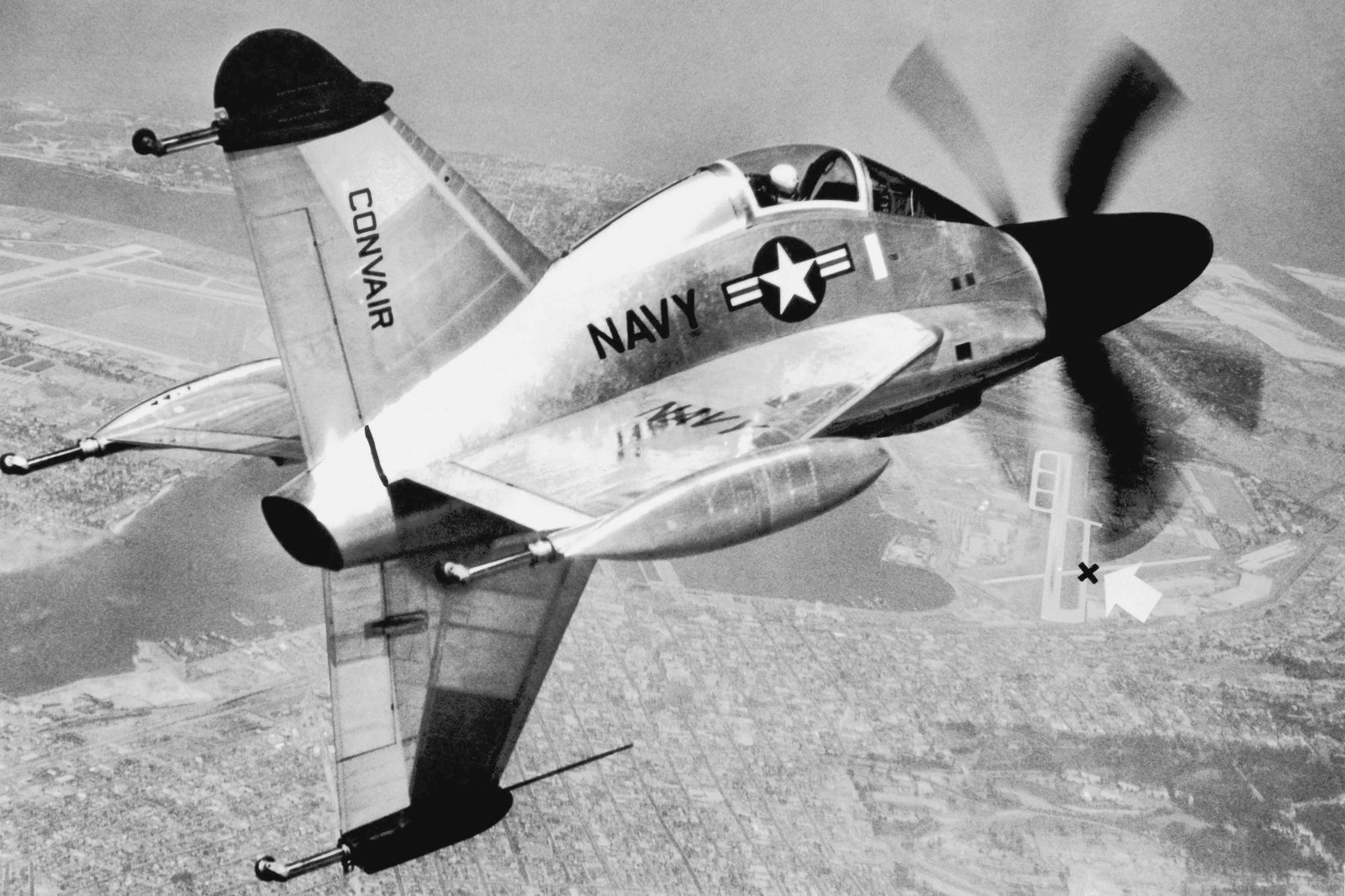
The Convair XFY-1 Pogo was an experimental vertical takeoff and landing (VTOL) fighter developed for the United States Navy during the early Cold War. The project originated from Project Hummingbird, a 1947 joint effort between the U.S. Air Force and Navy to explore ship-based defense aircraft. In May 1951, the Navy awarded contracts to Convair and Lockheed to build these aircraft, with the goal of enabling small warships—such as destroyers, oilers, and transports—to operate fighter protection without the need for aircraft carriers or catapults.
Designed as a "tailsitter," the Pogo was intended to take off and land vertically, resting on its cruciform tail surfaces and delta wings. The aircraft was powered by an Allison YT40-A-6 turboprop engine (also referred to as the XT-40 or YT40-A-16) produced by the Allison Division of General Motors. This engine drove two 16-foot contra-rotating Curtiss Electric propellers, which cancelled torque effects and provided the necessary thrust to lift the aircraft's 16,000 lb gross weight. While the prototype flew unarmed, the design called for four 20 mm cannons and forty-eight 2.75-inch Mk 4 Folding-Fin Aerial Rockets.
Flight testing began in April 1954 with tethered hovers at Moffett Field's Hangar One in California. The first untethered vertical flight occurred on August 1, 1954. On November 2, 1954, test pilot James F. "Skeets" Coleman achieved a historic milestone by completing the first full transition from vertical takeoff to horizontal flight and back to a vertical landing. Despite this success, the program faced significant operational hurdles; landing the aircraft vertically required the pilot to look over his shoulder to judge the descent, a process deemed impractical without modern sensors. Following an unsuccessful flight on May 19, 1955, the Navy cancelled the program on August 1, 1955, officially closing the project on August 1, 1956.
Although two prototypes were contracted, only one XFY-1 was completed and flown. The aircraft was manufactured by Convair in San Diego, California. Convair, originally the aircraft division of Consolidated Vultee Aircraft Corporation, had been acquired by Atlas Corporation in 1947 and later by General Dynamics in 1953. The sole surviving XFY-1 Pogo is now preserved as a static exhibit in the Smithsonian National Air and Space Museum, specifically at the Paul E. Garber Facility in Maryland.