
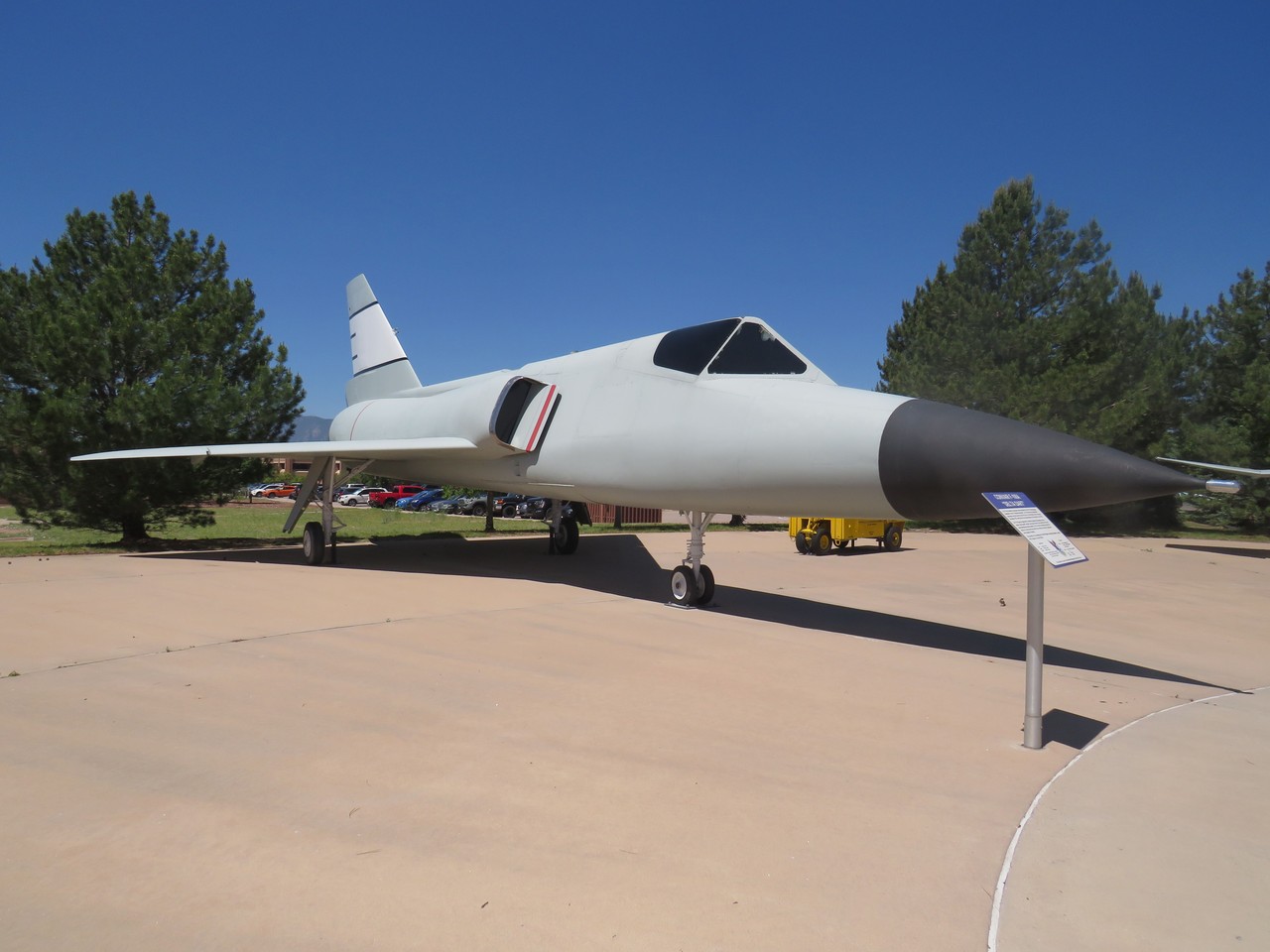
The Ultimate Interceptor
The F-106 Delta Dart represented the pinnacle of 1950s interceptor technology, serving as the Air Defense Command's primary weapon against potential Soviet bomber threats throughout the Cold War. Unlike multi-role fighters, the Delta Dart was purpose-built for one mission: high-altitude interception of enemy aircraft approaching North American airspace. Its sophisticated fire control system and nuclear-armed missiles made it the most advanced interceptor of its era.
Service History
The F-106 achieved initial operational capability in October 1959 with the 498th Fighter Interceptor Squadron at Geiger Field, Washington. During its 29-year service life, the aircraft equipped numerous Air Defense Command squadrons across the continental United States, Alaska, and Iceland. The type never saw combat, serving instead as a deterrent force during the height of Cold War tensions. In December 1959, Major Joe Rogers set a speed record in an F-106, reaching 1,525.95 mph at 40,000 feet over Edwards Air Force Base.
The aircraft underwent several significant upgrades during its service life. In 1967, air-to-air refueling capability was added, extending the interceptor's patrol endurance. A major modification program in 1972 installed the M61A1 Vulcan 20mm cannon, removing the AIR-2A Genie nuclear rocket while adding conventional firepower. This change reflected evolving air defense doctrine and improved the aircraft's versatility.
Design Evolution
Convair's engineering team, led by key designers including Richard W. Johnson, developed the F-106 as an advanced derivative of the F-102 Delta Dagger. The new aircraft incorporated area rule fuselage shaping to reduce transonic drag, variable-geometry inlet ramps for optimal engine airflow, and the sophisticated MA-1 fire control system with Semi-Automatic Ground Environment (SAGE) datalink capability.
The delta wing configuration, featuring a 2.1 aspect ratio and NACA 0004-65 modified airfoil, provided excellent high-altitude and supersonic performance characteristics. Later production aircraft received conically cambered wings that further improved handling at extreme altitudes. The F-106 was also notable as the first USAF interceptor equipped with "zero-zero" ejection seats, retrofitted after 1965 by Weber Aircraft and capable of safe ejection at speeds up to 600 knots.
Manufacturing Heritage
Convair, formed in 1943 through the merger of Consolidated Aircraft and Vultee Aircraft, built all 340 F-106 aircraft at its San Diego, California facility between 1956 and 1960. The company, which became a General Dynamics division in 1954, had established its reputation with innovative designs including the B-36 Peacemaker and B-58 Hustler bombers. Production included 277 single-seat F-106A interceptors and 63 tandem-seat F-106B trainers, each costing approximately $5 million.
General Dynamics eventually absorbed Convair's operations into its Fort Worth facility by the 1990s, though the parent company continues operations today in aerospace, defense, and marine systems. The F-106 represented one of Convair's final major aircraft programs before the division's consolidation.
Powerplant and Performance
The heart of the F-106's performance was the Pratt & Whitney J75-P-17 afterburning turbojet, producing 17,200 pounds of thrust dry and 24,500 pounds with afterburner engaged. This powerplant enabled the aircraft to reach Mach 2.3 at 40,000 feet and climb at rates exceeding 29,000 feet per minute. Early aircraft equipped with the J75-P-9 engine suffered performance limitations, achieving only Mach 1.9 maximum speed, leading to the more powerful P-17 variant.
The aircraft's impressive performance envelope included a service ceiling above 57,000 feet and combat range of 1,335 nautical miles on internal fuel. With external tanks, maximum range extended to 2,346 nautical miles. The F-106 could reach 52,000 feet in just 6 minutes and 54 seconds, demonstrating the rapid response capability essential for interceptor missions.
Armament and Fire Control
Initially, the F-106 carried an unusual all-missile armament consisting of two AIM-4F Falcon infrared missiles, two AIM-4G Falcon semi-active radar missiles, and one AIR-2A Genie nuclear-tipped rocket. The MA-1 fire control system integrated with ground-based SAGE computers to provide automated intercept guidance, representing advanced technology for the late 1950s.
The 1972 modification program added the M61A1 Vulcan 20mm rotary cannon while removing the Genie nuclear rocket. This change provided pilots with conventional firepower for training and potential engagements not requiring nuclear weapons. Some aircraft also received the capability to carry AIM-26 Nuclear Falcon missiles.
Legacy and Preservation
F-106 service concluded in 1988, marking the end of the dedicated interceptor era in USAF operations. Approximately 200 retired aircraft received conversion to QF-106 full-scale aerial targets, serving missile test programs until 1998. These drone conversions provided valuable testing platforms for developing new air-to-air weapons systems.
Today, numerous F-106 aircraft are preserved in museums across the United States, including examples at the National Museum of the United States Air Force, Hill Aerospace Museum, Castle Air Museum, and McChord Air Museum. The aircraft remains significant as the last purpose-built interceptor in USAF service and a symbol of Cold War air defense strategy.