
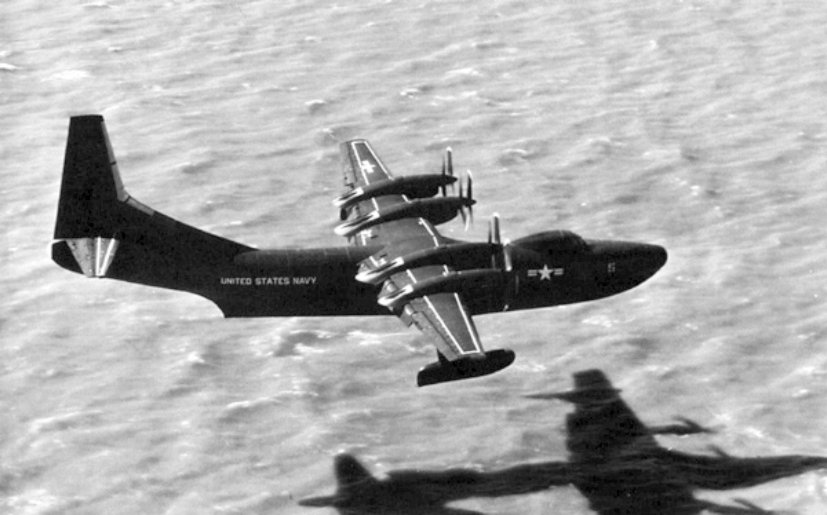
Production and Manufacturer History
The Convair R3Y Tradewind was developed by Convair (the Consolidated Vultee Aircraft Corporation) in San Diego, California. The company, formed by a 1943 merger of Consolidated Aircraft Corporation and Vultee Aircraft, became a division of General Dynamics in 1953. The R3Y program began as a response to a 1945 U.S. Navy request for a long-range patrol flying boat. While two XP5Y-1 prototypes were built, the production R3Y series consisted of 11 aircraft: five R3Y-1 transport/tankers and six R3Y-2 assault transports. The manufacturing process was a massive undertaking, with the twin hull assembly weighing 1,000,000 lb and requiring four work levels during construction.
Design and Technical Specifications
The R3Y was an advanced aircraft for the 1950s, utilizing a high-aspect-ratio laminar-flow wing to increase efficiency and speed. The airframe featured a pressurized and air-conditioned cabin for long-range transport. The R3Y-1 variant utilized a "cruiser-bow" design, while the R3Y-2 featured a raised flight deck and a bulbous nose section that pivoted upward, allowing vehicles and heavy cargo to be driven directly into the hull.
Power was provided by four Allison T40 turboprop engines, each consisting of two T38 gas generators driving common gearboxes for contra-rotating propellers. This configuration allowed for high speeds, with a cruise speed of approximately 580 km/h (360 mph). In 1954, the R3Y set a transcontinental seaplane speed record, averaging 403 mph (649 km/h) between NAS Alameda and NAS Patuxent River by utilizing jetstream tailwinds—a record that still stands for seaplanes.
Service History and Legacy
Operational service was conducted exclusively by the U.S. Navy's Naval Air Transport Squadron Two (VR-2), based at NAS Alameda, California, from 1956 to 1958. The R3Y-1s transported personnel and cargo between the U.S. West Coast, Hawaii, Wake Island, and Japan, with a payload capacity of 24 tons and the ability to carry 80 troops. The R3Y-2s were converted into four-point probe-and-drogue tankers; in September 1956, an R3Y-2 became the first aircraft to simultaneously refuel four Grumman F9F Cougar jets in a single pass.
Despite its capabilities, the Tradewind was plagued by the unreliability of the Allison T40 engines. Chronic gearbox and propeller failures led to catastrophic engine failures and several accidents. Due to these reliability issues, the U.S. Navy disbanded VR-2 and ordered all R3Y aircraft scrapped on April 16, 1958. No examples of the R3Y survive today, as all remaining airframes were broken up at Litchfield Park, Arizona.