
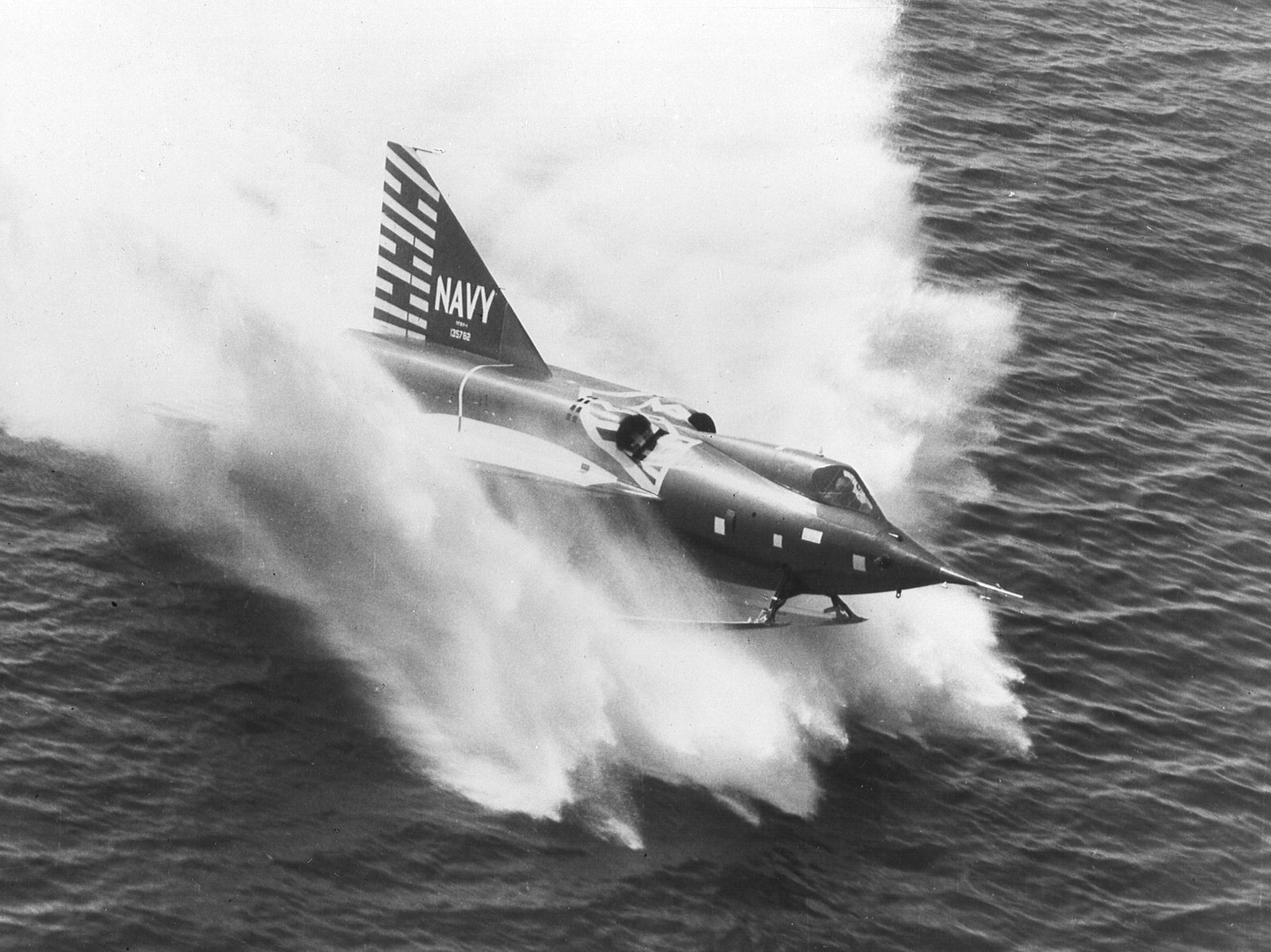
The Convair F2Y Sea Dart was an experimental supersonic seaplane fighter developed for the United States Navy during the early Cold War. The project originated from a 1948 design contest for a supersonic interceptor capable of operating without fixed land bases, fitting into the Navy's "Mobile Base Concept." This strategy envisioned high-performance fighters operating from sheltered waters to reduce reliance on vulnerable aircraft carriers. On January 19, 1951, the Navy ordered the first two prototypes, designated XF2Y-1.
Built by Convair in San Diego, California, the Sea Dart featured a distinctive delta-wing design and was the first combat-type aircraft to utilize retractable twin planing hydro-skis. These skis allowed the aircraft to take off and land at high speeds on water before retracting into the fuselage to minimize drag during flight. The prototype YF2Y-1 first left the water during a high-speed taxi test in San Diego Bay on January 14, 1953, followed by its official first flight on April 9, 1953.
Power was provided by two Westinghouse J46 afterburning turbojets. The YF2Y-1 specifically utilized J46-WE-12B engines, producing 4,500 lbf of dry thrust and 6,100 lbf with afterburners. While the aircraft achieved a maximum speed of Mach 1.04+ and reached approximately 825 mph (Mach 1.25) in a shallow dive, the J46 engines were noted for failing to meet their promised performance levels. Technical specifications included a wingspan of 33 ft 8 in and a maximum takeoff weight of 21,500 lb.
Of the five airframes produced, only three ever flew; two were completed without engines. The program suffered a major setback on November 4, 1954, when Convair test pilot Charles E. Richbourg was killed after aircraft BuNo 135762 disintegrated during a demonstration flight over San Diego Bay. This accident, combined with the rapid improvement of carrier-based supersonic operations—such as angled decks and steam catapults—rendered the water-based concept impractical. The program was halted in 1956, with the final flight occurring in 1957.
Although intended as an interceptor armed with four 20 mm Colt Mk 12 cannons, folding-fin rockets, and air-to-air missiles, no Sea Dart was ever equipped with operational armament. Today, four of the five airframes survive in U.S. museums, including the Smithsonian National Air and Space Museum and the San Diego Air & Space Museum.