
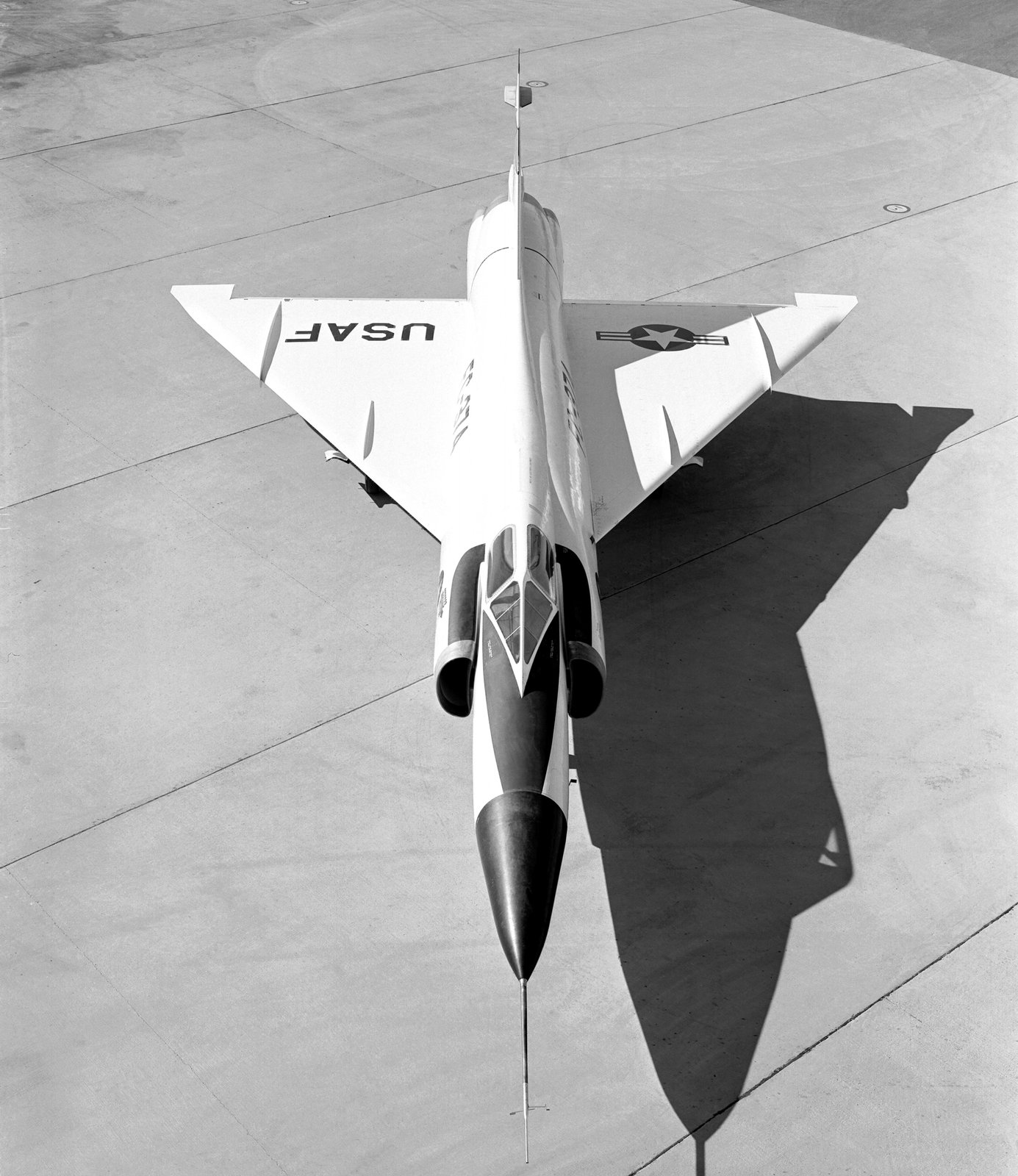
The Convair F-102 Delta Dagger was a pivotal development in American aerial defense, serving as the first operational supersonic interceptor and delta-wing fighter utilized by the United States Air Force (USAF). Designed and manufactured by Convair, a division of General Dynamics, the aircraft was produced in San Diego, California. The F-102A variant was built between 1955 and 1958, with a total production run of 1,000 aircraft.
Technologically, the F-102 was notable for its innovative airframe. To reduce transonic drag, Convair implemented an area-rule "wasp-waist" fuselage design. The aircraft also departed from traditional fighter configurations by omitting internal guns in favor of an internal weapons bay. This bay housed six Hughes GAR-1D/GAR-2 Falcon missiles, while the missile bay doors were equipped to carry 24 2.75-inch FFAR rockets. The aircraft first took flight on October 24, 1953, and entered operational service in 1956, with some sources citing April and others June of that year. The 327th Fighter-Interceptor Squadron was the first unit to be equipped with the Delta Dagger.
Powered by a turbojet engine, the F-102A achieved a maximum speed of 710 knots (approximately Mach 1.24) at an altitude of 35,000 feet. It possessed a service ceiling of 55,500 feet and a ferry range of 1,140 nautical miles. Beyond its technical specifications, the aircraft achieved public prominence when Captain Kenneth D. Chandler flew an F-102A to victory in the 1957 Bendix Trophy Race.
While primarily designed as a Cold War interceptor to defend against Soviet bomber threats, the F-102 saw limited combat service during the Vietnam War, where it was utilized for ground-attack and bomber escort missions. In addition to the USAF, the aircraft was exported to the Hellenic Air Force and the Turkish Air Force. Active USAF service concluded in 1973, though the Air National Guard continued operating the type until 1976, with some sources noting retirement as late as 1979. Today, the legacy of the F-102 is preserved in museums, including the Hill Aerospace Museum.