
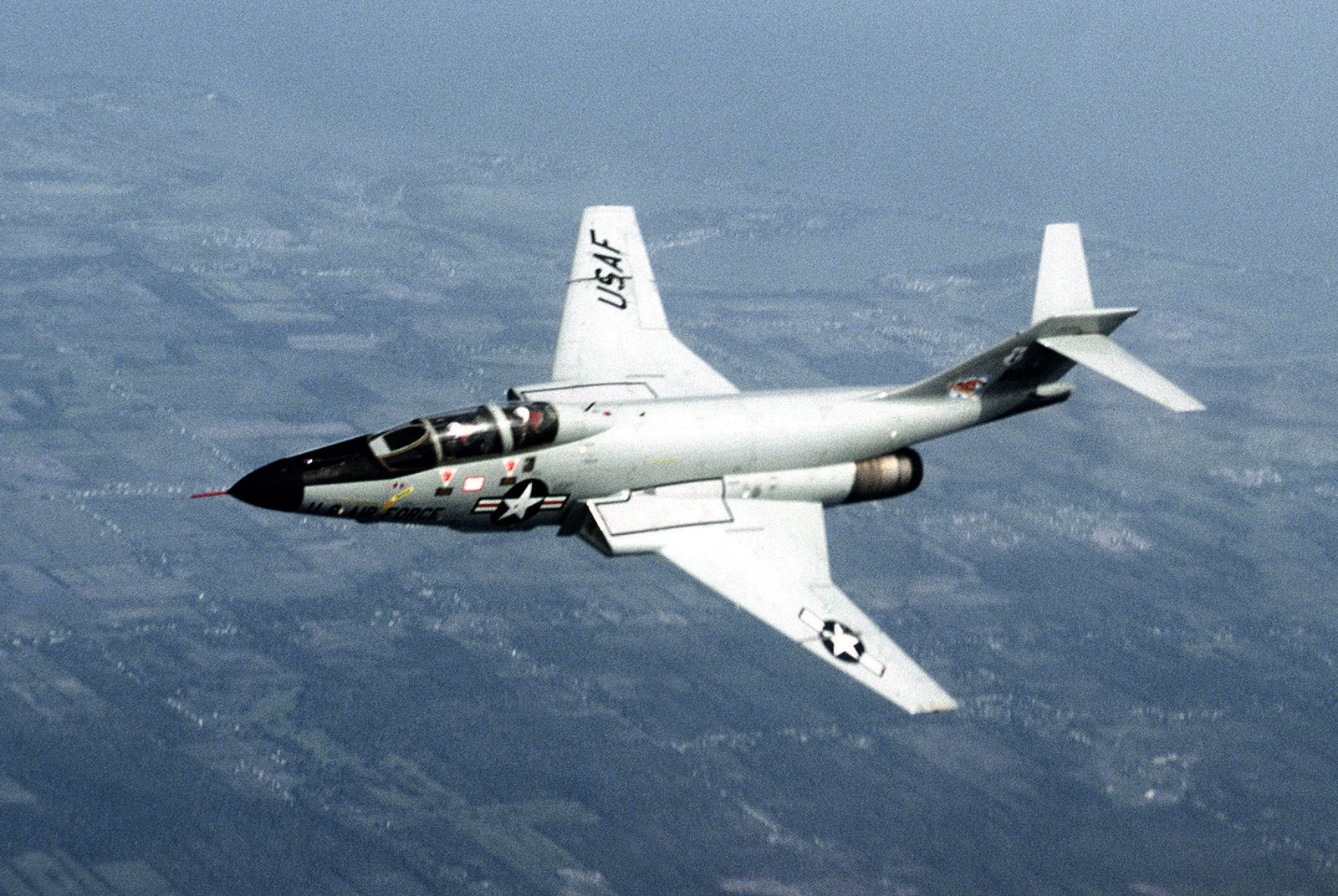
The McDonnell F-101 Voodoo was a twin-engine, supersonic jet fighter developed by the McDonnell Aircraft Corporation in St. Louis, Missouri. Emerging from the earlier XF-88 design in the late 1940s, the F-101 was originally conceived as a long-range "penetration fighter" to escort bombers for the U.S. Air Force Strategic Air Command (SAC). However, as strategic requirements shifted with the introduction of high-altitude bombers like the B-52, the aircraft was redesigned for roles as a tactical nuclear fighter-bomber, an all-weather interceptor, and a photo-reconnaissance platform.
The F-101 prototype first flew on September 29, 1954. Full-rate production began in 1957, with the first F-101A accepted by the USAF on May 2, 1957. Production continued until March 1961, resulting in a total of 785 aircraft. The F-101B interceptor was the most produced variant, with 480 units built. This two-seat version was designed for continental air defense and was armed with radar-guided AIM-4 Falcon missiles and nuclear-armed AIR-2 Genie rockets.
In terms of performance, the F-101 was a powerhouse of the second-generation supersonic era. In 1957, a variant set a world speed record of 1,207 mph (approximately Mach 1.86). Representative performance figures include a maximum speed of 1,134 mph, a service ceiling of 58,400 feet, and a rate of climb of 36,500 feet per minute. The fighter-bomber variants were equipped with four 20 mm Pontiac M39 revolver cannons and could carry Mark 7, 28, or 43 nuclear weapons on a centerline mount.
The Voodoo saw extensive military service across several Cold War conflicts. The RF-101 reconnaissance variants provided critical low-altitude intelligence during the 1962 Cuban Missile Crisis and operated extensively over Laos and Vietnam in the late 1960s. The aircraft served with the USAF until 1972, while the U.S. Air National Guard operated them until 1982. The Royal Canadian Air Force (RCAF) utilized the CF-101 for NORAD air defense, with service continuing until 1984. Today, the F-101 survives as static museum exhibits, including examples at the Museum of Aviation in Georgia and the MAPS Air Museum in Ohio.